
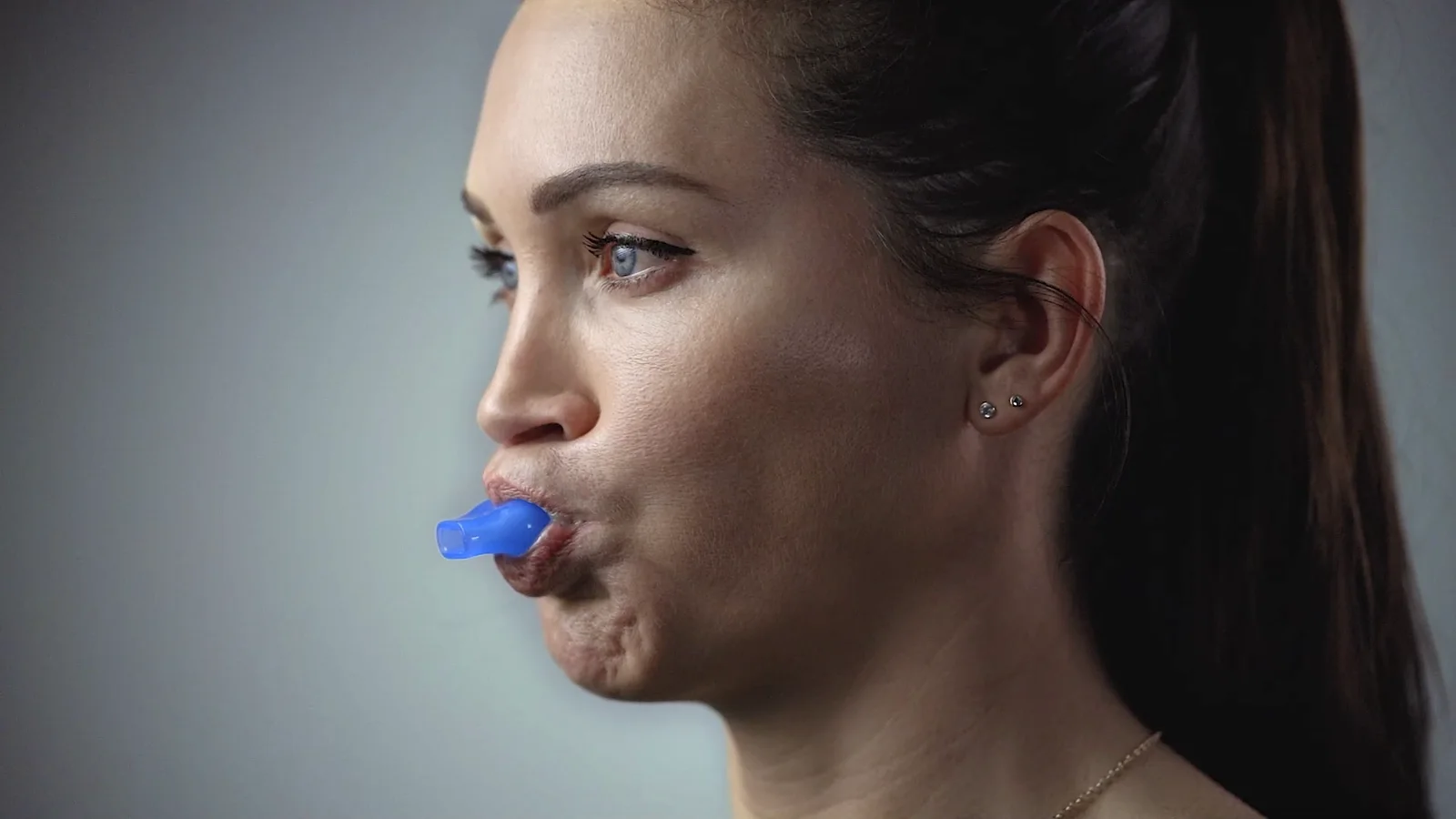
Specialist article: Face
Training facial musclesActive rather than just cared for
Creams, serums, Botox and fillers work from the outside, while face yoga relies on exercises. Here you will learn what tasks your facial muscles have in everyday life, what passive cosmetics achieve, what studies show about facial exercises and why, in our view, the function of the muscles is what counts, in the interplay of breathing, swallowing and head balance.
Does this sound familiar?
A lot of care for the face, and the muscles underneath?
What applies to you?
Tap whatever applies to you.
If several points apply, it is worth looking beneath the skin. Your facial muscles work all day long, when swallowing, breathing and speaking. How they do this is a pattern, and patterns can be trained.
What studies on face yoga showWhy the task countsThe key points at a glance
- Facial muscles are working muscles. They close the lips, work along during swallowing and chewing and hold the cheeks against the rows of teeth, many hundreds to a thousand times a day.
- Skincare, sun protection, Botox and fillers act on the skin, volume or individual muscles. That has its place. They do not change how the muscles work in everyday life, and Botox paralyses muscles that are part of a functional system.
- There are only small studies on face yoga and facial exercises so far. In our view, what counts is less the grimace than the task, that is breathing, swallowing and head balance. We do not promise any particular appearance.
Video
Facial muscles and facial skin: facial expression, masticatory muscles and function
Das Video lädt erst nach dem Klick. Dann werden Daten an YouTube (Google) übertragen.
Anatomy
Facial muscles are working muscles
When people think of the face, they think of skin and expression. Underneath, there is musculature that is used all day, even when you are not smiling.
Skeletal muscles usually run from one bone to another. The muscles of facial expression are built differently. They are flat, lie just beneath the skin and radiate a large part of their fibres directly into the skin. They are supplied by the facial nerve, the seventh cranial nerve. That is why every contraction moves the skin too, and why their work also shapes how a face looks.
Lip closure
The lips rest loosely together and seal the oral cavity. This is the prerequisite for calm nasal breathing.
Swallowing
Many hundreds to a thousand times a day, the lips and cheeks close the mouth while the tongue pushes the saliva backwards.
Chewing
The cheek muscle holds the food between the teeth, and the masticatory muscles provide the force.
Speech and expression
The lips and cheeks form sounds and show what you feel. Everyone knows this task, but it is only one of many.
In our view, appearance is therefore to a large extent a reflection of this work. How the lips rest, how the cheeks lie against the teeth and whether the chin helps with swallowing is decided in sequences that run unconsciously. How swallowing works is described in the article on Swallowing and swallowing disorders. These sequences are controlled from areas of the brain that are strikingly large for the lips, tongue and face.
after a Botox treatment in the face, the brain processed touch stimuli on the hand differently, measured by EEG before and after the treatment in Zurich1
Botox paralyses muscles that are part of a functional system. What the altered processing means in everyday life has not been studied. But it shows that the intervention does not end at the muscle, and in our view this consequence is rarely considered. The facial muscles are not stored individually in the brain, but as part of a network. In our view, anyone who wants to train the face is therefore above all training a control system, not individual muscles.
Context
Skincare, Botox, fillers: what passive cosmetics achieve
Passive does not mean bad here. It means that something happens to the face from the outside, while the muscles themselves contribute nothing.
Creams and serums care for the skin and support its protective layer. One inconspicuous product has been well studied: sun protection. Sunlight makes the skin age faster, which is known as photoageing. In Australia, a research group examined over several years whether regular sun protection changes this, comparing two groups formed by random allocation.
under the age of 55 were randomly assigned to daily sunscreen use or to use at their own discretion2
less skin ageing was shown by the group with daily sun protection after four and a half years, assessed on the fine texture of the skin2
Botulinum toxin, Botox for short, inhibits the transmission from nerve to muscle. The treated muscle works less for a few months, and wrinkles caused by its movement are smoothed. Fillers such as hyaluronic acid restore volume where it has diminished over the years.
Both are medical procedures whose effect wears off over time, and both carry risks, which the treating practice explains. With rollers, massage devices or gua sha, you stroke the skin. This can feel pleasant, but the muscles themselves do not work in the process.
Skincare acts on the skin. Training acts on what supports the skin.The two are not mutually exclusive. They are two levels with two different goals.
Active rather than passive
Two approaches, two goals
Passive cosmetics
- Cream, serum and sunscreen care for and protect the skin
- Botox slows down individual muscles
- Fillers replace volume
- The effect lasts as long as the application continues
Active training
- The muscles do the work themselves
- Lip closure, swallowing and nasal breathing are practised
- Head balance and the tongue reference position are part of it
- The aim is a pattern that runs by itself in everyday life
A face ages in all its layers, in the skin, fat, muscles and bones. No approach reaches them all.
This applies right down to the bone. A review from Australia describes how the facial skeleton recedes with age in certain places, for example at the upper jaw, the rims of the eye sockets and the lower jaw at the side in front of the chin3. Neither a cream nor training changes this in a short time. In our view, this argues for keeping expectations of any method honest.
What training can achieve lies in the tension of the muscles. Muscles that are integrated into a function are used and keep their tension. Muscles that are not used become slack. This applies to the legs as much as to the lips. In our view, training that anchors the function in everyday life ensures that the muscles work all day, not just during the exercise.
Like massage and back training
A massage does the back good. It loosens, warms and relaxes. Afterwards, however, the back has to be supported by its own muscles, and these only build up if they work. We see care and training for the face in a similar way. One is a treat for the surface, the other is work for what lies beneath.
Research
Face yoga and facial exercises: what studies show
Exercises for the face are popular, under names such as face yoga, facial fitness or facial gymnastics. Research on them is still in its early days.
In face yoga, you deliberately tense individual facial muscles, often against the resistance of your own fingers, hold grimaces or massage the tissue. The idea behind it is plausible. What applies to the body should also apply to the face.
Only a few studies have so far examined whether such exercises visibly change the face, almost all with very small groups and without comparison with people who did not train.
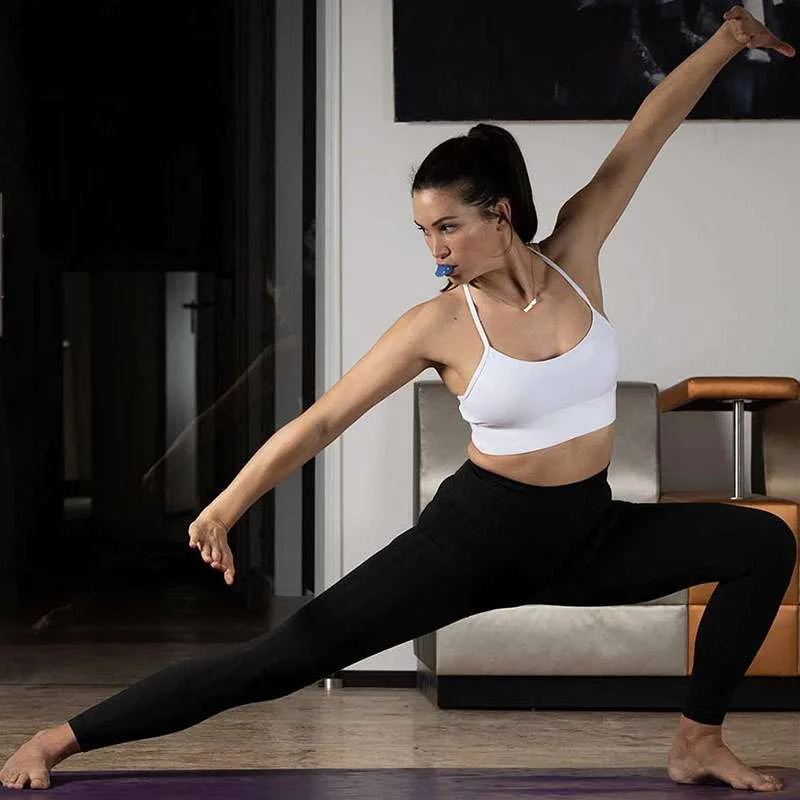
in Chicago completed a programme of 32 facial exercises over 20 weeks, initially for 30 minutes a day. There was no comparison group, and a co-author was the founder of the provider whose programme was practised4
improved according to blinded assessors in the same study, both relating to the fullness of the cheeks. The estimated age fell by just under three years on average4
compared with the control group was found by a Belgian study with 18 people after seven weeks of training, at the upper lip5
Individual small studies say little if nobody is compared without training. That is why it is worth looking at two reviews. The first found 9 studies, none with a comparison group and random allocation6. The second found 12 studies with 321 women, improvements in individual regions and no reported side effects, but considers the evidence insufficient7.
The absence of a study does not mean that the connection does not exist. It means that it has not been tested.This applies to face yoga just as much as to our training. There is no study on the cosmetic effects of FaceFormer training. What there is on the method can be found under Studies and science.
Muscle tension
More tension is not the goal
When people think of training, they think of strength and firmness. In the face, something else matters: a tension that suits the task.
A small study from Turkey examined women’s facial muscles before and after eight weeks of face yoga, using a device that measures the tension, stiffness and elasticity of the tissue. The result does not fit the idea that facial training simply makes the muscles firmer.
aged around 50 trained for eight weeks. Tension and stiffness of the orbicularis oris, the frontalis and the orbicularis oculi decreased, and elasticity increased in all measured muscles8
Here, the training loosened the muscles rather than tightening them. In our view, this is not surprising. Many faces are not too slack but unevenly tensed. If the lips cannot close from the jaw position, the chin muscle lifts the lower lip, the chin puckers, and the lips are pressed together instead of closed. You can read more about this pattern in the article on lip training.
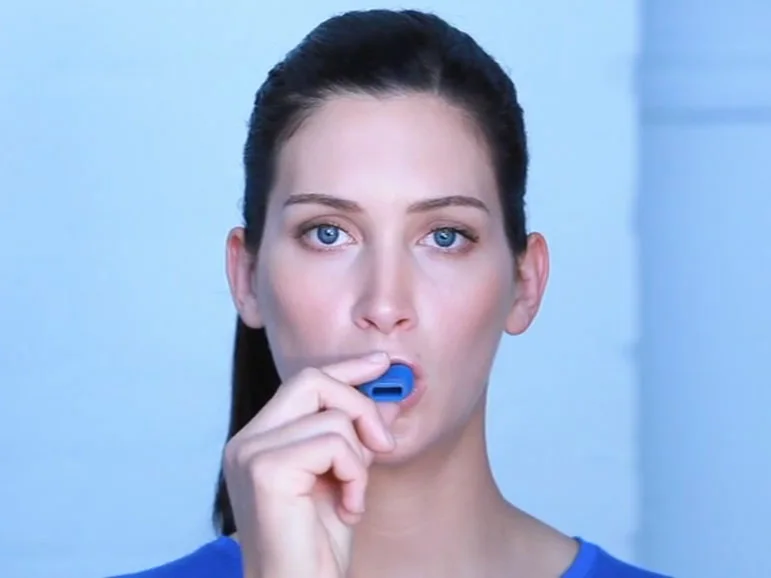
In FaceFormer training, the lips therefore work in alternation. They press the lip wedge briefly and firmly, then let go and enclose it without force. The pause is part of the exercise, short at first, longer later on.
If small vertical lines form above your upper lip while pressing, draw the corners of your mouth slightly to the side, as in a hint of a smile. The corners of your mouth stay closed around the lip wedge.
Our approach
Function instead of grimace: why everyday life is decisive
An exercise programme may take half an hour a day. For the remaining hours, your face works in its habitual pattern, when swallowing, breathing, at the screen and during sleep. If your mouth is often open or your chin helps to close it, your face practises exactly this pattern all day long. Against so many repetitions, a single exercise session carries little weight.
The pattern deviates
Mouth breathing, a low-lying tongue or a head that drifts forward. This often begins in childhood.
The body helps itself
The chin lifts the lower lip, the lips press when swallowing, the cheeks join in. The nervous system stores this solution as a pattern.
The tension shifts
Muscles that no longer fulfil their task are used less and lose tension. Others work too hard instead.
The face shows it
In our view, the lips then look thinner, the chin more restless and the jawline softer, often long before wrinkles become an issue.
In our view, this chain usually stands at the beginning of many changes that later appear to be a cosmetic matter. How the tongue reference position, the floor of the mouth and head balance help shape the jawline is described in the article on receding chin and double chin. Why this is not about pressing the tongue firmly against the palate is explained in the article on mewing.
What do you think: how many times a day do your lips close your mouth when you swallow?
Animation
The pull exercise step by step
The animation shows a repetition of the forward pull exercise in side section, from gripping via biting and swallowing to letting go.
Training
Training the facial muscles: with a task instead of a grimace
In FaceFormer training, you practise lip closure, tongue reference position, swallowing, nasal breathing and head balance in one sequence. The FaceFormer exercise instructions explicitly list cosmetics among the areas of use for the pull exercises. Nevertheless, we do not promise any particular appearance. The goal is a pattern that runs without thinking, because only then do the muscles also work outside the exercise.
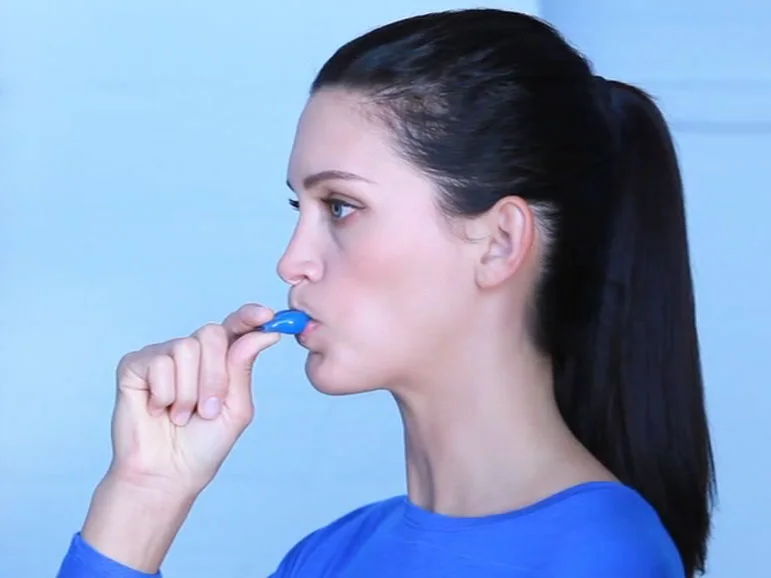
In the basic exercise, the FaceFormer sits in the oral vestibule, the tip of your tongue rests on the small ridge behind your upper front teeth, and your head is upright. You press the lip wedge with your lips for six seconds, bite down briefly with your back teeth and swallow once. Then you relax.
From around week 3, the pull exercise is added. You gently pull the lip wedge horizontally forward, keeping your elbow close to your body. If the FaceFormer slips out, you are pulling harder than your lips can hold at the moment. Then pull more gently.
- From day 1
Basic exercise
Three times a day with the FaceFormer ZERO, made of softer material. In week 1 eight repetitions, in week 2 fourteen, from week 3 twenty.
- From around week 3
Pull exercise and night
The pull exercise is added. At night you wear the ZERO once you have mastered the basic exercise.
- After a few weeks
Switching to the ONE is possible
For cosmetic applications, the exercise instructions name the softer ZERO. If you would like to train more firmly, use the ONE during the day. It has the same size and shape, only made of a firmer material.
- Later
Further pull directions
Pulling upwards, downwards or in changing directions is best used in consultation with a practice.
- Over months
The pattern runs by itself
The exercise manual allows six to twelve months until the new sequences run without thinking, followed by maintenance training.
The free FaceFormer app guides you through the basic exercises, and you can find all modules on the exercise pages. The training can be carried out before and after aesthetic procedures, such as Botox, fillers or facial surgery. Agree on when to start with the practice that treated you. An overview of other procedures is given in FaceFormer and other treatments.
Everyday life
Your face in everyday life
Lips resting lightly together
The lips touch without pressure, the tongue rests against the palate, the teeth do not touch. Your face spends most of the day in this basic position.
Breathe through your nose
A closed mouth directs the air through the nose. Where the tongue rests in the process is explained in the article on the tongue reference position.
Check your chin in the mirror
If your chin puckers when you close your lips, the chin muscle is helping. This is a sign of the pattern, not a flaw.
Head balance at the screen
Set up your screen and seat so that your head balances over your body. If it drifts forwards, your mouth opens more easily.
Sun protection still makes sense
Training does not replace skincare. Daily sun protection is one of the best-studied measures against photoageing of the skin.
Less grimace, more everyday life
You do not need exercises that contort your face. What matters is how your lips, cheeks and tongue work when you swallow and breathe.
Questions
Frequently asked
Can you train your facial muscles?
Yes. Facial muscles are skeletal muscles and, like other muscles, respond to whether they are used. The question is which training. Exercises that tense individual muscles in grimaces have so far only been examined in small studies. In our view, training that practises the muscles’ tasks goes deeper, that is lip closure, swallowing and nasal breathing in interplay with head balance.
What does face yoga achieve?
The evidence is thin. In a pilot study from Chicago, it was mainly the fullness of the cheeks that improved after 20 weeks; there was no comparison group. Reviews consider the evidence insufficient so far, but also report no side effects. There are therefore not yet any reliable statements about visible changes from face yoga.
Can facial training smooth wrinkles?
This has not been demonstrated, neither for face yoga nor for FaceFormer training, and we do not promise it. Wrinkles develop through many factors, including sunlight, age and changes in fat and bone. A muscle that is integrated into the function is used, has tension and supports the tissue above it. If you follow this logic, the conclusion suggests itself that an active ring of lip muscles and a tongue in the tongue reference position can create the conditions for a better-supported midface.
Is facial training an alternative to Botox or fillers?
It pursues a different goal. Botox slows down individual muscles, fillers replace volume; both act on the shape for as long as the effect lasts. The training practises how the muscles work in everyday life. If you know both approaches, you can decide what you actually want. You decide on medical treatments together with your practice.
Can I train after Botox or with fillers?
A Botox treatment does not generally rule out training. The treated muscle works less for some time, and the interplay of the muscles is limited during this phase. Agree on when to start after a treatment, and with fresh fillers, with the practice that carried out the treatment.
Can facial training help you lose weight in your face?
Not in a targeted way. Fat is broken down throughout the whole body, not in the spot you happen to be training. What the training works on is the tension and position of the tissue around the mouth and chin, which are connected with the tongue reference position, swallowing and head balance. More on this in the article on a receding chin and double chin.
Why does swallowing play a role for the face?
You swallow many hundreds to a thousand times a day, and each time the lips, cheeks, tongue and chin work together. If swallowing happens with pressed lips and a chin that helps along, this pattern is repeated just as often. In our view, it therefore shapes the face more strongly than any exercise you do on top.
How often and for how long should I train?
Three times a day for a few minutes, in the first week with eight repetitions of the basic exercise, from the third week with twenty. The exercise manual allows six to twelve months until the new sequences run without thinking, followed by maintenance training. Precision and regularity are more important than strength.
Which FaceFormer should I use for facial training?
To start with, the FaceFormer ZERO, made of softer material. The exercise instructions also name it for cosmetic applications, and you wear the ZERO at night anyway. If you want to train more firmly during the day after a few weeks, you switch to the FaceFormer ONE. Both are the same size and shape; they differ only in material.
Wrinkles form on my upper lip during training. Am I doing something wrong?
Usually it is just a small detail: the lips are pursed when pressing. Instead, draw the corners of your mouth slightly outwards, as if you were smiling, and hold the lip wedge with wide lips. Try this in front of the mirror first. Redness after exercising is due to blood flow and fades quickly. It is not about force but about the sequence: close your lips, tongue tip to its reference point, bite down briefly, swallow.
More articles from the knowledge section
Where to go next

Sources
- Haenzi S, Stefanics G, Lanaras T, Calcagni M, Ghosh A (2014). Altered cortical activation from the hand after facial botulinum toxin treatment. Annals of Clinical and Translational Neurology 1(1):64-68. PMID 25356383. Source
- Hughes MC, Williams GM, Baker P, Green AC (2013). Sunscreen and prevention of skin aging: a randomized trial. Annals of Internal Medicine 158(11):781-790. PMID 23732711. Source
- Mendelson B, Wong CH (2012). Changes in the facial skeleton with aging: implications and clinical applications in facial rejuvenation. Aesthetic Plastic Surgery 36(4):753-760. PMID 22580543. Source
- Alam M, Walter AJ, Geisler A, Roongpisuthipong W, Sikorski G, Tung R, Poon E (2018). Association of Facial Exercise With the Appearance of Aging. JAMA Dermatology 154(3):365-367. PMID 29299598. Source
- De Vos MC, Van den Brande H, Boone B, Van Borsel J (2013). Facial exercises for facial rejuvenation: a control group study. Folia Phoniatrica et Logopaedica 65(3):117-122. PMID 24296342. Source
- Van Borsel J, De Vos MC, Bastiaansen K, Welvaert J, Lambert J (2014). The effectiveness of facial exercises for facial rejuvenation: a systematic review. Aesthetic Surgery Journal 34(1):22-27. PMID 24327764. Source
- Seraj SS, Moses O, Kamel Y, Almishwat ASH, Maliyil JC, Dalmar M, Faderani R, Mosahebi A (2025). Efficacy of Conservative Techniques for Mechanical Facial Rejuvenation: A Systematic Review. Aesthetic Surgery Journal Open Forum 7:ojaf144. PMID 41322034. Source
- Güzel HÇ, Keçelioğlu Ş, Kurtoğlu A, Elkholi SM (2025). Effect of Intensive Face Yoga on Facial Muscles Tonus, Stiffness, and Elasticity in Middle-Aged Women: A Pre-Experimental Clinical Trial. Medicina (Kaunas) 61(5):840. PMID 40428798. Source
Get started
Ready for the training?
The free FaceFormer app guides you through the basic exercises, counts along and reminds you of your sessions. If you wish, a practice from the practitioner directory can support you.

FaceFormer ZERO + ONE
Both material hardnesses for getting started, day and night. The set for adults.

FaceFormer ZERO
The softer FaceFormer for getting started, for children and for the night.

FaceFormer ZERO Children’s Set
ZERO with hygiene box, plush bag and success book with stamp.
FaceFormer training aims to restore the physiological setting of the basic functions of breathing, swallowing and head balance, with lip closure and the tongue reference position, thereby creating the conditions under which symptoms can improve. It does not replace a medical assessment. You can find practitioners near you in the practitioner directory.


