

Specialist article on swallowing
Paralysis of the mouth and facereorganising after a stroke
The corner of the mouth droops, something runs out when drinking, words sound slurred, and swallowing has become laborious. Here you will find out what a stroke changes in the mouth, tongue and throat, why the patterns are concealed and not lost, and how guided training can supplement rehabilitation.
Does this sound familiar?
What has changed since the stroke in your mouth?
What applies to you or your relative?
Tap whatever applies to you.
Many of these signs are connected. They do not affect individual muscles but the sequence of breathing, swallowing and head balance that the brain controls. That is exactly where rehabilitation comes in. If one of them suddenly appears for the first time, call the emergency number 112.
What happens during swallowingWhat the training looks likeThe key points at a glance
- After a stroke, the mouth, tongue, palate and throat are often affected too. Swallowing disorders, slurred speech, drooling and an open mouth are among the most common consequences.
- In paralysis caused by a stroke, the nerves and muscles in the face are usually intact; what is disturbed is the control from the brain. In our view, the movement patterns are not erased but concealed, and training with clear guidance can help to uncover them again.
- FaceFormer training supplements speech and language therapy, physiotherapy and occupational therapy, coordinated with the treatment team. It practises mouth closure, tongue reference position, swallowing and nasal breathing in one sequence, and thus the triad of breathing, swallowing and head balance.
Video
Aphasia: loss of language after a stroke explained from a neuroscience perspective
Das Video lädt erst nach dem Klick. Dann werden Daten an YouTube (Google) übertragen.
Consequences
What a stroke changes in the mouth and face
The lips, tongue and jaw occupy a large area in the brain, far larger than their share of the body. If part of the control fails, you notice it in many places in everyday life.
Emergency: if a corner of the mouth suddenly droops, call the emergency number 112 immediately, even if the signs subside again. This applies especially if weakness in an arm or leg, slurred speech, visual or balance disturbances are added. Only start training once the cause has been clarified and your treatment team agrees.
Lip closure
The lips no longer close tightly on the affected side. Without secure mouth closure, nasal breathing also becomes more difficult.
Saliva
Saliva collects in the corner of the mouth and runs out, especially when leaning forward or during sleep.
Cheek and tongue
Food remains are left in the cheek pouch; the tongue no longer moves the bite cleanly backwards.
Swallowing
You choke more easily, cough when drinking or feel that something is getting stuck.
Speech
Lip sounds and tongue sounds sound slurred; the voice becomes quieter or hoarse.
Facial expression and posture
The smile becomes lopsided. Often the head also sinks to the side or forward, because the trunk and neck are affected too.
of people after a first cerebral infarction had a swallowing disorder in a Canadian records analysis (221 cases, one centre), 42 per cent had dysarthria, 28 per cent both at the same time1
Control
Not the nerve but the control: why patterns are concealed
Where a paralysis arises determines what it means. That distinguishes paralysis after a stroke from paralysis of the facial nerve.
In a stroke, part of the brain no longer receives sufficient blood supply. The nerve cells there fail or work only to a limited extent. The muscles in the face, their nerves and often the sensation in the lips and cheeks, on the other hand, are still there. What is missing is the control that brings them into the right sequence.
Because the pathways in the brain cross over, the half of the face opposite the affected side of the brain is paralysed, especially the mouth and cheek. The forehead can usually still be wrinkled. If the facial nerve itself is affected, the whole half fails. This is described in the article Facial paralysis (facial palsy).
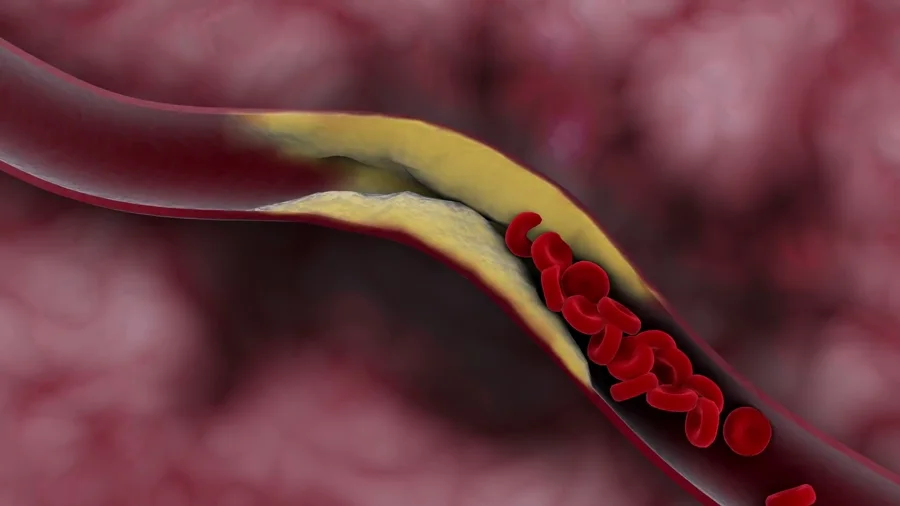
The patterns are not gone, they are concealed.This is how Dr. Klaus Berndsen describes it in the book “Trust the Triad”. Training with clear sensory guidance can help to uncover them again. How far depends on the location and extent of the damage.
After damage, the brain can relearn: other areas take over tasks, connections are rebuilt. Neuroscience has described rules for this: what is not used withers. What is to be learned must be practised exactly as it is needed, often and with sufficient intensity2. For the mouth and face, this means not strengthening individual muscles but practising the whole sequence.
Swallowing
Swallowing disorders after a stroke: common and often unnoticed
Swallowing is a firmly ordered sequence of lips, tongue, soft palate, larynx and breathing. After a stroke, it often gets out of rhythm.
was the frequency of swallowing disorders after a stroke in 24 analysed studies. The more precise the method, the more often they were found3
of pneumonia in people with a swallowing disorder; where food was shown to enter the airways, the risk was markedly higher still3
The mouth does not close
Without lip closure, the negative pressure that moves the bite cleanly backwards is missing.
The tongue works low down
It no longer forms the bite into a package and pushes it incompletely into the throat.
The timing slips
Swallowing and breathing share the throat. If the swallow comes too late, something can get into the larynx.
The protective reaction fails to occur
If the cough reflex is weakened, there is no coughing. This is then called silent aspiration.
That is why a swallowing disorder first belongs in the hands of speech and language therapy, which uses examinations to clarify whether and what can be swallowed safely. In our view, the aim nevertheless remains clear: to train the correct swallowing pattern again. FaceFormer training can also be used as a supplement in a neurological swallowing disorder, coordinated with the treatment team. More on the sequence can be found in the article Swallowing and swallowing disorders.
Speaking and saliva
Slurred speech, saliva, a lopsided smile: a common origin
What looks like many separate problems depends on the same muscles and the same control.
Speech disorder
In dysarthria, language in the mind is intact, but the lips, tongue and soft palate no longer produce the sounds precisely. This is to be distinguished from aphasia, in which finding and understanding language is impaired.
Drooling
Usually it is not that too much saliva is produced; it is swallowed too rarely and too imprecisely. If lip closure is also missing, it runs out.
Open mouth
A mouth that is open at rest shifts breathing into the mouth. The mucous membranes dry out, the tongue sinks, and swallowing becomes even more difficult.
Head balance
If the head sinks forward, the position of the hyoid bone and larynx changes. This makes swallowing and speaking even more difficult.
A Swedish study followed eight people 7 to 14 months after a stroke who practised twice a day for five minutes with an oral vestibule plate. Lip strength and the ability to create negative pressure in the mouth increased. Participants in both groups, after stroke and with paralysis of the facial nerve, reported less saliva escaping and fewer food remains in the cheek4. The group was small, there was no comparison group, and here too it was a different device from the FaceFormer.
How swallowing, voice and posture interact is also described in the article on Parkinson’s, in which similar sequences are affected. On the voice itself, see Hoarseness and voice.
Rehabilitation
Rehabilitation is teamwork
After a stroke, several disciplines work together. Each has its place, and none replaces another.
Speech and language therapy treats swallowing, speaking and facial movements and determines which diet is safe. Physiotherapy works on the trunk, posture and walking, and thus on the foundation on which the head and mouth work. Occupational therapy practises everyday activities such as eating and personal care.
Neurology and the GP practice treat the cause and accompany the course. FaceFormer therapy does not replace any of these components. It gives the mouth an exercise programme that runs every day between appointments.
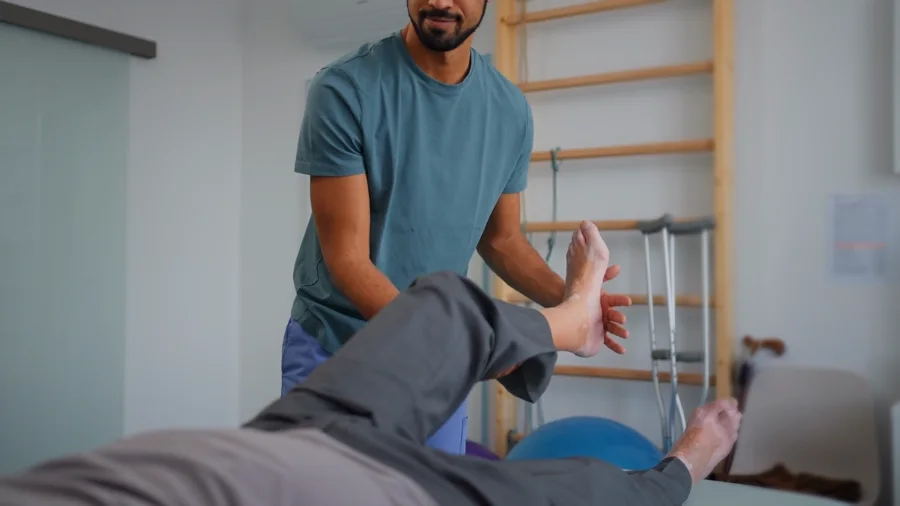
- Acute hospital
Cause and safety
Diagnosis, treatment of the cause, first swallowing examination. This is about safety, not training.
- Rehabilitation
Targeted practice
Speech and language therapy, physiotherapy and occupational therapy work intensively. FaceFormer training can be added in consultation with the team.
- At home
Every day
What started in rehabilitation has to continue in everyday life. Short, daily sessions carry the pattern through the months.
Do not stop or change medically prescribed treatments and diets on your own initiative. The training can be combined with speech and language therapy, physiotherapy and occupational therapy. With degenerative diseases such as ALS, advanced Parkinson’s or bulbar palsy, only train after consulting a doctor.
Principle
Guided movement: what rehabilitation knows from walking
After a stroke, many people relearn walking on devices that guide the movement. In our view, this principle can be transferred to the mouth.
involving 4,224 people after a stroke were analysed by Cochrane on gait training with electromechanical devices. Together with physiotherapy, participants were probably more likely to regain the ability to walk independently. Gait training is a different method and proves nothing for the FaceFormer5
Like a handrail for movement
In guided gait training, the device sets the path and the person works along actively. With every step, the brain receives a clean, always identical signal, and the pattern can become the norm again. The FaceFormer’s lip wedge is such a handrail for the mouth: a fixed shape, a defined resistance, a direction of pressure that repeats in the same way every time.
The lips and face are among the most sensitive regions of the body. Their signals reach the control centres for facial expression, tongue, chewing and swallowing in the brainstem. That is why the training never practises only the lips. Mouth closure, tongue reference position, swallowing, nasal breathing and head balance run in one sequence. Even if the lips only deliver a weak signal at first, the tongue, palate, throat and neck help carry the pattern.
It is not strength that counts, but a clean pattern, repeated precisely many times.A pattern does not change through insight, but through precise, frequent repetition. You have to keep at it; it can be worth it.
Evidence
What has been studied on mouth training after a stroke
There is no dedicated study on the FaceFormer in stroke. However, independent studies on similar forms of training show that the mouth and swallowing can respond to training.
after a stroke with a swallowing disorder practised in Sweden for at least five to eight weeks with an oral vestibule plate. Lip strength and swallowing performance increased markedly, with and without facial paralysis. The analysis was retrospective, without a comparison group, and the oral vestibule plate is a different device from the FaceFormer6
after a stroke pressed the tongue against the palate for eight weeks. Tongue strength and swallowing pressure increased, and liquid entered the airways less often. There was no comparison group7
The authors of the Swedish study consider it more likely that the success is due to sensorimotor stimulation and the learning capacity of the nervous system than to strengthening the lips themselves6. That fits our model. A systematic review on facial paralysis after brain damage found 16 studies, including three with oral vestibule plates, and called for more studies before firm conclusions are possible8.
We say this openly: the studies are small, and none has examined the FaceFormer. But the absence of a study does not mean that the connection does not exist. It means that it has not been tested. What has been studied on the FaceFormer at the ISST and in other work can be found on the page Studies and science.
Training
What training after a stroke can look like
Paralysis in the mouth and facial area is among the areas of application named in the FaceFormer’s exercise instructions. The training supplements treatment and is coordinated with the treatment team.
You start with the FaceFormer ZERO, made of softer material. It sits centrally in the oral vestibule, behind the lips and in front of the teeth, even if one side is paralysed. In the basic exercise, the lips press the lip wedge together for six seconds, the tip of the tongue lies at the reference point behind the upper incisors, the molars bite down briefly, and then you swallow. Three times a day, starting with a few repetitions. After a stroke, before your first swallow during training, have a speech and language therapist clarify whether and how you may swallow, because choking often goes unnoticed.
From around week 3, the pull exercise in varying directions is added, which the exercise instructions also name for paralysis of the lips and tongue. Which directions and how many sessions are best agreed with your practice. The free FaceFormer app guides you through the basic exercises.
Swallow only after approval
If you have a swallowing disorder, your speech and language therapist first clarifies whether and how you swallow during training.
Think about the hand
If one arm is weakened, pull with the stronger hand or practise only the basic exercise at first. Relatives help with inserting it but do not pull themselves. Anyone who cannot safely follow the instructions practises only with support.
Keep an eye on saliva
At first, more saliva may collect. Keep a cloth ready and only swallow in the way your speech and language therapist has approved.
Use a mirror
In front of the mirror, you can see whether both halves of the mouth enclose the wedge.
Night-time after consultation
Whether and from when you wear the ZERO at night, you discuss with your treatment team.
Allow for patience
The exercise manual expects six to twelve months of training until patterns have become automatic.
Relatives
For relatives: support, do not take over
After a stroke, relatives are often the most important training partners. Their attention and their patience carry a lot.
Short sessions at fixed times work better than long sessions. Help with inserting and holding if the hand is not yet cooperating, but let the lips do the work. Praise every bit of progress, even a swallow that goes more easily.
When eating, drinking and practising, watch out for coughing, throat clearing or a wet, gurgling voice. These are signs that something is getting into the airways. Something can get into the airways even without coughing. If shortness of breath, recurring fever or pneumonia occur, pause the training and clarify it with the speech and language therapist and the doctor’s practice.
Sit upright
Sit upright for eating, drinking and practising, with the head balanced above the trunk.
Check the mouth
After eating, check whether food remains have been left in the cheek pouch.
Care for mouth and nose
Good oral hygiene and a clear nose relieve the mucous membranes and airways.
Practices that work with FaceFormer therapy can be found in the practitioner directory. How the therapy is structured and how long it takes is explained under Process and duration.
Questions
Frequently asked
Can facial paralysis after a stroke be trained?
In paralysis after a stroke, the muscles and nerves in the face are usually intact; what is disturbed is the control from the brain. The nervous system can relearn through targeted, frequent practice. How far functions reorganise depends on the location and extent of the damage. A result cannot be promised.
Can I use the FaceFormer if I have a swallowing disorder after a stroke?
Yes, as a supplement and coordinated with the treatment team, as soon as your speech and language therapist approves swallowing during training. The aim is to train the correct swallowing pattern again.
When can I start training after a stroke?
When the cause has been clarified and your treatment team agrees. In the acute phase, safety comes first; in rehabilitation and afterwards, daily practice. The brain remains capable of learning even months after a stroke. How much will change cannot be promised.
In which direction do I pull if one side is paralysed?
According to the exercise instructions, in the pull exercise in varying directions, towards the healthy side. In practice, several directions are often combined. The FaceFormer sits centrally, and you only pull as hard as the lips can hold.
What can be done about drooling after a stroke?
Usually it is not that too much saliva is produced; it is swallowed too rarely, and lip closure is missing. Drooling should first be assessed by a speech and language therapist and a doctor; medication can also play a role. Training mouth closure and the swallowing pattern addresses the function. In a small Swedish study, people with facial paralysis reported less saliva escaping after lip training with a different device.
What is the difference between dysarthria and aphasia?
In dysarthria, language in the mind is intact, but the lips, tongue and soft palate no longer produce the sounds precisely. In aphasia, finding, forming or understanding language is impaired, often reading and writing as well. Both can occur together after a stroke.
What is the difference from facial palsy?
In a stroke, the disorder lies in the brain; mainly the mouth and cheek are affected, while the forehead usually remains mobile. This is an indication, not a test to do yourself. In peripheral facial palsy, the facial nerve itself is affected, and the whole half of the face fails. More on this in the article on facial paralysis.
Which FaceFormer should I use after a stroke?
You start with the ZERO, made of softer material. The ONE is the same size and shape and only made of firmer material. Whether and when you switch during the day depends on how well the lips hold the wedge.
More articles from the knowledge section
Where to go next

Sources
- Flowers HL, Silver FL, Fang J, Rochon E, Martino R (2013). The incidence, co-occurrence, and predictors of dysphagia, dysarthria, and aphasia after first-ever acute ischemic stroke. Journal of Communication Disorders 46(3):238-248. PMID 23642855. Source
- Kleim JA, Jones TA (2008). Principles of experience-dependent neural plasticity: implications for rehabilitation after brain damage. Journal of Speech, Language, and Hearing Research 51(1):S225-S239. PMID 18230848. Source
- Martino R, Foley N, Bhogal S, Diamant N, Speechley M, Teasell R (2005). Dysphagia after stroke: incidence, diagnosis, and pulmonary complications. Stroke 36(12):2756-2763. PMID 16269630. Source
- Wertsén M, Stenberg M (2020). Training lip force by oral screens. Part 3: Outcome for patients with stroke and peripheral facial palsy. Clinical and Experimental Dental Research 6(3):286-295. PMID 32301276. Source
- Mehrholz J, Kugler J, Pohl M, Elsner B (2025). Electromechanical-assisted training for walking after stroke. Cochrane Database of Systematic Reviews 5:CD006185. PMID 40365867. Source
- Hägg M, Anniko M (2008). Lip muscle training in stroke patients with dysphagia. Acta Oto-Laryngologica 128(9):1027-1033. PMID 19086198. Source
- Robbins J, Kays SA, Gangnon RE, Hind JA, Hewitt AL, Gentry LR, Taylor AJ (2007). The effects of lingual exercise in stroke patients with dysphagia. Archives of Physical Medicine and Rehabilitation 88(2):150-158. PMID 17270511. Source
- Fabricius J, Kothari SF, Kothari M (2021). Assessment and rehabilitation interventions for central facial palsy in patients with acquired brain injury: a systematic review. Brain Injury 35(5):511-519. PMID 33645363. Source
Get started
Ready for the training?
The free FaceFormer app guides you through the basic exercises, counts along and reminds you of your sessions. If you wish, a practice from the practitioner directory can support you.

FaceFormer ZERO + ONE
Both material hardnesses for getting started, day and night. The set for adults.

FaceFormer ZERO
The softer FaceFormer for getting started, for children and for the night.

FaceFormer ZERO Children’s Set
ZERO with hygiene box, plush bag and success book with stamp.
FaceFormer training aims to restore the physiological setting of the basic functions of breathing, swallowing and head balance, with lip closure and the tongue reference position, thereby creating the conditions under which symptoms can improve. It does not replace a medical assessment. You can find practitioners near you in the practitioner directory.


