
Specialist article: breathing
Mouth breathing and nasal breathingWhy the airway matters
You get air through your mouth too. Here you will find out why it still matters which route it takes: what the nose does with every breath in, why mouth breathing so often goes unnoticed, how early the breathing pattern is shaped and why nasal breathing is a pattern made up of breathing, swallowing and head balance.
Does this sound familiar?
You breathe through your nose as long as you think about it?
What applies to you or your child?
Tap whatever applies to you.
If several points apply, in our view the nose is not your preferred airway. That is no reason to worry, but it is a reason to take a closer look. Nasal breathing is not a resolution but a stored pattern, and patterns can be trained.
How to recognise mouth breathingWhat the nose doesThe key points at a glance
- Mouth breathing is common and often goes unnoticed, because the nose works at rest and the mouth only takes over under exertion and during sleep.
- The nose filters, warms and humidifies the air, its mucous membrane is the first line of defence, and nitric oxide from the paranasal sinuses reaches the lungs with the inhaled air. With mouth breathing, all of this is lost, and the air reaches the throat and larynx unfiltered. That is why, in our view, mouth breathing is harmful as soon as it becomes the normal case.
- The breathing pattern is shaped early and, in our view, depends on lip closure, tongue reference position and head balance. That is why you cannot simply think it away, but you can train it.
Video
Mouth breathing and nasal breathing: why the airway matters
Das Video lädt erst nach dem Klick. Dann werden Daten an YouTube (Google) übertragen.
Prevalence
Mouth breathing: common and often unnoticed
Very few mouth breathers know that they are mouth breathers. This is not due to a lack of attention, but to when the mouth takes over.
On TV: “JENKE. Experiment. Schlaflos” (ProSieben, 8 October 2026) is about poor sleep and its consequences. The FaceFormer can also be seen in the programme, in connection with sleep and posture. Watch the programme free of charge on Joyn
Anyone who pays attention can usually breathe through their nose. That is exactly what makes mouth breathing so hard to recognise. The switch happens where nobody is paying attention to themselves: during light exertion, in conversation, in front of the screen and above all during sleep. During the day everything seems unremarkable; at night the mouth is open.
of the 370 randomly selected children aged three to nine in a small Brazilian town were mouth breathers according to clinical assessment. The survey form was specially developed and not validated1
of the mouth breathers among these children slept with their mouth open, 79 % snored, and 62 % left saliva on the pillow2
The figures come from a single region and cannot simply be transferred to Germany. But they show how widespread the pattern can be and how it gives itself away: rarely during the day, clearly at night.
It is similar in adults. Mouth breathing is often only noticed through its consequences: a dry mouth in the morning, snoring or a comment from a partner.

Open mouth at rest
When reading, playing or watching TV, the lips are slightly parted.
Dry mouth in the morning
Tongue and lips feel dry and furred after waking up.
Snoring
Noises during sleep, even quiet ones, show that the air is not flowing calmly through the nose.
Damp pillow
Saliva runs out of the open mouth at night.
Restless sleep
Frequent tossing and turning, waking up, and in children also irritability during the day.
Functions of the nose
What the nose does with every breath in
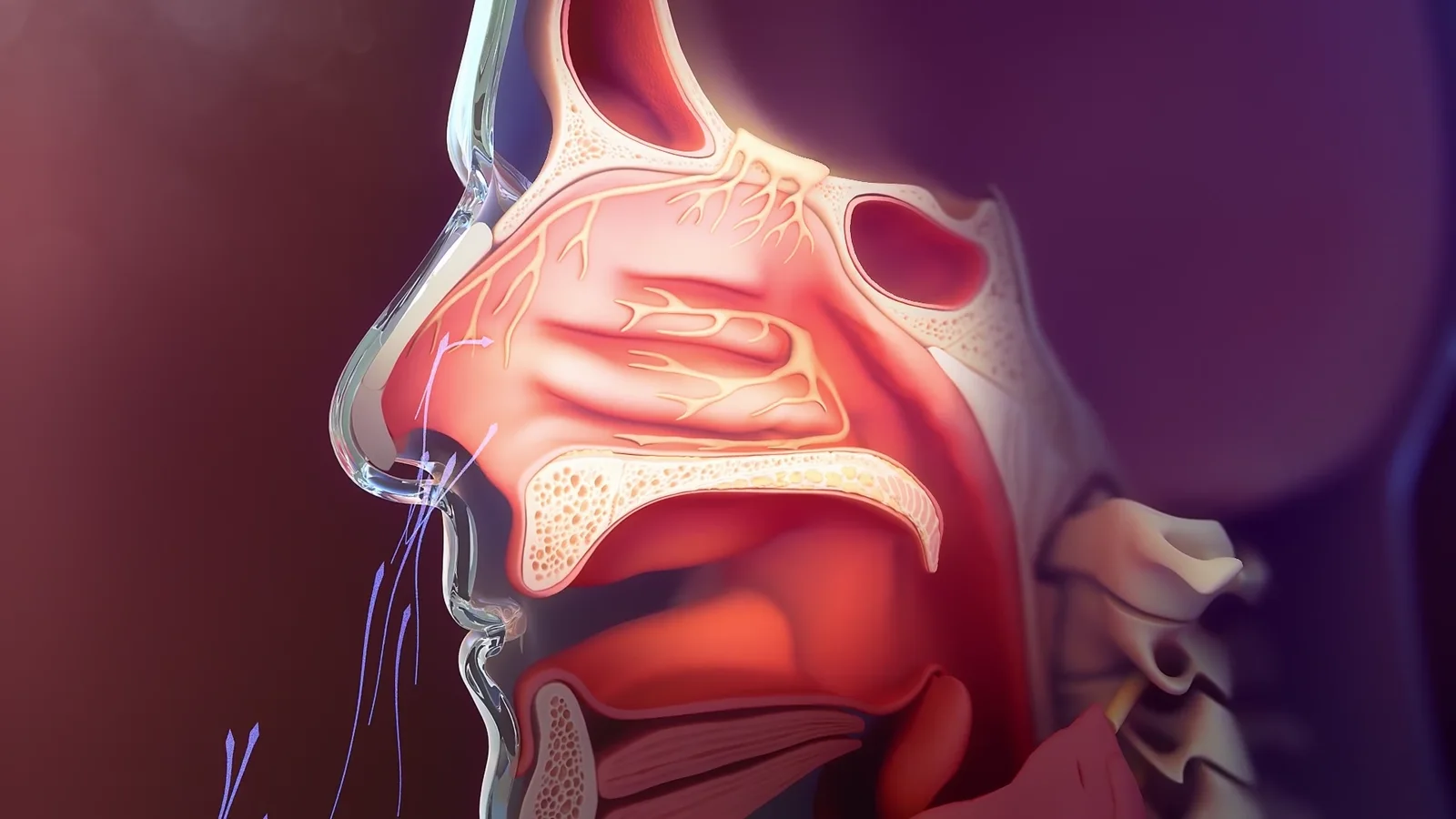
The nose is not a pipe through which air reaches the lungs. It prepares the air, checks it and reports to the brain what is coming in.
Filtering
Dust, pollen and germs stick to the mucus of the nasal mucous membrane before they get any further.
Warming
The well-perfused nasal turbinates warm the air on its short route through the nose.
Humidifying
The mucous membrane releases moisture so that the air does not dry out the lower airways.
Smelling and setting the rhythm
With every breath in, air passes the olfactory mucosa and registers in the brain.
A research group in Ulm measured how quickly the nose works. In 23 volunteers, it recorded temperature and humidity at several points in the nose. Both values rose markedly even in the front section. Conditioning of the air therefore begins just behind the nostril, long before the air reaches the throat3.
The brain is listening too. In a study of people who had electrodes placed in the brain for epilepsy diagnostics, electrical activity in the olfactory cortex, the amygdala and the hippocampus followed the rhythm of breathing. When the air was diverted from the nose to the mouth, this rhythm weakened4.
Through the mouth, air comes in. Through the nose, conditioned air comes in.You breathe around 20,000 times a day, and every breath either goes through the filter of the nose or past it. The mouth takes over none of its tasks. It is an emergency route, and as an emergency route it makes sense, for example with a cold or great exertion.
Defence
Mucus and cilia: the first line of defence
The nasal mucous membrane is where the air we breathe first meets the body. Accordingly, it is densely equipped with protective functions.
The surface of the mucous membrane is covered by a thin layer of mucus, beneath which stand fine hair-like projections, the cilia. They beat in coordinated waves and push the mucus, with everything caught in it, towards the throat. There it is swallowed without being noticed.
This removal is called mucociliary clearance. A review describes it as the most important innate defence mechanism of the airways5. In the mucus itself, antibodies and the body’s own antimicrobial proteins are also at work.

This system needs a moist mucous membrane with air flowing through it. In our view, anyone who breathes through the mouth for years leaves the nose unused, and what is not integrated into its function loses performance.
The mouth takes over
The air takes the seemingly easier route, especially during sleep.
Less air flows through the nose
The mucous membrane and erectile tissue receive less stimulation.
The mucous membrane changes
In our view, it becomes more susceptible and swells more easily.
Nasal breathing becomes harder
The nose feels narrower, and the mouth steps in even more often.
In our view, mouth breathing is harmful, and the mechanism is simple. The filtering, warming and humidification of the nose are lost, and the air reaches the mouth, throat and larynx unfiltered, whose mucous membrane is not built for this. This favours irritation and infections in the mouth and throat area. Nasal breathing is not a protective shield; people who breathe through the nose also catch colds. But it is the form of breathing for which the defences of the upper airways are built. You can find more on the role of the nose in hay fever in the article Allergies and nasal breathing.
Nitric oxide
A messenger substance only the nose supplies
In the paranasal sinuses, a gas is produced that was long known only as an air pollutant. With nasal breathing, it reaches the lungs.
In 1995, a research group at the Karolinska Institute in Stockholm discovered that the mucous membrane of the paranasal sinuses continuously produces nitric oxide, NO for short. The concentration in the air of the sinuses was very high. Because of the known antimicrobial effect of NO, the researchers suspected it plays a role in keeping the sinuses low in germs6.
higher was the partial pressure of oxygen at the skin in six of eight healthy people while they breathed through their nose instead of their mouth7
was the rise in NO in exhaled nasal air in ten healthy people when they hummed instead of breathing out quietly8
With nasal breathing, this NO reaches the lungs with every breath in, where it acts as a messenger substance on the blood vessels. With mouth breathing, the air does not take this route. Humming shows how closely ventilation and NO are linked: the vibrating air flushes through the sinuses. There is more on the sinuses in the article Sinusitis.
Hum a low note with your lips closed for one minute. What do you notice?
Early childhood
Mouth breathing is not innate
Newborns breathe through their nose. Whether it stays that way is decided in the first years of life.
An infant keeps breathing through the nose while feeding, even though the mouth is full of milk. In the first months, the larynx sits so high that the mouth is practically unavailable as an airway. Only when the larynx descends does mouth breathing become possible at all. Whether it later becomes the preferred route depends, in our view, on which patterns have become established by then.
At the breast, the child works with lips, tongue and jaw against resistance. The tip of the tongue seeks the point behind the upper incisors, and the lips close. This is how the tongue reference position becomes established.
A dummy that stays in the mouth for hours occupies exactly this space. The tongue lies lower, and the lips get used to being open. The child still breathes through the nose, but what is stored is the pattern of an open mouth.
Mouth breathing is not a predisposition. It is an acquired dysfunction.The basic programme of nasal breathing has not been erased, but overlaid. That is why it can be learned again, even in adulthood.
The pattern deviates
Open mouth, low-lying tongue, the mouth becomes an airway.
The body compensates
The nervous system stores the workaround as the preferred pattern, especially for sleep.
Form follows function
Palate, jaw, tooth position and head balance adapt over the years.
Complaints appear
When and how strongly depends on the extent, the duration and the age.
Jaw, teeth, ear
What studies show about the consequences in children
In children the face is still growing. That is why the consequences of an altered airway show particularly clearly there.
A research group in San Francisco investigated this relationship experimentally as early as 1981. The noses of young rhesus monkeys were closed with silicone plugs. All the animals then kept their mouths open; some lowered the lower jaw or pushed the tongue forward. Over time they developed a different face and a different bite from the control animals9.
Crossbite in the posterior teeth in children with obstructed nasal breathing compared with nasal breathers, evaluated retrospectively in 116 orthodontically treated children in Jerusalem10
lack of a seal between lips and tongue at the front of the mouth, in the same evaluation10
summarised a meta-analysis from China. In mouth breathers, the upper and lower jaws were rotated backwards and downwards, and the pharyngeal space was narrower11
Gums and teeth are affected too. A review of eleven cross-sectional studies found more gum bleeding and more plaque in children and adolescents with mouth breathing. For caries, the association was only apparent at certain stages12. Cross-sectional studies show associations, not their direction. But they fit with what the animal experiment suggests.
Jaw and teeth
In our view, a narrow upper jaw, a crossbite or an open bite often accompany a mouth that does not close.
Ear
The Eustachian tube connects the throat and the middle ear. In our view, how well it ventilates is linked to swallowing and nasal breathing; more under Ear pressure.
Adenoids
Enlarged adenoids and mouth breathing often occur together; more under Polyps.
Speech
If the tongue lies low and forward, the formation of individual sounds also changes, for example the S.
In adults, the face is fully grown, and in our view the consequences usually show elsewhere: a dry mouth and irritated mucous membrane, snoring, complaints in the teeth and jaw joint, tension in the neck and head. Hardly anyone connects these complaints with breathing, and so each is treated on its own.
The triad
Nasal breathing is a pattern, not a resolution
A clear nose is not enough. For air to flow through the nose, the oral cavity must be sealed, and three functions work together to achieve this.
In our view, breathing, swallowing and head balance form a common functional circuit. After every swallow, the tongue rests against the palate, the lips lie loosely together, and the base of the tongue seals off the throat. Then the airflow stays in the nose.
If the head is balanced above the body, the space in the throat stays clear. If it drifts forward, the mouth opens more easily. A disturbance at one point pulls the others along with it.
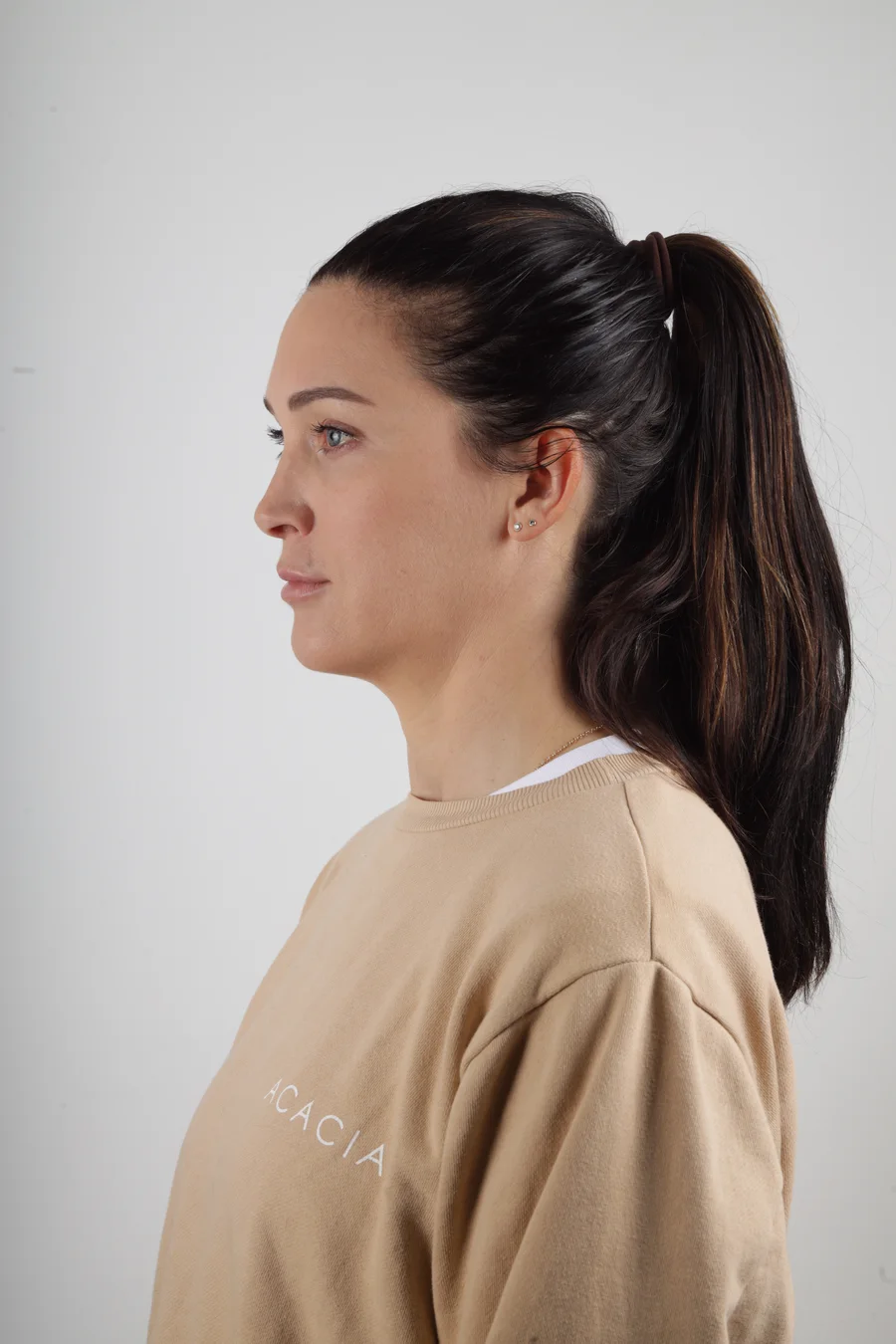
That is why the resolution to breathe through your nose only works as long as you think about it. The tongue reference position and the swallowing pattern run without conscious awareness. Muscles that are not involved in their function are not used and lose tone. When the function is needed again in everyday life, the tone builds up again.
A habit is not given up through insight, but displaced through repetition.Mouth breathing is stored in implicit memory, the same place where walking and swallowing are stored. Relearning therefore requires frequent, precise repetition over months.
Context
Spray, tape, surgery: why the pattern remains
Many people try to stop mouth breathing from the outside. That can bring relief for a while, but it does not change the control.
The consequences of mouth breathing end up in different places: the dry nose with nasal spray, the grinding with the splint, the tooth position with braces, the next middle ear infection with medication. Each treatment can alleviate the symptom, but the breathing pattern behind it remains untouched, and in our view hardly anyone makes the connection. Anyone who does not also treat the cause achieves a weakening of the effects, not a resolution of the chain.
It is similar with many breathing techniques. They work with deliberately set stimuli, such as breathing less or breathing in through the nose and out through the mouth. With these, you practise a skill that you only carry out with attention. In our view, they usually do not reach the pattern that runs during sleep and under strain, that is, lip closure, tongue reference position, swallowing and head balance, and alternating between nose and mouth keeps the mouth in the airway.
Controlling from the outside or consciously
- Taping the mouth shut at night (mouth taping)
- Nasal spray, nasal strips or nasal clips
- Reminding yourself to breathe through your nose during the day
- Breathing techniques that only work with attention
Relearning the pattern
- Practising lip closure, tongue reference position and swallowing together
- Integrating head balance into the same sequence
- Repeating it until it runs by itself during sleep
A plaster closes the mouth, but it does not teach it to close. Why we do not recommend mouth taping is explained in the article Mouth taping.
Passive aids change the airway for the duration of use, but the control behind it remains as it was. Nasal spray and nasal rinsing can clear or moisten the nose and make sense for that, but they do not change the habit of using the mouth. With constant use, decongestant sprays attack the mucous membrane. It gets used to the active ingredient and swells shut more quickly without the spray14. Plan coming off decongestant sprays with your practice.
A nasal operation can improve patency, but whether a long-standing mouth breather becomes a nasal breather again is decided by the breathing pattern. An open nose is a condition, nasal breathing is a skill, which is why relearning also belongs after an operation. A side effect that is rarely associated with the operation is empty nose syndrome: after excessive reduction of the turbinates, the nose feels blocked or dry despite a clear passage.
Like stabilisers on a bicycle
A stabiliser wheel keeps the bicycle upright as long as it is fitted. The child only learns balance when they balance themselves. In our view, tape, clips and constant spray are such stabiliser wheels. The balance of breathing develops in the interplay of breathing, swallowing and head balance, and the training can be combined with any medical treatment.
Training
Training nasal breathing: from day to night
In FaceFormer training you practise the building blocks of nasal breathing in one sequence until it runs without thinking.
The FaceFormer sits in the oral vestibule, behind the lips and in front of the teeth. The tip of the tongue rests on the small elevation behind the upper incisors, the head is balanced upright, and you breathe through your nose.
In the basic exercise you press the lip wedge together with your lips, bite down briefly with your back teeth and swallow. The negative pressure draws the tongue to the palate, and the oral cavity is sealed.
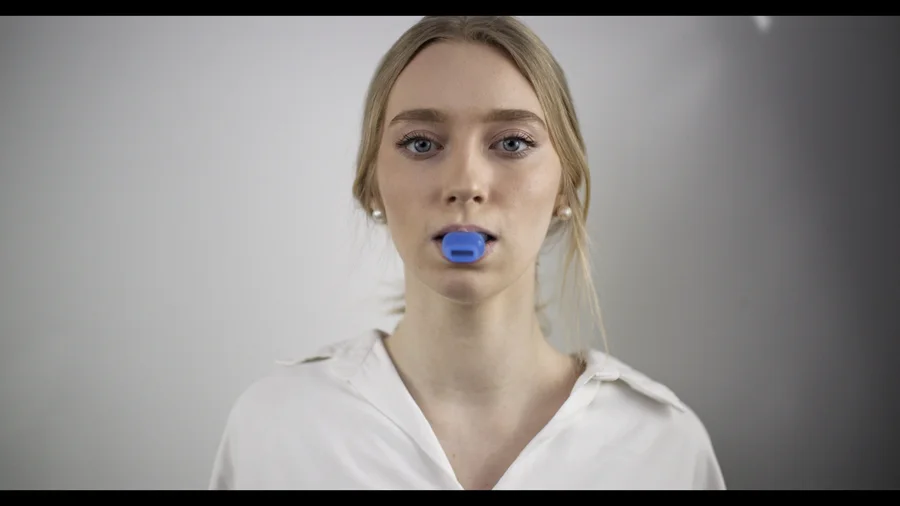
The night is only added once the nose is cooperating better thanks to daytime training, usually after two to three weeks. If the FaceFormer falls out at night at first, that is normal. It means the pattern is not yet consolidated during the day.
From about week 6, the breathing exercise combines the training with calm nasal breathing and short breathing pauses.
- From day 1
Basic exercise
A few minutes three times a day with the FaceFormer ZERO; you increase the repetitions week by week.
- After two to three weeks
The night
At night you wear the FaceFormer ZERO as soon as nasal breathing works better during the day.
- After a few weeks
Switching to the ONE
During the day, you train with the FaceFormer ONE. It is the same size and shape as the ZERO, just made of firmer material.
- From around week 6
Breathing exercise
Calm nasal breathing with breathing pauses that become longer over time.
- Over months
The pattern runs by itself
The exercise manual allows for six to twelve months, followed by maintenance training.
In our view, nasal breathing is an important part of the recipe with which the body shields itself against pathogens and allergens, and a prerequisite for restful sleep. The training can create the conditions for it to run again in everyday life and at night. You have to keep at it, and it can be worth it.
What has been studied? In the Hamburg study at the University Medical Centre Hamburg-Eppendorf, 45 children with functional disorders in the oral cavity were randomly assigned to treatment either with the FaceFormer or with myofunctional therapy without a device. Both groups improved; in the FaceFormer group, habitual lip closure was established more quickly13. After six months, only 30 children were re-examined, and a co-developer of the method was a co-author. You can find all studies under Studies and science.
The free FaceFormer app guides you through the basic exercises, and you can find all modules on the exercise pages. If your nose has been completely blocked for a long time, have this checked before training. Children have their own exercise plan; more under FaceFormer for children.
Everyday life
Nasal breathing in everyday life: what you can do yourself
Observe rather than force
For a few days, pay attention to when your mouth opens: at the screen, when climbing stairs, when falling asleep. This shows you where the pattern tips over.
Lips closed, tongue up
The lips lie loosely together, and the tip of the tongue rests behind the upper incisors. From this position, air flows through the nose by itself.
Humming
A few minutes of humming with closed lips ventilates the sinuses and makes the nose noticeable.
Increase sport gradually
First breathe through your nose during calm exertion, such as walking, and build up from there.
Head balance at the screen
Set up your screen and seat so that your head balances over your body and does not drift forwards.
No tape
We do not recommend taping the mouth shut. If the nose is blocked at night, the emergency route is then missing.
Do not stop prescribed treatment on your own
If you use nasal spray or other remedies on medical advice, discuss any changes with your practice.
Mouth breathing stands at the beginning of many causal chains that can extend to snoring, a dry mouth or an often blocked nose. You can find the individual topics in the linked articles, and the common starting point here.
Questions
Frequently asked
How can I tell that I breathe through my mouth?
Typical signs are a dry mouth in the morning, chapped lips, snoring, a damp pillow and slightly parted lips at rest. Because the switch happens mainly during sleep and exertion, it often goes unnoticed during the day. A comment from a partner or parents is therefore often the first clue.
Is mouth breathing harmful?
In our view, yes, as soon as it becomes the normal case. With a cold or great exertion, the mouth is a sensible emergency route. As a permanent state, the air bypasses the filtering, humidification and warming of the nose and reaches the throat and larynx unfiltered, and in our view the pattern has repercussions for the jaw, teeth and head balance. Studies in children show associations with jaw shape, bite and gums.
Why is nasal breathing better than mouth breathing?
The nose filters, warms and humidifies the air, its mucous membrane carries away particles and germs, and nitric oxide from the paranasal sinuses reaches the lungs with each inhalation. The mouth performs none of these tasks.
Can you train yourself out of mouth breathing?
Yes, as a pattern. A resolution is not enough, because breathing runs automatically during sleep and exertion. In FaceFormer training you practise lip closure, tongue reference position, swallowing and head balance in one sequence until it runs without thinking. The exercise manual allows for six to twelve months.
Does it help to tape your mouth shut at night?
We do not recommend mouth taping. A plaster closes the mouth from outside; the pattern behind it remains. And if the nose is blocked at night, the emergency route is missing too. More on this in the article on mouth taping.
Why does my child breathe through their mouth?
In our view, common reasons are an open mouth posture established early, for example through long use of a dummy, a low-lying tongue, enlarged adenoids or a nasal mucous membrane swollen by allergy. Often several factors come together. Have the adenoids and nose examined by a doctor, and keep the pattern in view as well.
From what age can a child train nasal breathing?
For children aged 2 to 10, the FaceFormer ZERO made of softer material is recommended, with short active sessions from about age 3. Under the age of 4, a child is best trained with expert support. You can find the exercise plan under FaceFormer for children.
My nose is often blocked. Can I still train?
A nose that is temporarily narrower is not an obstacle; after all, the training is meant to improve nasal breathing. That is why night-time use only begins after a few weeks of daytime training. If the nose has been completely blocked for a long time, have this checked before training.
More articles from the knowledge section
Experiences on this topic
Where to go next

Sources
- Abreu RR, Rocha RL, Lamounier JA, Guerra AF (2008). Prevalence of mouth breathing among children. Jornal de Pediatria (Rio J) 84(5):467-470. PMID 18830512. Source
- Abreu RR, Rocha RL, Lamounier JA, Guerra AF (2008). Etiology, clinical manifestations and concurrent findings in mouth-breathing children. Jornal de Pediatria (Rio J) 84(6):529-535. PMID 19060979. Source
- Keck T, Leiacker R, Heinrich A, Kühnemann S, Rettinger G (2000). Humidity and temperature profile in the nasal cavity. Rhinology 38(4):167-171. PMID 11190750. Source
- Zelano C, Jiang H, Zhou G, Arora N, Schuele S, Rosenow J, Gottfried JA (2016). Nasal Respiration Entrains Human Limbic Oscillations and Modulates Cognitive Function. Journal of Neuroscience 36(49):12448-12467. PMID 27927961. Source
- Bustamante-Marin XM, Ostrowski LE (2017). Cilia and Mucociliary Clearance. Cold Spring Harbor Perspectives in Biology 9(4):a028241. PMID 27864314. Source
- Lundberg JO, Farkas-Szallasi T, Weitzberg E et al. (1995). High nitric oxide production in human paranasal sinuses. Nature Medicine 1(4):370-373. PMID 7585069. Source
- Lundberg JO, Settergren G, Gelinder S, Lundberg JM, Alving K, Weitzberg E (1996). Inhalation of nasally derived nitric oxide modulates pulmonary function in humans. Acta Physiologica Scandinavica 158(4):343-347. PMID 8971255. Source
- Weitzberg E, Lundberg JO (2002). Humming greatly increases nasal nitric oxide. American Journal of Respiratory and Critical Care Medicine 166(2):144-145. PMID 12119224. Source
- Harvold EP, Tomer BS, Vargervik K, Chierici G (1981). Primate experiments on oral respiration. American Journal of Orthodontics 79(4):359-372. PMID 6939331. Source
- Harari D, Redlich M, Miri S, Hamud T, Gross M (2010). The effect of mouth breathing versus nasal breathing on dentofacial and craniofacial development in orthodontic patients. The Laryngoscope 120(10):2089-2093. PMID 20824738. Source
- Zhao Z, Zheng L, Huang X, Li C, Liu J, Hu Y (2021). Effects of mouth breathing on facial skeletal development in children: a systematic review and meta-analysis. BMC Oral Health 21(1):108. PMID 33691678. Source
- Kimura ACRS, de Arruda JAA, Drumond VZ, Martins-Júnior PA, Mesquita RA, Abreu LG (2026). Dental Caries and Periodontal Outcomes in Mouth-Breathing Children and Adolescents: A Systematic Review. International Journal of Paediatric Dentistry 36(1):24-32. PMID 40739849. Source
- Korbmacher HM, Schwan M, Berndsen S, Bull J, Kahl-Nieke B (2004). Evaluation of a new concept of myofunctional therapy in children (Hamburg study). International Journal of Orofacial Myology 30:39-52. PMID 15832861. Source
- Graf P, Hallén H (1996). Effect on the nasal mucosa of long-term treatment with oxymetazoline, benzalkonium chloride, and placebo nasal sprays. The Laryngoscope 106(5 Pt 1):605-609. PMID 8628089. Source
Get started
Ready for the training?
The free FaceFormer app guides you through the basic exercises, counts along and reminds you of your sessions. If you wish, a practice from the practitioner directory can support you.

FaceFormer ZERO + ONE
Both material hardnesses for getting started, day and night. The set for adults.

FaceFormer ZERO
The softer FaceFormer for getting started, for children and for the night.

FaceFormer ZERO Children’s Set
ZERO with hygiene box, plush bag and success book with stamp.
FaceFormer training aims to restore the physiological setting of the basic functions of breathing, swallowing and head balance, with lip closure and the tongue reference position, thereby creating the conditions under which symptoms can improve. It does not replace a medical assessment. You can find practitioners near you in the practitioner directory.


