

Specialist article: body and posture
Neck pain and back painWhy the head sets the pace
A tense neck after a day at the screen, a back that no longer wants to straighten up properly? Here you will learn why the head determines the statics of the whole body, what lies behind text neck and “forward head posture”, what role the tongue, hyoid bone and floor of the mouth play, and why we train head balance together with breathing and swallowing.
Does this sound familiar?
Your neck is stiff and nobody really knows why?
What applies to you?
Tap whatever applies to you.
If several of these points apply, it is worth looking beyond the neck. In our view, neck tension and back pain are usually connected with head balance, which is coupled with breathing and swallowing. This pattern can be trained.
What lies behind text neckWhat the tongue has to do with itThe key points at a glance
- Neck and back pain are among the most common complaints worldwide. Massage, insoles and painkillers bring relief where it hurts. In our view, the starting point usually lies further up, which is why the complaints often return.
- The head defines the space and determines the body’s statics. If it moves forward, the neck and back take on postural work. One important reason for this is the airway: if it becomes narrow, the body pushes the head forward.
- The tongue, jaw and head balance are connected via the hyoid bone and the floor of the mouth. That is why FaceFormer therapy trains breathing, swallowing and head balance in one sequence instead of just stretching the neck.
Video
Back and neck pain: what does the tongue have to do with it?
Das Video lädt erst nach dem Klick. Dann werden Daten an YouTube (Google) übertragen.
Context
Neck and back: the most common sites of pain
Almost everyone knows what a stiff neck or a pulling sensation in the lower back feels like.
people worldwide had neck pain in 2020 according to estimates from the Global Burden of Disease study, women more often than men1
people had lower back pain in the same year2
Lower back pain is the leading cause of years lived with health impairment2
Treatment is usually given where it hurts. Massage, heat, insoles and painkillers relieve this area and can do you good. An insole distributes the load on the foot, but it does not change the pattern that pushes the head forward.
If, in our view, the starting point usually lies further up, the effect from below remains limited, and the complaints often return as soon as the aid is removed. Then it is worth asking why the neck and back have to work so hard in the first place. Muscles rarely tense up without a reason.
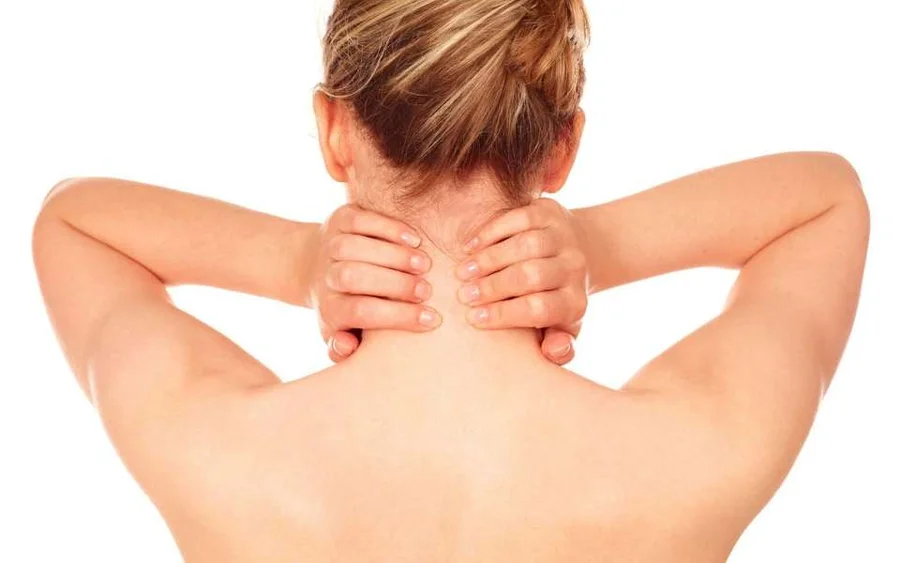
Where the pain is felt is not necessarily where it arose.In our view, the chain usually begins with head balance, breathing and swallowing.
The third basic function
The head defines the space and determines the body’s statics
In our view, breathing, swallowing and head balance form the triadic functional circuit. Head balance is the least conspicuous of the three, yet it carries the whole body.
On TV: The FaceFormer can also be seen in “JENKE. Experiment. Schlaflos” (ProSieben, 8 October 2026), in connection with sleep and posture. Watch the programme free of charge on Joyn
What many people search for as “head posture”, we call head balance. A head that has to be held costs muscular effort. A head that is balanced sits above the cervical spine in such a way that it is carried. The neck looks long, the chin is neither raised nor tucked in, and the gaze is straight ahead.
Physiologists in Utrecht described as early as the 1920s that the body aligns itself according to the head. The eyes and the organ of balance are located in the head, which is why righting reflexes align the head first, followed by the neck, trunk and pelvis.
In the craniocervical functional model, CCFM for short, the working model developed by Sabine and Klaus Berndsen, this part is called the external system. Its core principle is that the position of the head aligns the line of gravity. The shoulder girdle, spine, pelvis, knees and feet adapt to it.
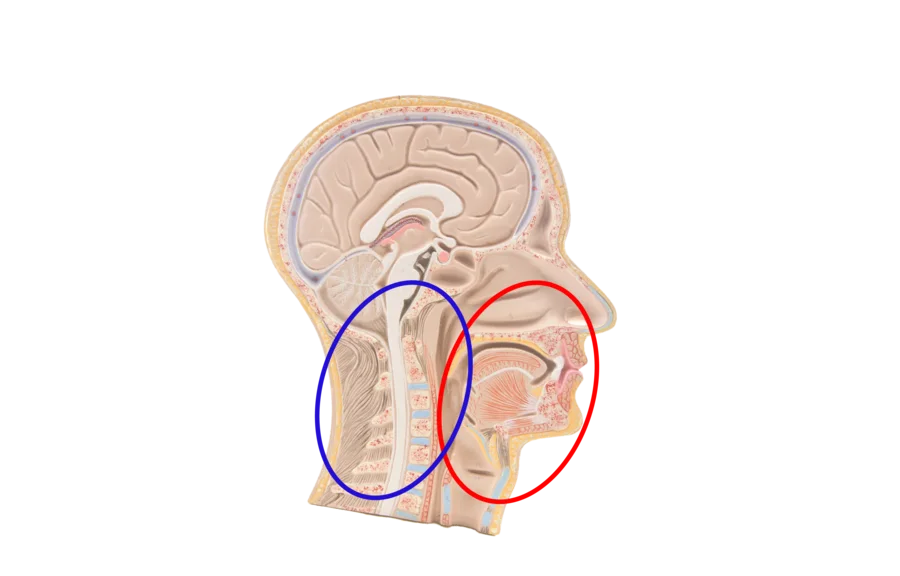
The head leads, the body follows.If the head moves out of balance, the body below compensates with the neck, shoulders, back and pelvis.
For us, head balance is therefore not a question of discipline but a basic function. It creates space for the airways and straightens the body so that the diaphragm and pelvic floor can also work well. If it is not right, the neck and back muscles take over holding work that puts a strain on them over time.
In our view, tooth position also depends on these functions. After orthodontic treatment, in many people the teeth move back towards their old position over the years, even though the result was initially successful. One possible reason: the treatment aligns the teeth, while head balance, breathing and swallowing remain unchanged. More on this in the article on retainers and relapse.
Text neck
Text neck and forward head posture: what the lever shows
Looking down at smartphones has given the phenomenon its name. The technical term is forward head posture.
With forward head posture, the head as a whole moves forward and the ear sits in front of the shoulder. To keep the gaze straight ahead, the chin lifts: the neck is bent forward at the bottom and overextended at the top.
An adult’s head weighs about four to five kilograms. If it moves forward, the lever becomes longer and the neck muscles have to work harder to hold against it. As with a bag held at arm’s length, the weight stays the same, only the lever grows.
A widely cited model calculation by a New York spinal surgeon arrives at a multiple of the head’s weight3. Nothing was actually measured, and the assumptions have not been disclosed. The kilogram values are useful for illustration, not as measurements.
on “text neck” were analysed by researchers in Rio de Janeiro. They found no proven link with neck pain4
difference in head-neck angle between people with and without neck pain, from 26 studies5
was the difference between women and men alone5
So posture alone does not explain the pain. The authors of the review on “text neck” even advise against calling any posture wrong4. We see it similarly. The key question is why the body needs the head to be forward.
Stand loosely against a wall with your heels, buttocks and shoulder blades touching it, and look straight ahead. What does the back of your head do?
Causes
Why the head moves forward: the airway as the reason
When the head moves forward, the nervous system has solved a problem. The question is which one.
Orthodontics provides one answer. In an experiment from 1980, the test subjects’ noses were blocked. In all cases, they then extended their heads, even when their vision was blocked at the same time6. When the airway and the gaze come into conflict, the airway wins.
with severe sleep apnoea in Copenhagen had a noticeably extended head position, in the authors’ view an adaptation that keeps the airway open7
more space behind the base of the tongue corresponded, by calculation, to 10 degrees more head extension, measured in ten adults8
So extension widens the throat, and the body maintains it because it helps. To keep the gaze horizontal, the head as a whole moves forward in the process.
Conversely, the throat becomes narrower when the head sinks forward and down. Under anaesthesia, it collapsed considerably more easily with the head bent forward and considerably less easily with the head extended9.
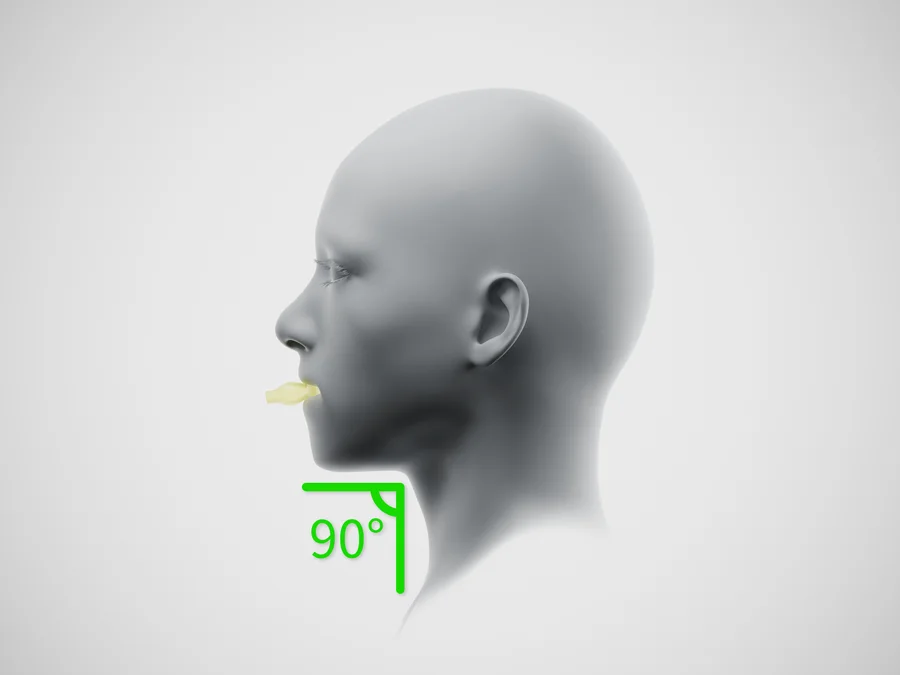
The pattern deviates
It often begins in childhood with mouth breathing, for example due to a blocked nose or a dummy. The tongue rests low.
The body compensates
The head extends and moves forward to keep the airway open. The nervous system stores this solution.
The body’s static balance shifts
The neck, shoulders and spine adjust to this. The front neck muscles are hardly used and lose tension, while the back ones work harder.
Symptoms become noticeable
Only now do the neck or back start to complain. When and how strongly depends on the extent and duration of the compensation and on age.
Like limping after a leg injury
If you have injured your leg, you protect it when walking and limp, often without noticing. In the short term, this is a good solution. If the limping continues for weeks, it becomes a habit and puts strain on joints, ligaments and muscles elsewhere, sometimes long after the injury has healed. We see the forward-shifted head in a similar way: it was once a sensible response to a narrow airway.
In our view, this chain is at the root of many neck and back complaints, often together with other consequences of the same pattern, such as snoring and sleep apnoea. This somatic routine can persist even when its original cause has long since disappeared. It has not been erased, only overlaid, and can therefore be relearned.
Tongue and hyoid bone
Tongue, hyoid bone and floor of the mouth: the front neck chain
What does the tongue have to do with the neck? More than you might think, because both hang from the same lines of pull.
The hyoid bone is the only bone in the body without a bony neighbour. Above it, the muscles of the floor of the mouth pull towards the lower jaw and tongue; below it, muscles pull towards the breastbone, shoulder blade and larynx. In between, the bone hangs in a balance of pull and counter-pull.
This mechanically links the tongue, jaw, airway and head balance. If one direction of pull changes, the hyoid bone shifts, and everything else shifts with it.
were X-rayed in Shanghai in neutral and in forward head balance. All but one of the measurements of hyoid bone position differed10
researchers in Copenhagen followed 24 denture wearers. The horizontal position of the hyoid bone followed mainly the inclination of the cervical spine11
Like a mast with guy ropes
A ship’s mast stands because ropes hold it from the front and from the back. If the front rope sags, the rear ones have to pull harder, and the mast still leans. This is roughly how we see the neck. The floor of the mouth, the hyoid bone and the deep neck flexors form the front bracing, and the neck muscles form the rear bracing.
If the tongue lies low instead of resting against the palate in the tongue reference position, the front chain lacks tension, in our view. Muscles that are not engaged in their function are not used and go slack. During swallowing, the tongue presses against the palate several hundred to a thousand times a day. When this is trained, the front chain regains tension.
Nervous system
The neck measures more than it carries
Beneath the large neck muscles you can feel when they are tense lie small muscles with a completely different task.
Directly beneath the back of the head, short muscles connect the skull to the uppermost cervical vertebrae. They are hardly strength muscles but rather sensors. They contain a particularly large number of muscle spindles, fine sensors that continuously report how much a muscle is being stretched.
The CCFM therefore distinguishes between two levels. The large muscles, such as the trapezius, hold the head; the small, deep ones fine-tune its balance.
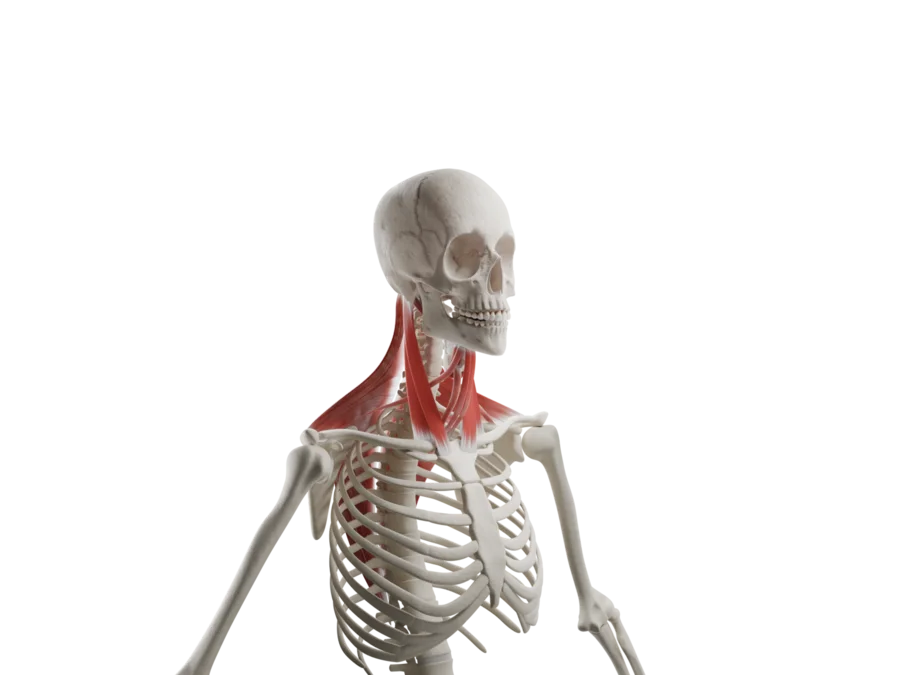
were counted by researchers in Vellore in the inferior oblique head muscle, examined in foetuses12
was the figure in the same study for the superior oblique head muscle12
If the baseline tension of these muscles shifts over a long period, in our view the zero point of their measurement shifts too. The brain then calculates correctly, but from a wrong baseline. Massage and stretching of the large muscles can relax them, but they barely reach the fine control beneath.
In addition, there is a relay station in the brainstem. Pain signals from the upper neck and from the head region converge there on the same nerve cells, the trigeminocervical complex13. This is why neck tension is often experienced as a headache. More on this in the articles on craniomandibular dysfunction (TMD) and the jaw joint and on tinnitus.
From the neck downwards
From the neck into the back: hollow back, rounded back, pelvis
A forward-positioned head does not stay a neck issue. The body below looks for a solution to keep its centre of gravity over the feet.
In our view, the body usually chooses one of two strategies, often a mixture of both. Both serve the same purpose. They bring the centre of gravity back under the head so that you do not tip forwards.
Both require extra holding work, in the upper back, the lower back or the pelvis.
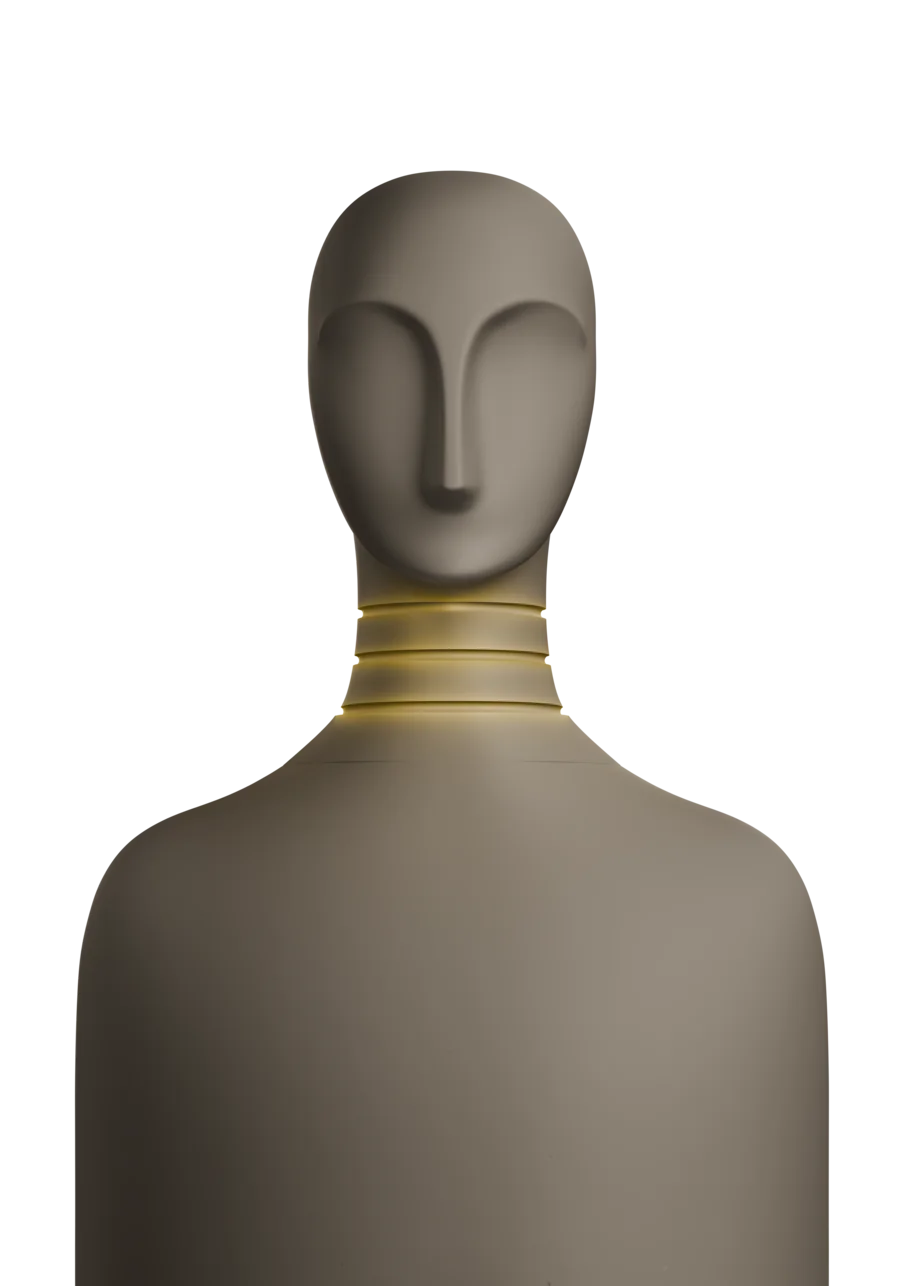
Hollow back
The chest stays as if holding an inhalation, the pelvis pushes forwards, and the lumbar spine curves more strongly.
Rounded back
The upper back rounds, the shoulders drop forwards, and the head sits in front. To keep the gaze straight ahead, the upper neck is overextended.
Balanced
The head sits above the body, and the spine stays in balance. The muscles work without holding on.
From the pelvis and spine, the adaptation continues into the hips, knees and feet. That is why people with neck complaints often also complain about their shoulders, lower back or hips and receive different findings from several specialties. The common starting point often remains unconsidered.
Scoliosis, a pelvic obliquity or a leg length discrepancy is also often named as the cause. In our view, pelvic obliquity and a slight leg length discrepancy are usually more a consequence of a body posture that is oriented to the position of the head, and the extent of a scoliosis also follows it. Anyone who only compensates for leg length is treating the effect, not the starting point.
with asymmetries in the region of the back of the head and the cervical spine were also examined for their oral functions at the University Medical Centre Hamburg-Eppendorf14
of them showed orofacial dysfunctions, for example affecting the tongue, lip closure or articulation14
This is a correlation, not proof of a direction. But it shows that the mouth and posture belong together when assessed, especially in children whose spines are still growing. More on this under FaceFormer for children.
Research
What studies show and what they don’t
There is also our own research on the relationship between oral function, head balance and body statics. We present it as it is.
At the University of Frankfurt, five women with dysfunctions of the jaw system trained with the FaceFormer three times a day for at least four months. Their backs were measured three-dimensionally every four weeks. The authors saw this as an indication that head balance can influence the uprighting of the spine down into the lumbar region15.
without a comparison group, published as a conference poster; Klaus Berndsen is a co-author. A first indication, not proof15
were examined by Herget, Ohlendorf and Kopp in 2012 in the journal Manuelle Medizin before and after six months of training. The inclination of the trunk decreased significantly16
Independent reviews support the principle without examining the FaceFormer. Seven randomised studies with 627 participants show that targeted exercises can noticeably change the head-neck angle in forward head posture and moderately improve neck pain17. For breathing exercises in forward head posture, an analysis from Korea found a moderate effect on the angle but rated the certainty of the evidence as very low18.
The absence of a study does not mean that the relationship does not exist. It means that it has not been tested.There is as yet no randomised study on FaceFormer therapy for neck and back pain. You can find all of our own studies, with size, comparison group and limitations, on the page Studies and science.
Training
Training head balance: patterns instead of posture reminders
What brings relief from the outside does not change the pattern that puts strain on the neck and back day after day. In our view, this also applies to spinal surgery. Such operations are major procedures with their own risks and without any promise of lasting improvement; they change the structure and leave the interplay of breathing, swallowing and head balance untouched. If there are no warning signs such as paralysis or numbness, a look at these functions belongs before any decision for an operation.
“Sit up straight” rarely lasts long. As soon as your attention is elsewhere, your head returns to its habitual pattern. Head balance is not a resolution but a stored sequence that changes through precise, frequent repetition. That is why we practise it together with lip closure, nasal breathing, tongue reference position and the swallowing action.
Relief from outside
- Massage, heat, pillows or insoles
- Work as long as they are used, afterwards complaints often return
- Release tension or change position
- The control pattern stays as it is
Patterns from within
- Breathing, swallowing and head balance in the same sequence
- Targets the control, not the individual muscle
- Requires repetition over months
- The goal is a pattern that runs without thinking
The two can be combined, including with physiotherapy. Do not stop treatments prescribed by a doctor on your own initiative.
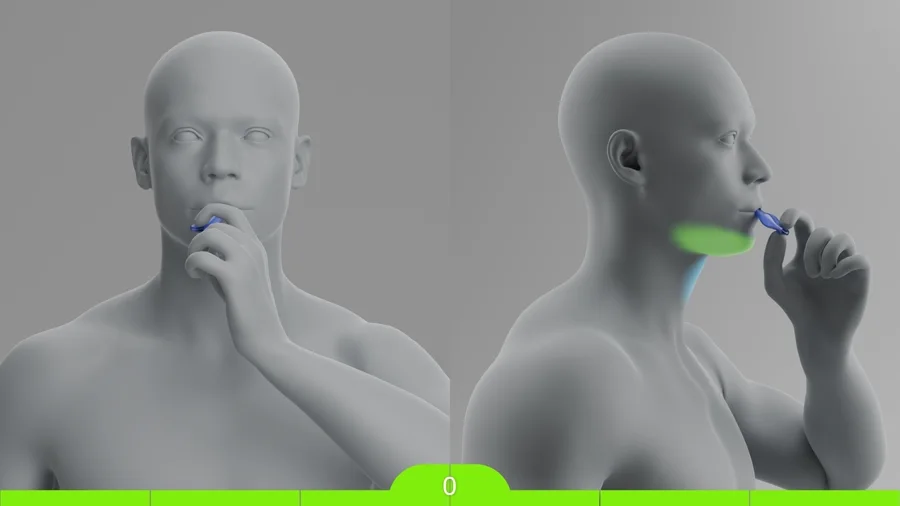
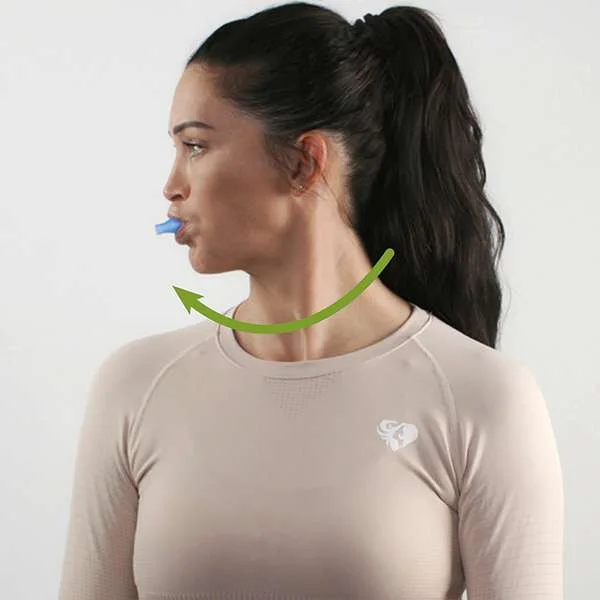
In the basic exercise, the FaceFormer sits in the oral vestibule, behind the lips and in front of the teeth. Hold your head upright, lengthen your neck, place the tip of your tongue on the palate and breathe through your nose. Then press the lip wedge, bite down briefly and swallow.
In the pull exercise, you additionally pull the lip wedge forward with your fingers. When you swallow, the floor of the mouth works too, and your head stays upright.
From around week 6, the head balance rotation is added. You press the lip wedge, slowly turn your head to the side for six seconds until you feel the neck muscles, bite down briefly and swallow. Then slowly turn back to the centre.
Your neck stays lengthened and your head does not tip forward. Later, the head balance with breathing combines the rotation with calm nasal breathing.
- From day 1
Basic exercise
Three times a day for a few minutes with the FaceFormer ZERO.
- From around week 3
Pull exercise and night
The pull exercise is added, and at night the FaceFormer ZERO.
- After a few weeks
Switching to the ONE
During the day the FaceFormer ONE, the same size as the ZERO, just made of firmer material.
- From around week 6
Head balance rotation
First 8, then from week 7 onwards 14 repetitions three times a day.
- Over 6 to 12 months
The pattern runs by itself
This is followed by maintenance training. Chewing gum and other oral habits interfere with pattern formation.
The free FaceFormer app guides you through the basic exercises, and you will find all modules on the exercise pages. If you feel pain, pause the exercise. If you feel dizzy when turning, turn more slowly and less far. If you are not making progress, a practice from the practitioner directory.
Safety
When to have neck or back pain checked by a doctor
Some signs suggest that there may be more behind it than a pattern. In that case, medical assessment comes first.
Radiating pain with numbness
Pain radiates into the arm or leg, along with tingling, numbness or loss of strength.
After an accident or fall
The symptoms began after an accident, fall or whiplash injury.
Fever or weight loss
This is accompanied by fever, night sweats or unintentional weight loss.
Bladder or bowel
It is harder to hold urine or stool, or the buttocks feel numb.
New and severe
The pain is new and very severe, or it gets worse at night while resting.
With headache or visual disturbance
This is accompanied by severe headache, dizziness, or visual or speech disturbances.
If such signs apply, have your symptoms checked by a doctor first. With acute pain radiating into the arm or leg, for example with a slipped disc, only start the training after consulting your treating practice. Do not stop ongoing treatments or prescribed medication on your own initiative.
In our view, a stiff neck after a day at the screen or a pulling sensation in the lower back after sitting for a long time is, as a rule, the expression of a pattern. In that case, correcting the basic functions is the starting point.
Everyday life
Relieve your neck, improve your posture: head balance in everyday life
Screen at eye level
Set up your monitor and laptop so that you look straight ahead. Raise your phone to look at it instead of lowering your head.
Lips closed, nose open
Your lips rest lightly together, and the tip of your tongue rests on the palate behind the upper front teeth. This relieves the neck and, we believe, also the vagus nerve.
Teeth apart
Except when chewing and swallowing, your teeth are slightly apart. Clenching tenses the jaw and neck muscles together.
Change instead of stiffness
Even a good sitting position becomes a strain over time. Stand up now and then and take a few steps.
Choose the right pillow
At night, your head lies in line with your spine, neither bent nor overextended. A pillow that is too high bends it forward.
Don’t force yourself into a posture
Pulling your head back with force creates new holding work. Balance comes from the pattern you train.
Questions
Frequently asked
What does the tongue have to do with neck pain?
The tongue is attached via the floor of the mouth to the hyoid bone, which is connected by muscles to the lower jaw, breastbone and shoulder blade. This front chain balances the head together with the neck muscles. If the tongue rests low instead of in the tongue reference position against the palate, in our view there is a lack of tension at the front, and the neck has to do more holding.
What is text neck?
This is the colloquial term for the head tilted forward while looking at a smartphone, technically known as forward head position or forward head posture. The lever of the head’s weight becomes longer and the neck muscles work harder. However, a review found no proven link with neck pain. In our view, what matters is whether the head moves forward as part of a pattern.
Can poor “head posture” cause back pain?
We prefer to speak of head balance rather than “head posture”. If the head sits in front of the body, the thoracic and lumbar spine compensate with a rounded back or a hollow back, and this compensatory work can cause symptoms. In our view, head balance is usually part of the cause, not the only one.
How can I improve my posture?
Not by constantly holding yourself upright, as that only creates new postural work. Posture improves when the head is balanced again, and that depends on breathing and swallowing. In FaceFormer training you practise nasal breathing, the tongue reference position, the swallowing act and head balance in one sequence until the pattern runs without you having to think about it.
Does massage help with neck tension?
Massage can loosen tense muscles and feel good. It mainly acts on the large, superficial neck muscles. The fine control of head balance lies deeper and is a learned pattern, which is why the tension often comes back. Massage and training combine well.
Which FaceFormer exercise is intended for the neck and head balance?
The foundation is the basic exercise and the pull exercise, in which you raise your head and lengthen your neck. From around week 6, the head balance rotation is added, and later head balance with breathing. You start with the FaceFormer ZERO and, after a few weeks, switch to the ONE during the day.
Can I train with the FaceFormer if I have a slipped disc?
If you have acute pain radiating into your arm or leg, or numbness and loss of strength, the first step is a medical assessment. You then discuss starting the training with your treating practice. Only perform the rotation exercises up to a comfortable stretch, never into pain.
More articles from the knowledge section
Experiences on this topic
Where to go next

Sources
- GBD 2021 Neck Pain Collaborators (2024). Global, regional, and national burden of neck pain, 1990-2020, and projections to 2050: a systematic analysis of the Global Burden of Disease Study 2021. Lancet Rheumatology 6(3):e142-e155. PMID 38383088. Source
- GBD 2021 Low Back Pain Collaborators (2023). Global, regional, and national burden of low back pain, 1990-2020, its attributable risk factors, and projections to 2050: a systematic analysis of the Global Burden of Disease Study 2021. Lancet Rheumatology 5(6):e316-e329. PMID 37273833. Source
- Hansraj KK (2014). Assessment of stresses in the cervical spine caused by posture and position of the head. Surgical Technology International 25:277-279. PMID 25393825. Source
- Grasser T, Borges Dario A, Parreira PCS, Correia IMT, Meziat-Filho N (2023). Defining text neck: a scoping review. European Spine Journal 32(10):3463-3484. PMID 37405530. Source
- Rani B, Paul A, Chauhan A, Pradhan P, Dhillon MS (2023). Is Neck Pain Related to Sagittal Head and Neck Posture? A Systematic Review and Meta-analysis. Indian Journal of Orthopaedics 57(3):371-403. PMID 36825268. Source
- Vig PS, Showfety KJ, Phillips C (1980). Experimental manipulation of head posture. American Journal of Orthodontics 77(3):258-268. PMID 6928735. Source
- Solow B, Ovesen J, Nielsen PW, Wildschiødtz G, Tallgren A (1993). Head posture in obstructive sleep apnoea. European Journal of Orthodontics 15(2):107-114. PMID 8500536. Source
- Muto T, Takeda S, Kanazawa M, Yamazaki A, Fujiwara Y, Mizoguchi I (2002). The effect of head posture on the pharyngeal airway space (PAS). International Journal of Oral and Maxillofacial Surgery 31(6):579-583. PMID 12521311. Source
- Walsh JH, Maddison KJ, Platt PR, Hillman DR, Eastwood PR (2008). Influence of head extension, flexion, and rotation on collapsibility of the passive upper airway. Sleep 31(10):1440-1447. PMID 18853942. Source
- Ye J, Jin L, Cheng R et al. (2025). Changes in the craniofacial morphology and hyoid bone position in the neutral and forward head posture in healthy individuals: A cross-sectional study. Journal of Back and Musculoskeletal Rehabilitation 38(3):533-543. PMID 39973255. Source
- Tallgren A, Solow B (1984). Long-term changes in hyoid bone position and craniocervical posture in complete denture wearers. Acta Odontologica Scandinavica 42(5):257-267. PMID 6597991. Source
- Kulkarni V, Chandy MJ, Babu KS (2001). Quantitative study of muscle spindles in suboccipital muscles of human foetuses. Neurology India 49(4):355-359. PMID 11799407. Source
- Bartsch T, Goadsby PJ (2003). The trigeminocervical complex and migraine: current concepts and synthesis. Current Pain and Headache Reports 7(5):371-376. PMID 12946290. Source
- Korbmacher H, Koch LE, Kahl-Nieke B (2005). Orofacial myofunctional disorders in children with asymmetry of the posture and locomotion apparatus. International Journal of Orofacial Myology 31:26-38. PMID 16739710. Source
- Herget A, Ohlendorf D, Berndsen K, Kopp S. Die FaceFormer-Therapie und die Auswirkungen auf die Haltung der Wirbelsäule. Poster demonstration, Annual Scientific Meeting of the German Orthodontic Society (Deutsche Gesellschaft für Kieferorthopädie) (according to the ISST list, 2009). Pilot study, 5 people, no comparison group, not peer-reviewed. Source
- Herget A, Ohlendorf D, Kopp S (2012). Auswirkungen der Face-Former-Therapie auf die Oberkörperstatik. Manuelle Medizin 50(3):204-210. Source
- Sheikhhoseini R, Shahrbanian S, Sayyadi P, O’Sullivan K (2018). Effectiveness of Therapeutic Exercise on Forward Head Posture: A Systematic Review and Meta-analysis. Journal of Manipulative and Physiological Therapeutics 41(6):530-539. PMID 30107937. Source
- Park S, Kim K, Kang M (2025). The Effects of Rehabilitation Programs Incorporating Breathing Interventions on Chronic Neck Pain Among Patients with Forward Head Posture: A Systematic Review and Meta-Analysis. Bioengineering 12(9):947. PMID 41007191. Source
Get started
Ready for the training?
The free FaceFormer app guides you through the basic exercises, counts along and reminds you of your sessions. If you wish, a practice from the practitioner directory can support you.

FaceFormer ZERO + ONE
Both material hardnesses for getting started, day and night. The set for adults.

FaceFormer ZERO
The softer FaceFormer for getting started, for children and for the night.

FaceFormer ZERO Children’s Set
ZERO with hygiene box, plush bag and success book with stamp.
FaceFormer training aims to restore the physiological setting of the basic functions of breathing, swallowing and head balance, with lip closure and the tongue reference position, thereby creating the conditions under which symptoms can improve. It does not replace a medical assessment. You can find practitioners near you in the practitioner directory.


