
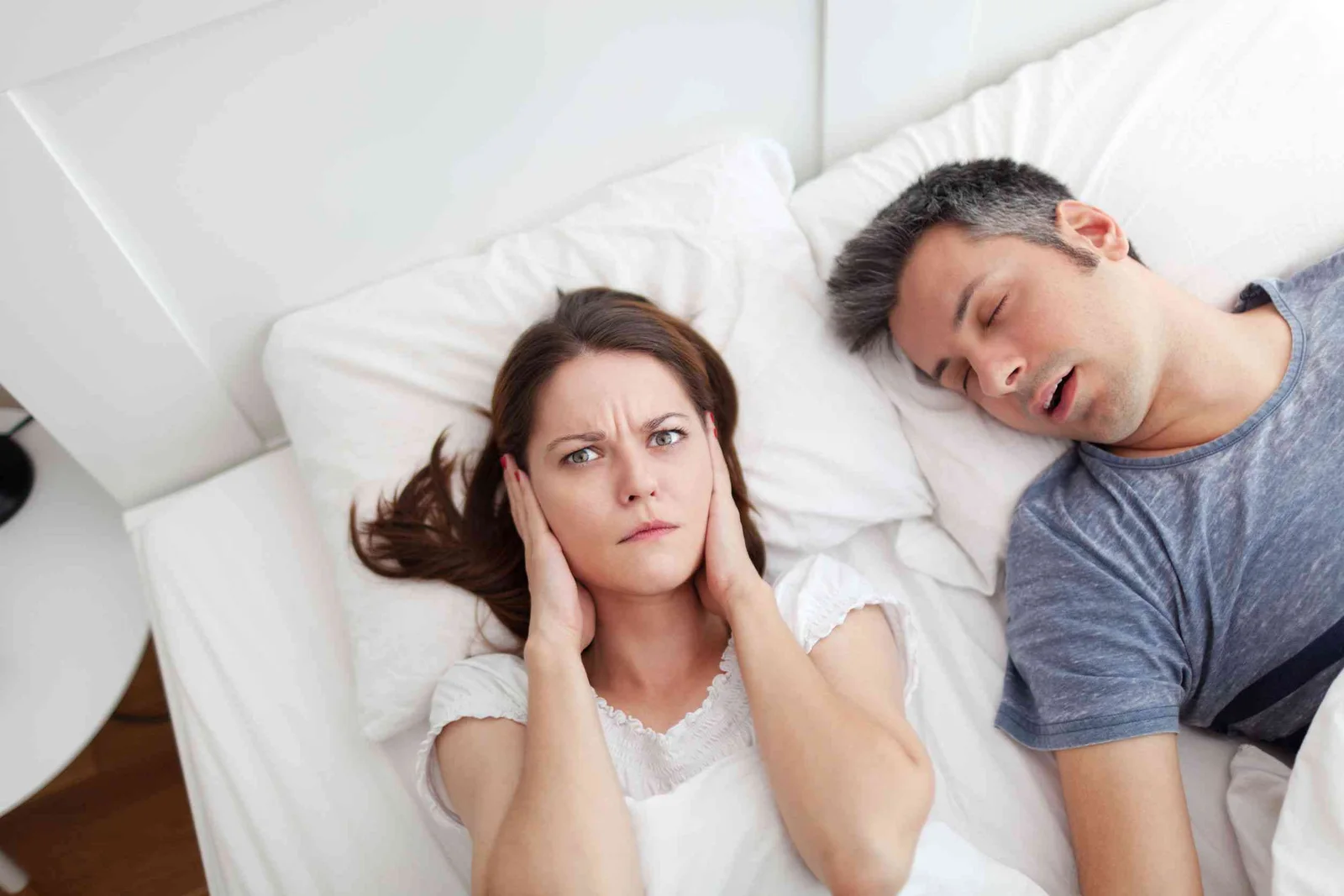
Specialist article: Sleep
Snoring and sleep apnoeaWhy the airway gives way at night
Loud snoring, pauses in breathing, waking up feeling wrecked? Here you can find out what happens in the throat at night, what, in our view, causes snoring and obstructive sleep apnoea, what CPAP and anti-snoring splints can do, and why a stable airway is a pattern of breathing, swallowing and head balance.
Does this sound familiar?
Loud at night, wrecked in the morning?
What applies to you?
Tap whatever applies to you.
If several points apply, it is worth taking a closer look at what happens in your throat at night. There, the airway has no rigid wall and is held open by muscles. In our view, how well this works depends on a pattern of breathing, swallowing and head balance, and patterns can be trained.
What happens in the throatWhat CPAP doesThe key points at a glance
- Snoring, reduced breathing and breathing pauses lie on the same continuum. What matters is how easily the throat gives way during sleep.
- In our view, the tissue becomes slack because, as a rule, it is no longer integrated into its function. Mouth breathing at night, a low-lying tongue and a forward-shifted head balance are part of this pattern.
- CPAP and anti-snoring splints keep the airway open as long as they are worn, but the pattern behind it remains, and over the years the splint measurably shifts the position of the teeth. Training the basic functions of breathing, swallowing and head balance addresses the pattern itself.
Video
Snoring: why we address the causes
Das Video lädt erst nach dem Klick. Dann werden Daten an YouTube (Google) übertragen.
Fundamentals
Snoring, breathing pauses, sleep apnoea: one line, not a leap
Snoring is seen as a nuisance, sleep apnoea as an illness. From a physiological point of view, the transition is gradual.
On TV: “JENKE. Experiment. Schlaflos” (ProSieben, 8 October 2026) is about poor sleep and its consequences. The FaceFormer can also be seen in the programme, in connection with sleep and posture. Watch the programme free of charge on Joyn
Snoring is a sound. It occurs when soft tissue in the nose, mouth and throat starts to vibrate as you breathe during sleep. Occasional snoring, for example with a cold, is considered a normal variant. If the airway becomes narrower, the airflow drops markedly; this is a hypopnoea. If it collapses completely, breathing stops. If this happens night after night, the diagnosis is obstructive sleep apnoea.
critical closing pressure in ten people who snored without any symptoms1
in six people with reduced breathing during sleep, in the same study1
in ten people with breathing pauses. A positive value means that the throat closes by itself and has to be actively held open1
What was measured was the pressure at which the throat closes during sleep, the critical closing pressure. The higher it is, the more easily the airway gives way. The authors see this as a continuum on which small differences tip the balance. Many people are affected. A 2019 estimate put the number of adults aged 30 to 69 worldwide with at least mild obstructive sleep apnoea at 936 million2.
Upper Airway Resistance Syndrome (UARS), the syndrome of increased airway resistance, is often placed between snoring and sleep apnoea. The airway remains largely open, but its resistance rises to such an extent that brief arousals repeatedly interrupt sleep. The typical breathing pauses of sleep apnoea are often absent. In our view, besides the anatomy of the mouth and throat, tissue tension and motor patterns also play a role here. Diagnosis and treatment belong in the hands of sleep medicine.
Anatomy
The throat: a tube without a framework
The nose and windpipe have a framework of bone and cartilage. The throat in between has none.
The wall of the throat consists of mucous membrane, connective tissue and muscles. It only stays open as long as these muscles hold it open. Every inhalation creates suction there that pulls the soft walls inwards.
Working against this are mainly the muscles of the tongue and soft palate. The most important opener is the genioglossus, the large tongue muscle. It attaches on the inside of the chin and pulls the base of the tongue forwards.
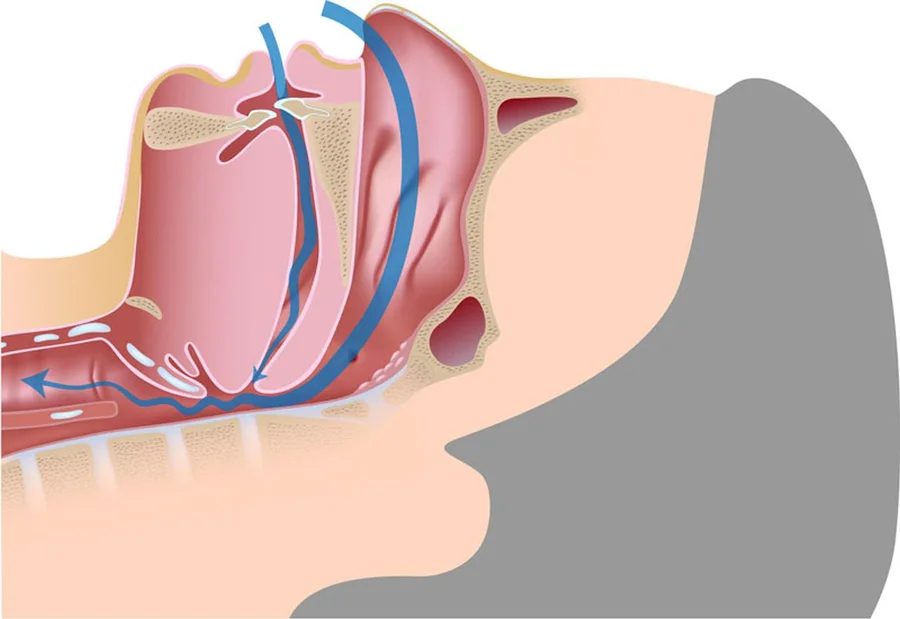
Try it out: the narrowing in the airway
unchanged
Narrow the airway with the slider. In the narrowing, the air flows faster and the pressure there drops. In the throat, this negative pressure pulls the soft walls further inwards until they begin to flutter.
This is how the snoring sound arises. When it gets narrow, the air flows faster, the pressure falls, and the soft palate, uvula and throat wall start to flutter. During the day, the muscles keep the airway open even when it is narrow. Measurements on the tongue muscle show how much work this can take. During sleep, this baseline tension decreases and the compensation falls away.
of its maximum activity was reached by the baseline activity of the genioglossus in eleven awake people with sleep apnoea3
was the figure in fourteen control subjects of the same age, in the same study3
What keeps the airway open at night is not a single muscle. It is a pattern.The tongue, soft palate, throat wall and hyoid bone work together in time with breathing. Whether this rhythm is right becomes apparent during sleep.
3D film
One breath during sleep
In just under 30 seconds, the animation shows one calm breath in a side view cross-section, lying on the back and with the FaceFormer in the oral vestibule.
Causes
Snoring causes: why the tissue gives way
Slack tissue in the mouth and throat is regarded as the cause of snoring and sleep apnoea. That describes what happens. It does not explain why.
In our view, slack tissue in the throat is not the starting point but the result. Muscles that are no longer involved in their actual function are hardly used and lose their tension. We speak of functional hypotonia, a loss of baseline tension due to non-use and maladaptation. When awake, this can still be compensated for. During sleep, when voluntary control falls away, the pattern takes over.
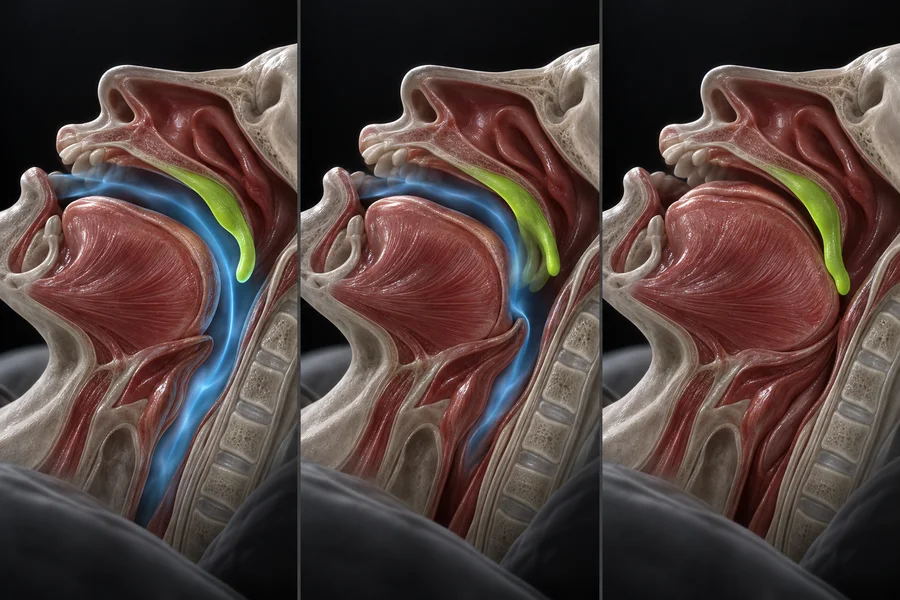
The slackness is the symptom, not the cause.A muscle’s tension is not a fixed characteristic of the tissue. It is the result of how it is used day after day.
The mouth stays open
It often begins in childhood, with a dummy, infections or a blocked nose. Mouth breathing becomes a habit.
The tongue drops
Without lip closure, the negative pressure that holds the tongue against the palate is missing. It lies low in the lower jaw, and the tongue reference position is lost.
The muscles are hardly used
The tongue, soft palate and throat wall are no longer properly involved in breathing and swallowing. Their tension decreases.
Head balance compensates
In our view, the head moves forwards to keep the airway open. The pattern of breathing, swallowing and head balance shifts as a whole.
During sleep, the airway gives way
Without voluntary control, the throat narrows. The tissue flutters, which is snoring, or it collapses, which causes breathing pauses.
Other factors increase this tendency. Alcohol and sleeping pills further reduce muscle tension. When you lie on your back, gravity pulls the base of the tongue backwards, and body weight narrows the space. This explains why one night is louder than another. In our view, however, it does not usually explain why the airway has so little tension in the first place.
Mouth breathing at night
Mouth breathing at night: the path that narrows the throat
Healthy people breathe almost exclusively through the nose during sleep. There is a mechanical reason for this.
A research group in Canada tested this in twelve healthy adults. While awake, upper airway resistance was similar with nasal breathing and mouth breathing. During sleep, this changed markedly as soon as the participants breathed through the mouth.
Upper airway resistance during sleep with mouth breathing, as a median value4
Resistance with nasal breathing, in the same people4
Breathing pauses and hypopnoeas with mouth breathing compared with nasal breathing, measured in healthy people4
In our view, the reason lies in how the parts interact. When the mouth is open, there is no negative pressure in the oral cavity. The tongue loses its hold on the palate and sinks backwards.
The muscles themselves also switch. In the palatoglossus, which connects the back of the tongue and the soft palate, only 35 instead of 92 motor units were firing during mouth breathing5. This was measured while awake.
How do you wake up in the morning?
The triad
A stable airway is a pattern
Snoring and sleep apnoea are part of breathing. In our view, however, whether the airway stays stable during sleep depends on how all three basic functions work together.
Breathing
With closed lips and nasal breathing, slight negative pressure builds up in the oral cavity. It holds the tongue against the palate and supports the throat. The airflow through the nose also continuously signals the breathing rhythm to the nervous system.
Swallowing
Several hundred to a thousand times a day, the tongue presses against the palate when you swallow, including during sleep. Each swallow links the tongue, soft palate, throat and hyoid bone in a single sequence. Its starting point is the tongue reference position.
Head balance
The position of the head changes the width of the throat. Under anaesthesia, the airway collapsed markedly more easily with the head bent forward than in a neutral position, and markedly less easily with the head extended.6.
In our view, the cause of snoring and obstructive sleep apnoea therefore does not usually lie in a single tissue but in the pattern. Mouth breathing, a low tongue position during swallowing and a forward head posture cause and reinforce one another. This triadic functional circuit stands at the start of many causal chains that can lead to snoring, breathing pauses and daytime tiredness. In some children and adults, a frenulum that is too short holds the tongue down. Why the cut and the training then belong together is explained in the article Tongue tie and frenotomy.
Like a tent in the wind
A tent does not stand because the canvas is rigid, but because poles and guy lines pull it taut in all directions. If one line slackens, the canvas starts to flutter in the wind, and a gust makes it collapse. This is roughly how we see the throat. Together, the tongue, hyoid bone, soft palate and head balance keep it open.
CPAP
CPAP: an effective support, not a treatment of the cause
In obstructive sleep apnoea, positive airway pressure therapy is the standard treatment. It is worth understanding what it does and what it does not do.
CPAP stands for continuous positive airway pressure. A device delivers air at slight positive pressure through a tube and mask into the nose or mouth. The pressure holds the throat open from the inside so that it cannot collapse.
In 1981, the Australian physician Colin Sullivan described the principle in five patients as a pneumatic splint, a splint made of air7. Masks are available for the nose, for the nose and mouth, or as cushions placed directly at the nostrils.
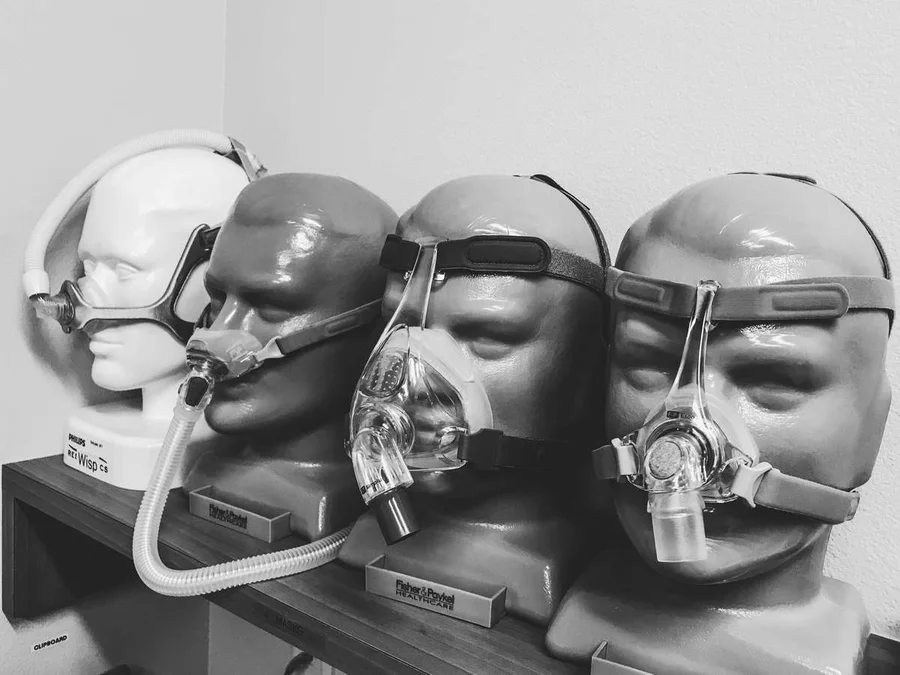
Pressure applied from outside has little in common with natural nasal breathing, but it works as long as the device is running. Breathing pauses do not occur, and many people are more alert during the day. A large review examined whether positive airway pressure therapy also protects the heart and circulation.
randomised, nine of them with CPAP, with a total of 7,266 people with sleep apnoea, analysed in 20178
Like a crutch
A crutch takes work off the leg. As long as the leg cannot bear weight, it is a real help. But the leg does not learn to walk with it, and if you never load the leg again, you will never get rid of the crutch. This is how we see CPAP. The pressure takes over from outside the work that the tongue, soft palate and throat wall would have to do themselves. The pattern that lets the airway give way at night remains, and that is why the device is often needed for many years.
In our view, anyone who relies on the device alone keeps the underlying problem and settles in with the crutch. The mask and device are regularly checked, adjusted and replaced, and the effort remains. In severe sleep apnoea, CPAP is an effective acute aid. In our view, however, the goal is for the airway to remain stable again under its own power and for the device to be able to become unnecessary over time.
Many people leave the sleep laboratory with a number: the apnoea-hypopnoea index, or AHI for short. It counts breathing pauses and hypopnoeas per hour of sleep. This is useful, but it shows only part of the picture. On its own, it does not tell you how far oxygen levels drop or how often sleep is disrupted. Don’t let a test result frighten you. Breathing pauses have a cause, and in our view a high value is above all a reason to start working on that cause now.
If you use a CPAP device, do not stop using it on your own. You can start training the basic functions alongside it. Whether positive airway pressure therapy can later be reduced or discontinued will be shown by a follow-up measurement in the sleep laboratory, and you make this decision together with your sleep medicine specialist.
Anti-snoring splint and other aids
Anti-snoring splint, surgery, pacemaker: what aids can do
The mandibular advancement splint, or anti-snoring splint for short, consists of two trays for the upper and lower jaw, connected by bars. It holds the lower jaw forward during sleep. Because the tongue is attached to the lower jaw, the base of the tongue follows, and the space behind it widens.
In our view, the splint acts like an orthosis. It does not guide the jaw, it holds it from the outside, and it trains neither lip closure nor nasal breathing nor swallowing. Night after night, for hours, it changes the position of the lower jaw, jaw joint and teeth. In long-term wearers, overbite and overjet shifted slightly but measurably, the more so the longer the splint was worn12. In our view, a symptom is thus replaced by another adaptation, while the function behind it remains unchanged.
Operations
In our view, a procedure on the soft palate, uvula or throat tissue only comes into question once the function has been trained and the finding remains. It changes the shape, not the pattern that made the tissue slack, which is why complaints can return. It is not without consequences. After operations on the soft palate and uvula, about half had persistent side effects in a review, above all difficulty swallowing, a lump sensation in the throat and an altered voice. For laser and radiofrequency procedures, it found no evidence of effect13.
Tongue pacemaker
An implant stimulates the tongue nerve during inhalation, pulling the base of the tongue forward. In a study with 126 people, breathing pauses decreased significantly. When the device was switched off, they increased again9. The impulse replaces the muscle control; it does not build it up.
Taping the mouth shut
Mouth tape is not something we recommend. It holds the lips together mechanically, and the pattern stays the same. A review of ten studies sees a potentially serious risk, especially when the nose is blocked10.
Splints, masks and nasal sprays are prescribed or fitted by a doctor. Do not stop using them on your own initiative. You do not wear the splint and the FaceFormer in your mouth at the same time. Whether the FaceFormer takes the place of the splint at night is something to discuss with the practice that fitted it.
Training
Snoring exercises: training the pattern
The idea that training can change the airway during sleep has been accepted in sleep medicine. In 2015, a review from Stanford summarised nine studies with 120 adults who did exercises for the mouth, tongue and throat. The number of breathing pauses and hypopnoeas per hour fell on average from 24.5 to 12.3, and snoring also decreased11. These were different programmes from FaceFormer training, and the figures cannot be transferred.
Our approach does not train individual muscles, but breathing, swallowing and head balance together in one sequence. A breathing pattern is not a resolution but a stored sequence, and it changes through repetition, during the day and in sleep.
In FaceFormer training, the FaceFormer sits in the oral vestibule, behind the lips and in front of the teeth. The tip of your tongue rests on the small ridge behind your upper front teeth, you breathe through your nose, and your head is balanced upright.
In the basic exercise, you press the lip wedge together with your lips, bite down briefly with your back teeth and swallow once. The negative pressure draws the tongue up to the palate, and the mouth is sealed. In the pull exercise, you also pull the lip wedge forward, only as firmly as your lips can hold it.
From around week 6, the breathing exercise is added. You breathe in through your nose for about six seconds, briefly hold your breath, bite down and swallow, and then breathe out for six seconds. You extend the pause in breathing afterwards in small steps, only as far as feels comfortable. In this way, calm nasal breathing becomes the norm, during the day and at night.
- From day 1
Basic exercise
A few minutes three times a day with the FaceFormer ZERO; you increase the repetitions week by week.
- From around week 3
Pull exercise and night
The pull exercise is added. At night, you wear the FaceFormer ZERO once the basic exercise is established. If it slips out during sleep at first, that is normal. Getting used to it takes anywhere from one night to four to six weeks.
- After a few weeks
Switching to the ONE
During the day, you train with the FaceFormer ONE. It is the same size and shape as the ZERO, just made of firmer material.
- From around week 6
Breathing exercise
The breathing exercise combines the training with calm nasal breathing and breathing pauses that become longer over time.
- Over months
The pattern runs by itself
The exercise manual allows six to twelve months until the new sequences run without thinking.
At night, the FaceFormer is part of the training, not a snoring stopper. The core is practising during the day. If you wear a CPAP mask or a splint at night, coordinate your night-time use with your treating practice. The free FaceFormer app guides you through the basic exercises, and you can find all modules on the exercise pages. A separate exercise plan applies to children; more under FaceFormer for children.
Everyday life
Breathing more calmly in sleep: what you can do in everyday life
Lips closed, nose open
Your lips rest loosely together, and the tip of your tongue sits at the reference point behind your upper front teeth. This keeps the mouth sealed, and the air takes the route through the nose, even as you fall asleep.
Don’t bend your head
A pillow that is too high bends the head forward and narrows the throat. Find a position in which your head lies in line with your spine.
Little alcohol in the evening
Alcohol and sleeping pills further reduce the tension of the throat muscles. Avoiding them in the evening takes a burden off the airway.
No mouth tape
We do not recommend sealing the mouth with tape. Lip closure should come from the pattern, not from adhesive tape.
Measurement as a comparison
A measurement in a sleep laboratory shows you where you stand. A follow-up measurement after a few months of training shows you what has changed.
Questions
Frequently asked
What is the difference between snoring and sleep apnoea?
In snoring, the airway narrows during sleep, but air keeps flowing and soft tissue starts to flutter. In obstructive sleep apnoea, the throat repeatedly closes completely or almost completely, and breathing stops for at least ten seconds. Measurements show that both lie on the same continuum. What matters is how easily the throat gives way during sleep.
Is snoring dangerous?
Occasional snoring, for example when you have a cold, is considered a normal variant. Loud, regular snoring shows that the airway becomes narrow during sleep. If observed pauses in breathing and severe daytime tiredness are added to this, a measurement in a sleep laboratory will provide clarity. It also serves as the baseline against which you can later track changes.
What causes snoring?
The immediate cause of snoring is that tissue in the throat has little tension during sleep and the airway becomes narrow. Alcohol, sleeping on your back and body weight make this worse. In our view, the slackness itself is, as a rule, the result of a pattern of mouth breathing, a low-lying tongue and a forward-shifted head balance.
Why do I snore mainly when lying on my back?
When you lie on your back, the base of the tongue and the soft palate sink backwards with gravity and narrow the throat. If the tongue already lies low, this has a particularly strong effect. When you lie on your side, the airway is often clearer. However, your sleeping position does not change the pattern that lets the throat give way.
Do exercises help with snoring?
Exercises for the mouth, tongue and throat have been examined in studies, with, on average, fewer breathing pauses and less snoring. FaceFormer training practises breathing, swallowing and head balance together in one sequence. It aims to restore the basic functions to a physiological setting, thereby creating the conditions for the airway to become more stable during sleep.
Do I have to use CPAP for the rest of my life?
CPAP keeps the airway open as long as the device is running. It does not change the cause, which is why it is often needed for many years. Our goal is for the airway to remain stable again under its own power. The daytime training can be started in parallel. Whether positive pressure ventilation can be reduced is shown by a follow-up measurement, and you make the decision with your sleep medicine team.
Can the FaceFormer become dangerous at night if I have sleep apnoea?
The FaceFormer itself poses no risk of choking. It sits in the oral vestibule in front of the teeth, can be pushed out with the tongue or lips at any time, and often falls out by itself when you move in your sleep, especially at the beginning. If it is still in place in the morning, this indicates that you breathed mainly through your nose during the night. If you have obstructive sleep apnoea, use it only alongside medical treatment, not as a substitute for it.
Can I wear the FaceFormer at night in addition to a CPAP nasal mask?
With a pure nasal mask this is technically possible, because the FaceFormer lies in the oral vestibule and does not touch the mask’s airway. Whether the combination makes sense in your case and whether anything about the device’s settings can be changed is something you decide together with your sleep medicine team.
Does an anti-snoring splint help?
A mandibular advancement splint holds the lower jaw forward, the base of the tongue follows, and the throat becomes wider. This can reduce snoring and pauses in breathing as long as the splint is worn. It does not train lip closure, nasal breathing or swallowing, and in long-term wearers it measurably shifts the position of the teeth. In our view, it is therefore a support, not a treatment of the cause.
Does it make sense to tape your mouth shut at night?
We do not recommend taping your mouth shut, also known as mouth taping. The tape holds the lips together mechanically, while the pattern of tongue, swallowing and breathing stays the same. A review also identifies a potentially serious risk, especially if the nose is blocked. Mouth closure should arise from the pattern itself.
FaceFormer or CPAP mask: do I have to choose?
No, it is not an either-or. The CPAP mask keeps the airway open during sleep with positive pressure. It works as long as it is worn, but it does not change the cause. FaceFormer training starts earlier: with the tongue reference position, lip closure, nasal breathing and swallowing sequence, that is, with the muscles that are supposed to keep the airway open during sleep. A high value in the sleep laboratory is therefore a good reason to start training now. Have your progress checked in the sleep laboratory after a few months and decide with your sleep medicine team whether the therapy can be adjusted.
More articles from the knowledge section
Experiences on this topic
Where to go next

Sources
- Gleadhill IC, Schwartz AR, Schubert N, Wise RA, Permutt S, Smith PL (1991). Upper airway collapsibility in snorers and in patients with obstructive hypopnea and apnea. American Review of Respiratory Disease 143(6):1300-1303. PMID 2048817. Source
- Benjafield AV, Ayas NT, Eastwood PR et al. (2019). Estimation of the global prevalence and burden of obstructive sleep apnoea: a literature-based analysis. The Lancet Respiratory Medicine 7(8):687-698. PMID 31300334. Source
- Mezzanotte WS, Tangel DJ, White DP (1992). Waking genioglossal electromyogram in sleep apnea patients versus normal controls (a neuromuscular compensatory mechanism). Journal of Clinical Investigation 89(5):1571-1579. PMID 1569196. Source
- Fitzpatrick MF, McLean H, Urton AM, Tan A, O’Donnell D, Driver HS (2003). Effect of nasal or oral breathing route on upper airway resistance during sleep. European Respiratory Journal 22(5):827-832. PMID 14621092. Source
- Jordan AS, Woods MJ, Cori JM, Chan JKM, Nicholas CL, Semmler J, Trinder J (2024). Motor control of the palatoglossus and genioglossus during changes in breathing route. Journal of Applied Physiology 137(5):1409-1417. PMID 39323393. Source
- Walsh JH, Maddison KJ, Platt PR, Hillman DR, Eastwood PR (2008). Influence of head extension, flexion, and rotation on collapsibility of the passive upper airway. Sleep 31(10):1440-1447. PMID 18853942. Source
- Sullivan CE, Issa FG, Berthon-Jones M, Eves L (1981). Reversal of obstructive sleep apnoea by continuous positive airway pressure applied through the nares. The Lancet 1(8225):862-865. PMID 6112294. Source
- Yu J, Zhou Z, McEvoy RD, Anderson CS, Rodgers A, Perkovic V, Neal B (2017). Association of Positive Airway Pressure With Cardiovascular Events and Death in Adults With Sleep Apnea: A Systematic Review and Meta-analysis. JAMA 318(2):156-166. PMID 28697252. Source
- Strollo PJ Jr, Soose RJ, Maurer JT et al., STAR Trial Group (2014). Upper-airway stimulation for obstructive sleep apnea. New England Journal of Medicine 370(2):139-149. PMID 24401051. Source
- Rhee J, Iansavitchene A, Mannala S, Graham ME, Rotenberg B (2025). Breaking social media fads and uncovering the safety and efficacy of mouth taping in patients with mouth breathing, sleep disordered breathing, or obstructive sleep apnea: A systematic review. PLoS One 20(5):e0323643. PMID 40397877. Source
- Camacho M, Certal V, Abdullatif J, Zaghi S, Ruoff CM, Capasso R, Kushida CA (2015). Myofunctional Therapy to Treat Obstructive Sleep Apnea: A Systematic Review and Meta-analysis. Sleep 38(5):669-675. PMID 25348130. Source
- Patel S, Rinchuse D, Zullo T, Wadhwa R (2019). Long-term dental and skeletal effects of mandibular advancement devices in adults with obstructive sleep apnoea: A systematic review. International Orthodontics 17(1):3-11. PMID 30770329. Source
- Franklin KA, Anttila H, Axelsson S, Gislason T, Maasilta P, Myhre KI, Rehnqvist N (2009). Effects and side-effects of surgery for snoring and obstructive sleep apnea: a systematic review. Sleep 32(1):27-36. PMID 19189776. Source
Get started
Ready for the training?
The free FaceFormer app guides you through the basic exercises, counts along and reminds you of your sessions. If you wish, a practice from the practitioner directory can support you.

FaceFormer ZERO + ONE
Both material hardnesses for getting started, day and night. The set for adults.

FaceFormer ZERO
The softer FaceFormer for getting started, for children and for the night.

FaceFormer ZERO Children’s Set
ZERO with hygiene box, plush bag and success book with stamp.
FaceFormer training aims to restore the physiological setting of the basic functions of breathing, swallowing and head balance, with lip closure and the tongue reference position, thereby creating the conditions under which symptoms can improve. It does not replace a medical assessment. You can find practitioners near you in the practitioner directory.


