
Expert article: jaw
Teeth grinding and clenchingWhy the jaw works at night
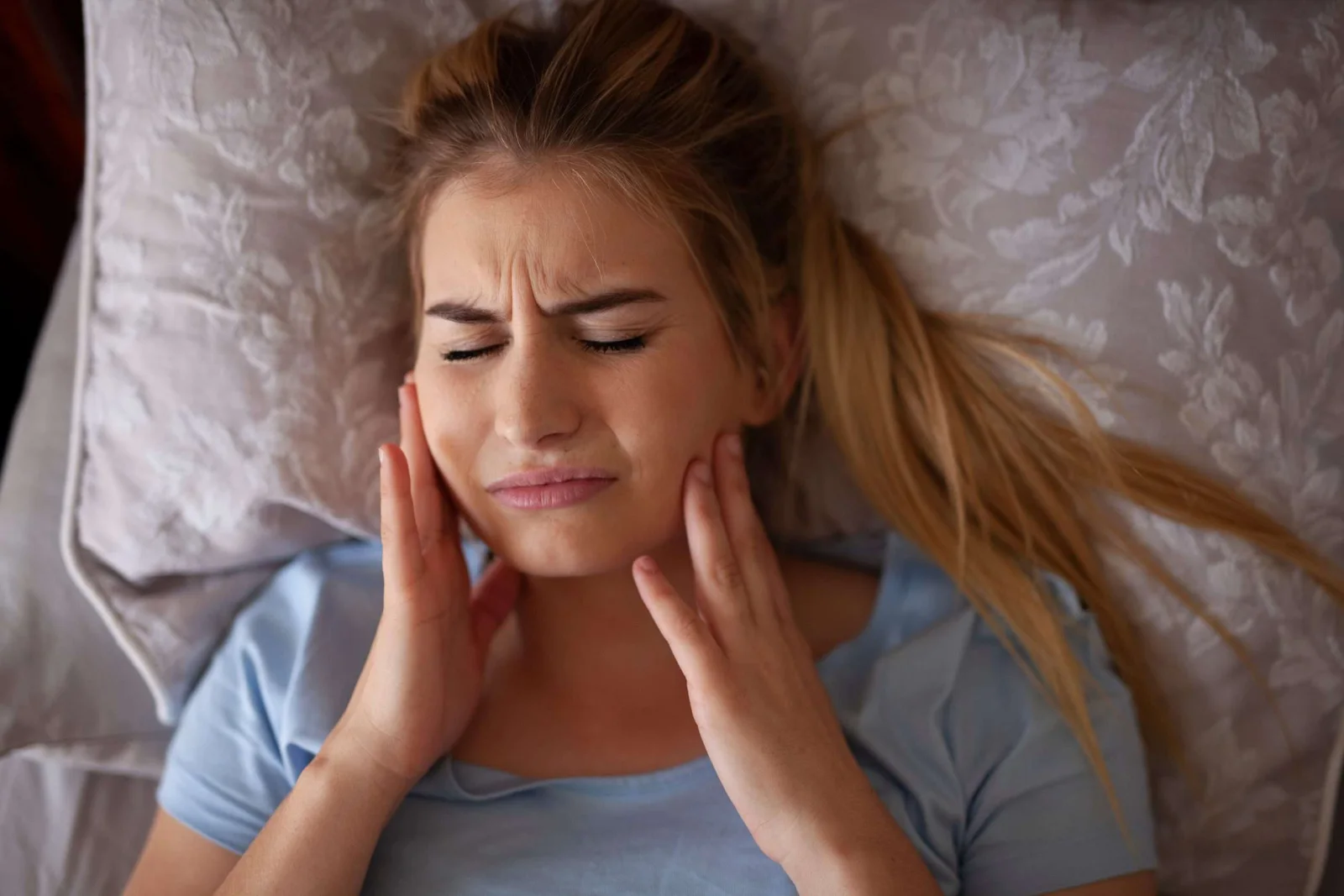
In the morning your jaw is tired, your temples ache, and your dentist shows you worn edges. Here you will find out what is behind bruxism, why, in our view, stress and bite do not explain it, what the night guard does and how you can train the pattern yourself.
Does this sound familiar?
Do you grind or clench?
What applies to you?
Tap whatever applies to you.
If two or more points apply, this can be a sign that your chewing muscles are working more than they need to. In our view, this is usually not a problem of the teeth but one of the control that guides the lower jaw.
Where the grinding comes fromWhat the splint doesThe key points at a glance
- Bruxism is the clenching or grinding of the teeth during sleep or while awake. In otherwise healthy people, experts now describe it as a behaviour, not as a disease in its own right. In our view, stress and an ill-fitting bite do not explain it.
- We see grinding as the nervous system’s attempt to compensate for faulty control that arises during the day in breathing, swallowing and head balance. At night, it is closely linked to breathing.
- The night guard protects the tooth substance; in our view, it does not change the pattern. The pattern can be changed through training: teeth apart at rest, lips closed, tongue against the palate, breathing through the nose. How far this succeeds depends on how long the pattern has existed and on your consistency.
Video
Teeth grinding: cause and therapy, and why the splint does not change the pattern
Das Video lädt erst nach dem Klick. Dann werden Daten an YouTube (Google) übertragen.
Term
What is bruxism?
Bruxism is the technical term for work by the chewing muscles that has nothing to do with chewing. The teeth are pressed together or shifted against each other, or the lower jaw is held tense.
On TV: “JENKE. Experiment. Schlaflos” (ProSieben, 8 October 2026) is about poor sleep and its consequences. The FaceFormer can also be seen in the programme, in connection with sleep and posture. Watch the programme free of charge on Joyn
Sleep bruxism
The chewing muscles work rhythmically during sleep, sometimes with audible grinding. Those affected often learn about it from others or from traces on their teeth.
Awake bruxism
During the day, it is more clenching than grinding, often during concentration, at the screen, while driving or during sport. Many only notice it when they consciously pay attention to it.
Holding without tooth contact
A lower jaw held tense or pushed forward also counts, even if the teeth do not touch.
In 2018, an international expert group stated that bruxism in otherwise healthy people is not considered a disease, but a behaviour that can become a risk factor for consequences1. That is an important sentence. A behaviour has a control, and a control can be trained.
of adults in population studies reported clenching or grinding while awake, around 13 per cent reported frequent grinding during sleep. The figures are based on self-reports2
Signs
How you notice teeth grinding
Many people grind for years without knowing it. The traces show on the teeth, in the muscles and in the morning.
Worn teeth
Flat, shiny edges, exposed tooth necks, sensitive teeth or breaking fillings.
Tired chewing muscles
In the morning your cheeks feel hard, and chewing tires you more quickly.
Temples and head
Pressure at the temples or a headache after waking up. The temporalis muscle is a chewing muscle.
Jaw joint
Clicking, grating or pain in front of the ear; more on this in the article on TMD.
Neck and ear
Tension in the neck, pressure on the ear, sometimes a noise in the ear.
Cheeks and tongue
Tooth impressions on the edge of the tongue or a white line on the inside of the cheek.
Observing yourself is harder than it sounds. In a study from Medellín, parents’ reports of their children’s night-time grinding agreed only moderately with a measurement in the sleep laboratory. A diary kept over several days was more accurate than a single question, but neither was reliable3. So do not just ask once; observe over one or two weeks.
Causes
Stress and bite: why the usual explanations fall short
You hear two explanations almost everywhere. Both sound plausible; in our view, both fall short.
The usual explanation
- Grinding comes from stress.
- The bite does not fit, and the teeth are looking for their position.
- So: reduce stress, grind in the teeth, splint.
What speaks against it
- Many people under a lot of stress do not grind their teeth. Stress amplifies; it hits the spot that is already under strain.
- Artificial interfering contacts on the teeth did not make healthy people clench more, but rather less.
- If you only address stress and the teeth, the control of the lower jaw remains unchanged.
In our view, stress is usually an amplifier and rarely the sole cause. It explains why symptoms appear right now.
Behind this is a basic principle. The lower jaw is guided by the muscles, not by the teeth. It hangs in the chewing muscles, the floor-of-mouth muscles and the tongue, and the teeth touch only briefly during swallowing and chewing. Many people with gaps between their teeth or crooked teeth have no jaw problems at all. If the bite were the trigger, it would have to be the other way round.
A research group in Naples examined the bite in a small study. For eight days, they glued a thin gold foil as an interfering contact onto a contact surface of the teeth of eleven healthy women. The everyday activity of the masseter muscle did not increase afterwards but decreased, and none of the women developed jaw problems4. The conclusion is obvious: one cusp too many does not simply turn a person into a grinder.
We also view the label “inherited” critically. Grinding occurs more frequently in families11. But families do not only pass on genes; they also pass on patterns such as mouth breathing, swallowing habits and the dummy. In many cases, we consider it a fallacy to conclude from a family cluster that this is an unchangeable fate.
In sleep
What happens in the jaw at night: grinding is linked to breathing
Sleep bruxism does not come out of nowhere. Measurements in the sleep laboratory show a fixed sequence, and breathing is part of it.
The brain briefly wakes up
Before most grinding episodes, the brainwave recording shows a brief arousal reaction that you do not notice yourself5.
The heart speeds up
One heartbeat before the chewing muscles start working, the pulse rises.
Breathing deepens
Seconds beforehand, the breaths become larger, as part of the arousal reaction. Breathing is deepest during the grinding episode6.
The chewing muscles work
First the muscles under the chin tense, then the rhythmic work of the chewing muscles begins. The lower jaw is moved and pressed.
A group in Montréal measured in 20 people with sleep bruxism without a breathing disorder that breathing depth increases as early as four seconds before grinding, markedly just before it and most strongly during it6. The muscles that kick in first are the floor-of-mouth muscles, i.e. those that hold the hyoid bone and the tongue. The measurement shows a close temporal link, not proof of a cause. For us, it is nevertheless a strong indication that night-time grinding is connected with the regulation of the airways during sleep.
As long as the functional disorder exists, the grinding has a purpose. The splint does not take away its purpose, only its surface.Paraphrased from Dr. Klaus Berndsen, “Trust the Triad”. For this reason, we work on function and not on the teeth.
Dr. Berndsen describes grinding as compensation. If you live during the day with a low-lying tongue, an open mouth or a forward head, you let your chewing muscles take on tasks they are not built for. At night, the nervous system tries to sort out this tension, and this shows up as clenching and grinding. If you snore or someone notices pauses in your breathing, also read the article on snoring and sleep apnoea.
The triad
Breathing, swallowing, head balance: why the chewing muscles help hold
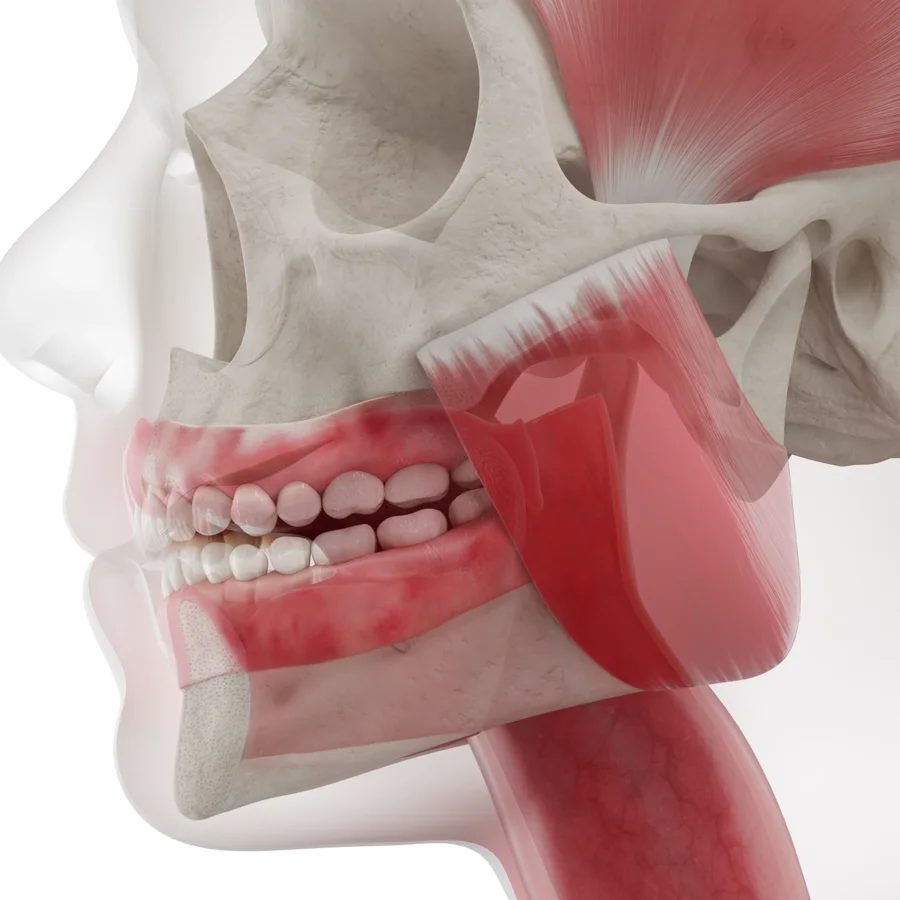
The masseter and temporalis are strong muscles. In our view, whether they come to rest is usually decided not by the bite but by the organisation of breathing, swallowing and head balance.
At rest, the teeth do not touch. The lips are closed, the tongue lies broadly against the palate, and the rows of teeth hover a small distance apart. Contact only occurs briefly during swallowing and chewing. In this hovering position, the chewing muscles manage with the least effort.
If the tongue’s support against the palate is missing, the masseter and temporalis muscles take on holding tasks. They are then under a baseline tension that has nothing to do with chewing.
Breathing
According to our model: if you breathe through your mouth, you lose the relaxed lip closure. The muscles around the mouth and cheeks work less, the lateral guidance of the lower jaw becomes weaker, and the tongue sinks down.
Swallowing
You swallow many hundreds to a thousand times a day. If the tongue pushes forward or the lips and chin press along, the chewing muscles practise more tooth contact and more tension with many swallows.
Head balance
If the head sits in front of the body, for example at the screen, the position of the hyoid bone changes. Via the floor-of-mouth muscles, this pulls on the lower jaw, and the chewing muscles hold against it.
Try the test: place your fingertips on your cheeks, where the masseter muscle sits. Where are your teeth right now?
Simply placing the tongue against the palate consciously is not enough. Tongue reference position, swallowing, breathing and head balance are connected as one control pattern, and a single element can hardly be changed on its own. More on the position of the tongue can be found in the article on the tongue reference position.
Splint
The night guard: what it protects and what it does not
The occlusal splint is the most common response to teeth grinding. It has a clear benefit and clear limits.
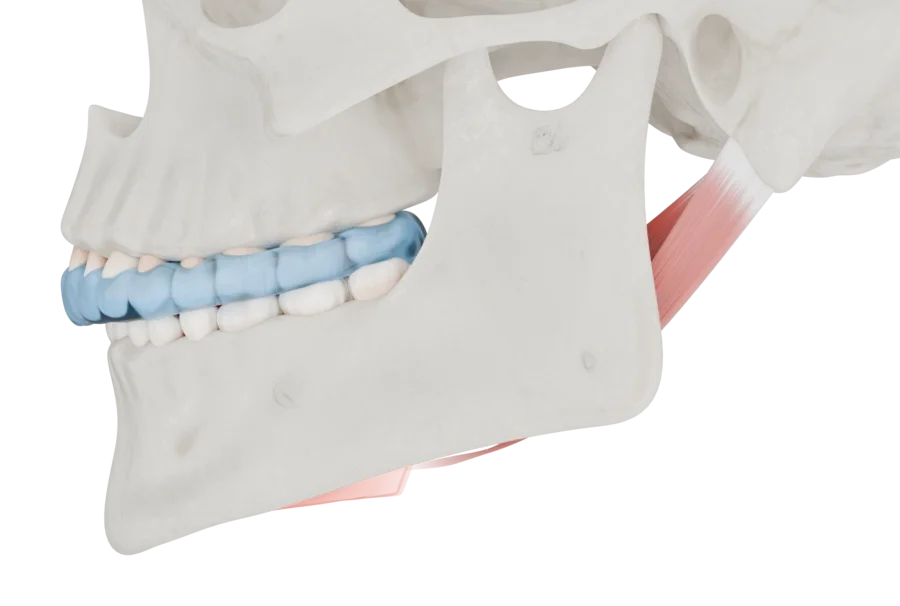
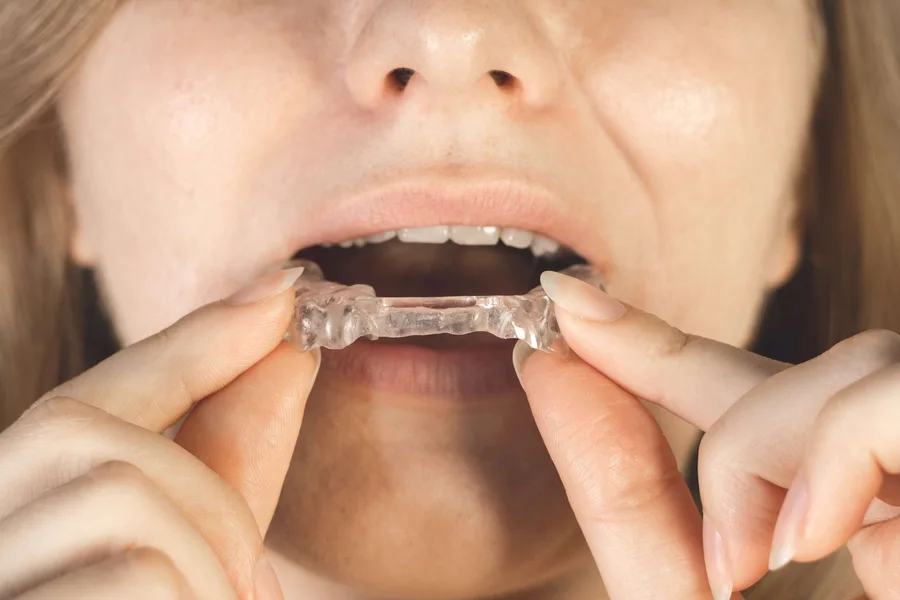
The benefit is simple. Instead of tooth rubbing on tooth, tooth rubs on plastic, and the tooth substance is spared. With severe wear, that is of real value. Dr. Berndsen points out that the worn-off plastic is swallowed in the process, and the splint wears down until the next one is due.
The limit is just as simple. The splint lies between the rows of teeth, exactly where nothing should be at rest. It creates tooth contact where none belongs at rest, removes the hovering position and gives the chewing muscles a surface to work against. In our view, it can thereby rather trigger the muscles and intensify the imbalance. Dr. Berndsen puts it like this: the splint does not adapt to the body; the body adapts to the splint.
were found by a 2007 Cochrane review on splints for sleep bruxism. The evidence was not sufficient for an effect on grinding during sleep; a benefit for tooth wear was possible7
was the length of a measurement with two types of splint in 16 grinders. Both, one of them without tooth coverage, lowered muscle activity immediately after insertion. After two, four and six weeks, no reduction compared with the baseline was measurable any more8
showed measurably higher chewing muscle activity at night with a soft splint than without one. A hard splint reduced activity in eight out of ten. A small study from 19879
To be honest: in measurements, hard splints often reduce night-time muscle activity, at least at first. That is exactly what explains the initial relief. The fact that the effect wears off after a few weeks fits our view that the control behind it remains unchanged.
Like a crutch
If you break your leg, you use crutches for a while. They relieve the load, but the bone has to heal by itself. That is how we see the splint: it can protect the teeth and provide relief at first, because the cramped muscles are stretched. In our experience, this is often followed by a relapse, the next splint, grinding-in of the teeth, and in retrospect people say “well, it helped”. It has its place as symptom relief. It is too often sold as a treatment of the cause, because it does not reach the control that produces the grinding.
One more thing is important for training. The hovering position that is supposed to develop needs space at night. A splint occupies exactly this space. That is why our aim is to reduce the splint gradually as soon as the function holds.
If you wear a prescribed splint, do not stop wearing it on your own initiative. You do not wear the splint and the FaceFormer in your mouth at the same time. Whether and from when you train at night with the ZERO and pause the splint for this, you discuss with your dental practice.
In context
Botox, relaxation, grinding-in: relieving the symptom or changing the pattern
Besides the splint, other approaches are offered. The question is the same for all of them: do they change what produces the grinding?
Botox in the chewing muscles
The nerve toxin partially paralyses a muscle. But the masseter works in a functional system with the tongue, swallowing and head balance. If it is weakened, the brain learns an altered pattern through many chewing movements, and in our view the cause continues. We view this very critically.
Grinding in the teeth
Healthy tooth substance is irretrievably lost so that the teeth fit together better. If the bite does not explain the grinding, grinding in the teeth does not resolve it either.
Relaxation and stress reduction
Does you good and lowers the load that hits a weak spot. The weak spot itself, the pattern in the mouth, remains.
Training the function
Addresses the control: breathing, swallowing and head balance are practised in one sequence, with the aim that the hovering position runs by itself. This takes time and consistency.
If you have learned to play tennis the wrong way, you will not learn the right stroke from a bandage.Paraphrased from Dr. Berndsen. A movement pattern is replaced by a new one, and that happens through practice until it runs automatically.
Training
Training against teeth grinding: reorganising the pattern
There is no special exercise for grinding. The training follows the same structure as for the other areas of application, because it addresses the common cause.
Teeth grinding and clenching are among the areas of application named in the FaceFormer’s exercise instructions. In the basic exercise, the lips press the lip wedge, the tip of the tongue lies at the reference point, the molars bite down briefly, and you swallow.
Then the teeth release again. This very alternation is the core: brief contact during the swallow, then the hovering position. This is how the nervous system learns when the teeth belong together and when they do not.
- From day 1
Basic exercise
Three times a day with the FaceFormer ZERO. The repetitions increase from week to week; during relaxation, the teeth do not touch.
- From around week 3
Pull exercise and night
The pull exercise is added. At night you wear the ZERO as a supplement; if you are currently using a splint, after consulting your dental practice.
- After a few weeks
Switching to the ONE
During the day you train with the ONE. It is the same size and shape as the ZERO; the only difference is the hardness of the material. At night you stay with the ZERO.
- From around week 6
Head balance
The head balance rotation connects the lips and tongue with head balance and is used to guide and stabilise the jaw joints.
- Over months
Consolidating the pattern
The exercise manual expects six to twelve months until new sequences run without thinking. You have to keep at it; it can be worth it.
with severe teeth grinding trained for eight weeks in an ISST pilot observation. Six of them reported markedly less pain after just two weeks; on average, self-assessment and partner assessment improved markedly. Poster, not peer-reviewed, self-reported without a comparison group and no proof of efficacy10
At the beginning, a feeling of pressure on the upper incisors may occur after the night, which eases in the course of the morning. If this turns into pain, pause the night-time use and continue training during the day. The free FaceFormer app guides you through the basic exercises; all modules are on the exercise pages. If you cannot make progress on your own, you can find support in the practitioner directory.
Everyday life
In everyday life: lips closed, teeth apart
Training practises the new pattern. Everyday life decides how often the old one still comes into play.
Tooth contact check
Link a frequent moment to a quick check, such as every glance at your phone: lips closed, teeth apart, tongue against the palate.
Screen and head
Position your screen so that your head balances above your body and does not drift forward. More on this in the article on neck and back.
Skip chewing gum
Constant chewing keeps the chewing muscles at work and disrupts pattern formation. The same applies to pencils, fingernails and lip chewing.
Clear nose
Breathe through your nose during sport and in the evening, too. A dry mouth in the morning suggests mouth breathing during the night.
Observe rather than guess
Keep a short diary for one or two weeks: when do you clench, how does your jaw feel in the morning, what does your partner hear?
Get things checked where necessary
If someone notices pauses in your breathing during sleep, this is a matter for sleep medicine. Brittle teeth and fillings are a matter for your dental practice.
How the jaw, ear and neck are connected is explored in more depth in the articles on tinnitus, trigeminal pain and migraine and headache.
Questions
Frequently asked
What is bruxism?
Bruxism is the clenching or grinding of the teeth, during sleep or while awake. Holding the lower jaw tense also counts. In otherwise healthy people, it is now regarded as a behaviour that can become a risk factor, not as a disease in its own right.
Where does teeth grinding come from?
In our view, usually from faulty control of breathing, swallowing and head balance. If the tongue lies low, the mouth is open or the head sits in front of the body, the chewing muscles take on holding tasks. At night, the nervous system tries to sort out this tension. Stress intensifies this, but in our view it is rarely the sole cause.
Is teeth grinding caused by stress?
In our view, stress is usually an amplifier and rarely the sole cause. Many people under a lot of stress do not grind their teeth. Stress hits the spot that is already under strain, and in people who grind, that is the control of the jaw, tongue and breathing.
Does a night guard help?
It protects the teeth from wear; that is its benefit. A Cochrane review found insufficient evidence that it reduces grinding during sleep, and in one measurement over six weeks its effect on muscle activity quickly wore off. In our view, it does not change the pattern.
Can I combine the FaceFormer with a night guard?
During the day you can train without restriction. You do not wear the splint and the FaceFormer in your mouth at the same time. Whether and from when you train at night with the ZERO and pause the splint for this, you discuss with your dental practice.
Should the teeth touch at rest?
No. At rest, the lips are closed, the tongue lies against the palate, and the rows of teeth hover a small distance apart. Contact only occurs briefly during swallowing and chewing.
Does Botox make sense for teeth grinding?
We view this very critically. Botox partially paralyses a muscle that works in a functional system with the tongue, swallowing and head balance. The brain learns an altered chewing pattern, and the cause of the grinding remains.
How long does it take for something to change in the grinding?
That depends on how long the pattern has existed, how consistently you train and whether you still wear a splint at night. The exercise manual expects six to twelve months until new sequences run by themselves. A result cannot be promised.
My child grinds their teeth at night. Is that bad?
Grinding is common in the milk teeth and on its own is no cause for concern. But pay attention to whether your child breathes through the mouth, snores or sleeps restlessly, because grinding is closely linked to breathing during sleep. More on children can be found on the page FaceFormer for children.
More articles from the knowledge section
Where to go next

Sources
- Lobbezoo F, Ahlberg J, Raphael KG et al. (2018). International consensus on the assessment of bruxism: Report of a work in progress. Journal of Oral Rehabilitation 45(11):837-844. PMID 29926505. Source
- Manfredini D, Winocur E, Guarda-Nardini L, Paesani D, Lobbezoo F (2013). Epidemiology of bruxism in adults: a systematic review of the literature. Journal of Orofacial Pain 27(2):99-110. PMID 23630682. Source
- Restrepo C, Manfredini D, Castrillon E, Svensson P, Santamaria A, Alvarez C et al. (2017). Diagnostic accuracy of the use of parental-reported sleep bruxism in a polysomnographic study in children. International Journal of Paediatric Dentistry 27(5):318-325. PMID 27612328. Source
- Michelotti A, Farella M, Gallo LM, Veltri A, Palla S, Martina R (2005). Effect of occlusal interference on habitual activity of human masseter. Journal of Dental Research 84(7):644-648. PMID 15972594. Source
- Kato T, Rompré P, Montplaisir JY, Sessle BJ, Lavigne GJ (2001). Sleep bruxism: an oromotor activity secondary to micro-arousal. Journal of Dental Research 80(10):1940-1944. PMID 11706956. Source
- Khoury S, Rouleau GA, Rompré PH, Mayer P, Montplaisir JY, Lavigne GJ (2008). A significant increase in breathing amplitude precedes sleep bruxism. Chest 134(2):332-337. PMID 18490400. Source
- Macedo CR, Silva AB, Machado MA, Saconato H, Prado GF (2007). Occlusal splints for treating sleep bruxism (tooth grinding). Cochrane Database of Systematic Reviews 4:CD005514. PMID 17943862. Source
- Harada T, Ichiki R, Tsukiyama Y, Koyano K (2006). The effect of oral splint devices on sleep bruxism: a 6-week observation with an ambulatory electromyographic recording device. Journal of Oral Rehabilitation 33(7):482-488. PMID 16774505. Source
- Okeson JP (1987). The effects of hard and soft occlusal splints on nocturnal bruxism. Journal of the American Dental Association 114(6):788-791. PMID 3475357. Source
- Berndsen K, Berndsen S, Kopp S (2009). Bruxism: Diagnosis and new ways of functional treatment by the FaceFormer Therapy. Poster demonstration P19, DGKFO Mainz; abstract in Journal of Orofacial Orthopedics 70(5):430. Pilot observation, 12 people, without a comparison group. Source
- Khoury S, Carra MC, Huynh N, Montplaisir J, Lavigne GJ (2016). Sleep Bruxism-Tooth Grinding Prevalence, Characteristics and Familial Aggregation: A Large Cross-Sectional Survey and Polysomnographic Validation. Sleep 39(11):2049-2056. PMID 27568807. Source
Get started
Ready for the training?
The free FaceFormer app guides you through the basic exercises, counts along and reminds you of your sessions. If you wish, a practice from the practitioner directory can support you.

FaceFormer ZERO + ONE
Both material hardnesses for getting started, day and night. The set for adults.

FaceFormer ZERO
The softer FaceFormer for getting started, for children and for the night.

FaceFormer ZERO Children’s Set
ZERO with hygiene box, plush bag and success book with stamp.
FaceFormer training aims to restore the physiological setting of the basic functions of breathing, swallowing and head balance, with lip closure and the tongue reference position, thereby creating the conditions under which symptoms can improve. It does not replace a medical assessment. You can find practitioners near you in the practitioner directory.


