
Specialist article: ear
TinnitusWhat connects ear, jaw and neck
Whistling, rushing or humming in your ear? Here you can find out what tinnitus is, why the brain plays the main role, what the jaw, neck and Eustachian tube have to do with it, and why we look at breathing, swallowing and head balance.
Does this sound familiar?
A whistling in your ear, and no one but you can hear it?
What applies to you?
Tap whatever applies to you.
If several points apply, it is worth looking beyond the ear. If the noise changes via the jaw or neck, your nervous system is combining signals from the head and neck with hearing. If, on the other hand, it came on suddenly and you hear less well at the same time, have this checked by a doctor promptly first.
Came on suddenly? Here’s what to doWhen jaw and neck play a partThe key points at a glance
- Tinnitus is an ear noise without an external sound source. It is generated and maintained in the auditory pathway of the brain, not in the ear alone.
- In many people affected, the noise changes with movements of the jaw and neck, because the brainstem combines them with hearing.
- In our view, the starting point is usually a disturbed interplay of breathing, swallowing and head balance. We consider correcting it a prerequisite, because it creates the conditions under which tinnitus can improve. Behavioural therapy and hearing aids help in dealing with the noise, but they do not address the pattern. Sudden tinnitus with hearing loss should first be clarified by a doctor.
Video
Tinnitus: traces in the brain, news from neuroscience
Das Video lädt erst nach dem Klick. Dann werden Daten an YouTube (Google) übertragen.
Fundamentals
What is tinnitus? A noise without a source
Whistling in the ear, ringing, rushing, humming or buzzing: tinnitus has many tones. What they have in common is that there is no sound from outside behind them.
The word comes from the Latin tinnire, to ring. It refers to any tone for which there is no source in the surroundings. As a rule, only the person affected can hear it, and because no one can measure it, many feel they are not taken seriously. Yet tinnitus is real and can place a considerable strain on concentration and sleep.
When to see a doctor
Sudden tinnitus: get it checked first
Not every ear noise is an emergency. If it comes on suddenly, together with poorer hearing, it is urgent.
Sudden hearing loss is a sudden loss of hearing in one ear, often accompanied by tinnitus, a feeling of pressure or dizziness. The American guideline on sudden hearing loss recommends having your hearing tested as soon as possible and within 14 days at the latest. The treatment options it names start early, the first within two weeks of onset2. Whether such treatment is an option for you is decided by your doctor’s practice.
Suddenly hearing worse
From one day to the next, one ear sounds muffled or as if stuffed with cotton wool.
Pulsing with your heartbeat
A pulsating sound that follows your heartbeat.
Dizziness or neurological symptoms
Severe spinning vertigo, numbness in the face, paralysis or visual disturbances.
After a bang or an accident
Tinnitus after acoustic trauma from a bang, a head injury, or with earache and discharge.
This is a legitimate reason to have things checked, not a formality. With long-standing tinnitus without such signs, the question is a different one: no longer whether there is acute damage, but what keeps the sound going.
FaceFormer training can be combined with medical treatment and hearing aids. Do not stop anything that has been prescribed on your own; discuss any changes with your practice.
Auditory pathway
Why tinnitus arises in the brain
We hear with our ears, but it is the brain that decides what we hear.
Sound makes the eardrum vibrate. The ossicles in the middle ear transmit the vibration to the cochlea, where it is translated into electrical impulses.
The impulses travel via the auditory nerve to the brainstem and on to the auditory cortex. Only there does a pattern of impulses become a sound. Tinnitus is such a pattern, one that was not preceded by any sound.
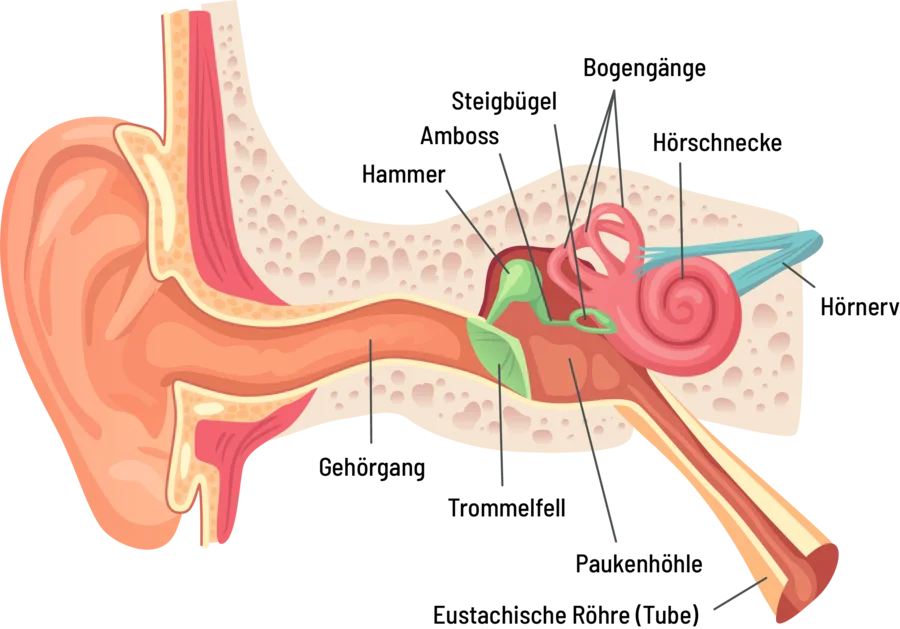
The ear often provides the trigger. The brain holds on to the tone.Tinnitus is less a defect you can see in the ear than a pattern the auditory pathway has learned.
The Tübingen ENT specialist Hans Peter Zenner described this with the model of secondarily centralised tinnitus. A trigger in the ear, such as noise, generates a signal. If it persists, the auditory pathway learns to generate the sound itself, even after the trigger has subsided3. A review of animal studies from Michigan shows where this can begin. In the auditory nucleus of the brainstem, signals from the ear are processed together with signals from the head and neck. If this balance shifts, the spontaneous activity of the nerve cells increases4.
Like a radio with a weak station
When a station becomes weak, you turn up the volume, and along with the programme the static gets louder too. The auditory pathway can react in a similar way when less or altered signal arrives from the ear. In doing so, it makes background noise audible.
Somatic tinnitus
When jaw and neck change the sound
Many people notice that their ear noise becomes louder, quieter or different when they clench their teeth or turn their head. This is no coincidence.
In 1999, the Boston ENT specialist Robert Levine described patients whose tinnitus was linked to complaints in the head or upper neck. The sound was on the same side as the problem, and hearing was the same in both ears and often normal. He explained this via the auditory nucleus in the brainstem, which, via relay stations, also receives signals from the trigeminal nerve and from the neck5. This is referred to as somatic or somatosensory tinnitus.
of 121 tinnitus patients were able to change their ear noise through targeted muscle tension6
of 100 healthy people without tinnitus heard a tone during the same manoeuvres6
involving the head, neck, arms and legs were tested in São Paulo. The head and neck had a considerably stronger effect6
Briefly clench your teeth firmly, then push your lower jaw forward, and finally press your forehead against the palm of your hand. What happens to the sound?
If muscles of the jaw and neck change the tone, the nervous system does not process hearing and body separately. In our view, the cause of long-standing tinnitus therefore does not, as a rule, lie in the ear alone, but in the pattern with which the jaw, tongue and neck work all day long.
The jaw and craniomandibular dysfunction (TMD)
Tinnitus and the jaw: neighbours sharing a line
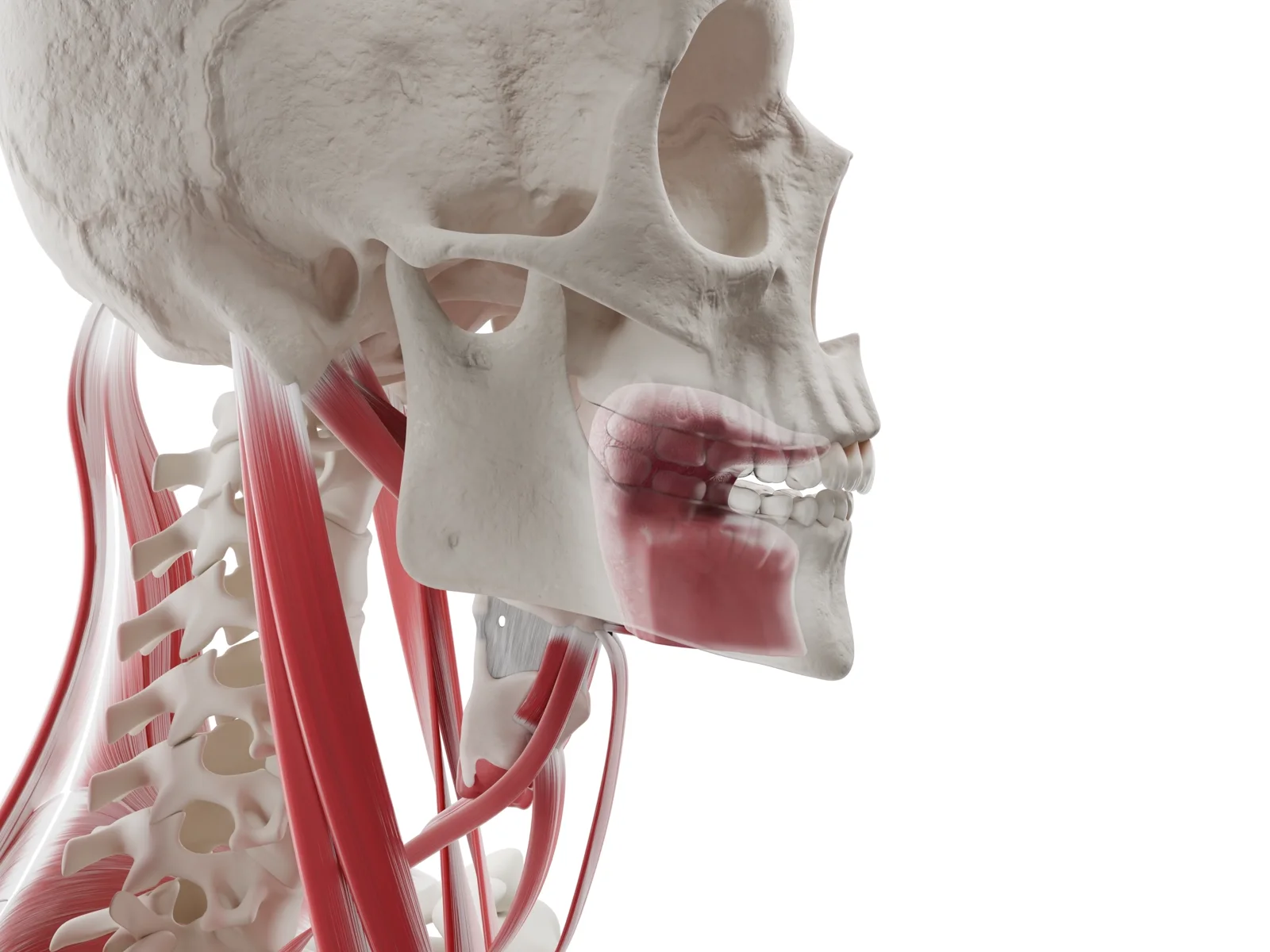
The jaw joint sits directly in front of the ear canal. The proximity is more than spatial.
The temporalis muscle and the masseter muscle hold the lower jaw suspended. They are supplied by the third branch of the trigeminal nerve. The same branch supplies the tensor of the soft palate, which opens the Eustachian tube when you swallow, and a small muscle in the middle ear that pulls on the malleus.
Chewing function, the soft palate and the middle ear are therefore linked by a shared pathway. In our view, anyone who uses their jaw differently over years, for example by clenching, also changes the conditions of this branch.
of patients with jaw joint or masticatory muscle complaints at a dental clinic in Regensburg had tinnitus, compared with 4.4% of those without such complaints, among 951 people examined7
was the average proportion of tinnitus in TMD in a review of 22 studies, compared with 12% in the control groups8
In Regensburg, one-sided jaw complaints and one-sided tinnitus were on the same side in all those affected7. The Swedish review therefore regards tinnitus as a comorbidity of TMD. Whether treating the jaw also influences the ear noise is, in the authors’ view, not yet sufficiently proven owing to a lack of control groups8.
A randomised study from Antwerp provides an indication. Of 80 patients with jaw-related tinnitus, half received physiotherapy in the facial area, with a splint if needed. Their tinnitus burden decreased more, and about a third of this effect was attributable to less jaw pain9. In our view, a splint sets the position of the jaw from the outside; it does not train the guidance provided by the muscles. More on this in Understanding TMD.
Neck and head balance
Tinnitus and the neck: what head balance contributes
The head weighs several kilograms and balances on the cervical spine. How well this works is not only felt in the neck and shoulders.
A review from Groningen covering 22 studies found that people with tinnitus report problems with the cervical spine more often. Because of methodological weaknesses, the authors consider the evidence for this link weak10. The nerves of the upper neck report to the brainstem, where the auditory pathway is also connected5.
of 38 patients with tinnitus and neck problems experienced a marked improvement in their ear noise after six weeks of physiotherapy on the neck11
still reported this improvement six weeks after the end of treatment11
The fact that treatment of the neck can ease the ear noise points to a functional cause. The fact that the effect wears off again in many people shows, in our view, that the cause had not been resolved. Passive treatments take work off the muscles. If the head continues to hang in front of the body in everyday life, the muscles take on the same holding work again afterwards.
Middle ear
Eustachian tube and swallowing: the ear gets ventilated too
The middle ear is a small, air-filled space behind the eardrum. It is ventilated from the throat.
The Eustachian tube, also known as the auditory tube, leads from the nasopharynx to the middle ear. Normally it is closed. When you swallow or yawn, it is opened by the tensor muscle of the soft palate, whose fibres attach to its wall, and the pressure equalises.
How much this muscle contributes was shown in an experiment on twelve monkeys in Pittsburgh. After it was paralysed, the mechanical properties of the Eustachian tube changed measurably12.
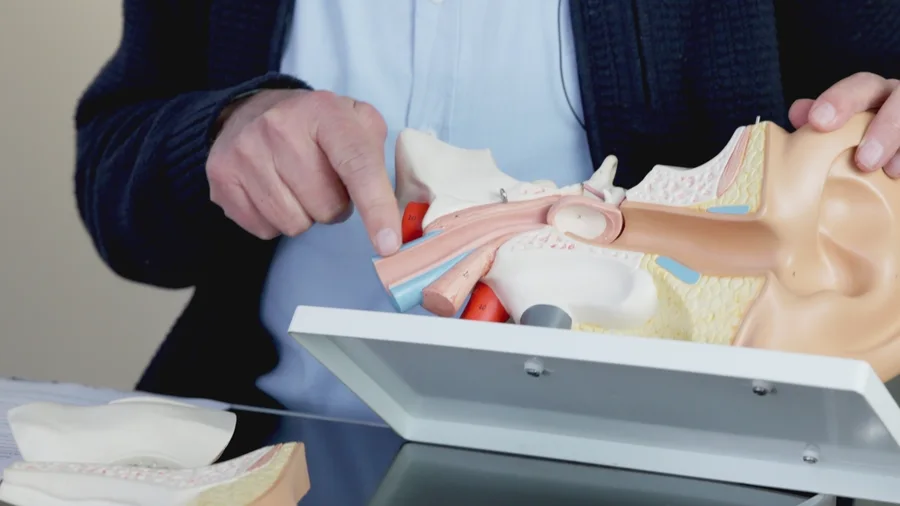
Every swallow is also a ventilation process for the middle ear.We swallow many hundreds to a thousand times a day. How cleanly this sequence runs helps determine how well the ear is ventilated.
The tongue and soft palate are coupled by muscles. When the tongue presses against the palate during swallowing, the soft palate tightens and lifts, and the Eustachian tube opens. In our view, this only works sufficiently when the tongue, soft palate and nasal breathing work together. With mouth breathing and a tongue that pushes against the teeth, this pull is missing.
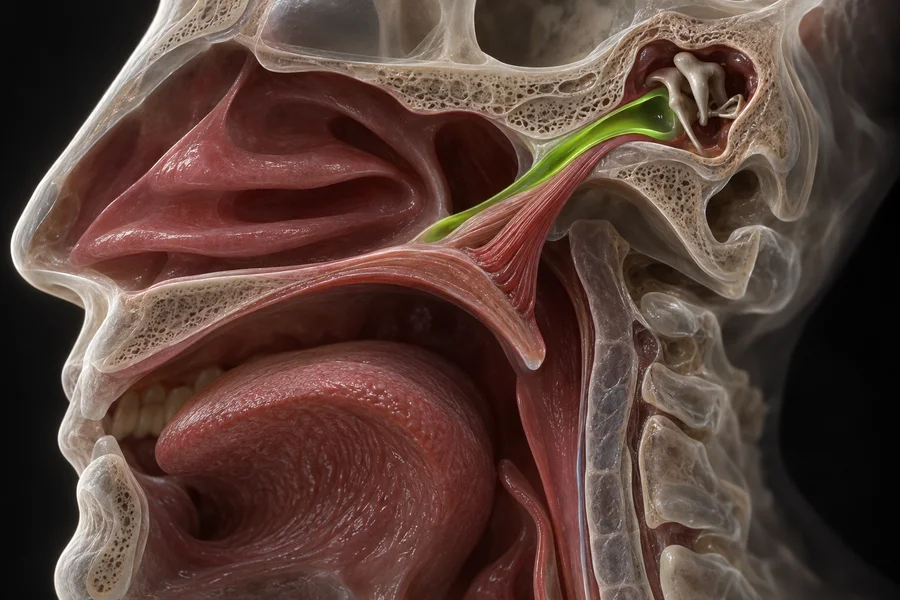
A muffled ear, pressure or clicking when swallowing are typical signs of a poorly ventilated Eustachian tube. In our view, the pattern often begins early. In children, it frequently shows up as middle ear infection, enlarged adenoids or recurring colds, later as pressure on the ear, sensitivity to noise, sudden hearing loss or tinnitus. These stages are usually treated separately and rarely seen as a chain. The chain as a whole has not been tested; it is our model. More in the article Ear pressure and pressure equalisation.
The triad
Causes of tinnitus: the common denominator
Jaw, neck and Eustachian tube are three routes to the ear. In our view, they share a common starting point.
Breathing and swallowing take place in the inner system of nose, mouth and throat. When you swallow, the tongue moves from the tongue reference position against the palate, the soft palate lifts and the Eustachian tube opens.
The outer system of cervical spine and neck muscles carries the head balance. With mouth breathing or a head that moves forward, the chewing, throat and neck muscles do compensatory work.
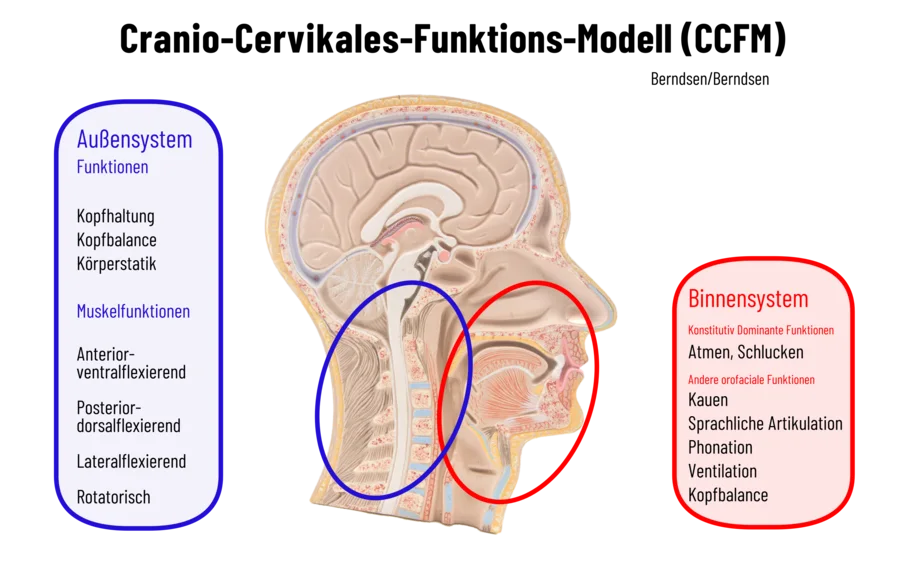
Breathing, swallowing and head balance run around the clock and are controlled in the brainstem, close to the auditory nuclei. In our view, the starting point of long-standing tinnitus therefore usually lies in a disturbed interplay of these three functions. We call this the triadic functional circuit. It stands at the beginning of many causal chains, and the ear noise can be a late, clearly audible link in them.
A basic function tips over
Often already in childhood, with mouth breathing or an altered swallowing pattern, later with a head that moves forward at the screen.
Muscles do compensatory work
Chewing muscles clench, neck muscles hold the head, the tongue pushes against the teeth.
The signals change
Altered signals from the jaw and neck reach the brainstem, and the Eustachian tube opens less.
The auditory pathway factors this in
The balance in the auditory nucleus shifts, and spontaneous activity increases.
The sound becomes audible
Stress, tiredness or silence make it louder. They explain why it appears right now.
Behind this lies a simple principle. Muscles that are not integrated into their actual function become slack or are recruited for other tasks. If breathing, swallowing and head balance run correctly again in everyday life, each muscle group is used for its own task and keeps its balanced tension. Then the signals to the brainstem can also normalise again.
Deviations in breathing, swallowing and head balance are very common and, in our view, receive too little attention when long-standing tinnitus is investigated. We consider correcting them a prerequisite, because these functions determine the conditions under which the jaw, neck, middle ear and auditory pathway work. This is based on our clinical observation; there are no controlled studies on it. The training thus creates the conditions under which tinnitus can improve, but that is not a promise.
Treatments
Treating tinnitus: the approaches in context
If you have lived with tinnitus for a long time, you have often already tried a few things. The common methods pursue different goals.
Behavioural therapy, relaxation, sound offerings and hearing aids aim to help you cope better with the noise, because anxiety and attention intensify it. What keeps the tone going in the auditory pathway is not their aim. Cognitive behavioural therapy is the best studied. A Cochrane review of 28 studies with 2,733 participants found a lower burden, with low certainty of evidence. Data after six and twelve months are lacking13.
lower in the tinnitus questionnaire (0 to 100) than without treatment, measured at the end of therapy13
was the difference compared with audiological care, and 5.8 points compared with other active procedures13
are considered the threshold above which a difference is clinically significant. Both comparisons lie below it13
A support in dealing with the noise, not an answer to the question of why it persists.This is how we classify behavioural therapy, relaxation, sound offerings and hearing aids. They can reduce the burden, but in our view they do not address the pattern behind it.
The American guideline on sudden hearing loss strongly recommends against routinely prescribing circulation-enhancing and vasoactive agents2. For long-standing tinnitus, we see even less basis for them. A circulatory disorder usually does not explain why a noise that the auditory pathway itself maintains persists for months and years.
Dealing with the sound
- Behavioural therapy, relaxation, sound therapy, hearing aid
- Goal: to reduce the burden caused by the noise
- Targets perception and attention
Addressing the pattern
- Training of breathing, swallowing and head balance
- Goal: to set the functions back to physiological patterns
- Targets jaw, tongue, neck and ear ventilation
The two are not mutually exclusive. If you are in behavioural therapy or wear a hearing aid, you can train at the same time.
Training
Tinnitus exercises: training the pattern
Good intentions for your jaw and head last until your attention is elsewhere. Then the old pattern returns. A movement pattern is a stored sequence, and it changes through repetition. Our approach is therefore to train breathing, swallowing and head balance in one combined sequence.
The FaceFormer sits in the oral vestibule, behind the lips and in front of the teeth. The tip of your tongue rests on the small ridge behind your upper front teeth, you breathe through your nose, and your head is balanced upright.
In the basic exercise you press the lip wedge together with your lips, bite down briefly with your back teeth and swallow. Afterwards your teeth are slightly apart again.
From around week 6, the head balance rotation is added. You press the lip wedge and slowly turn your head to the side with your neck extended, bite down briefly there, swallow and turn back.
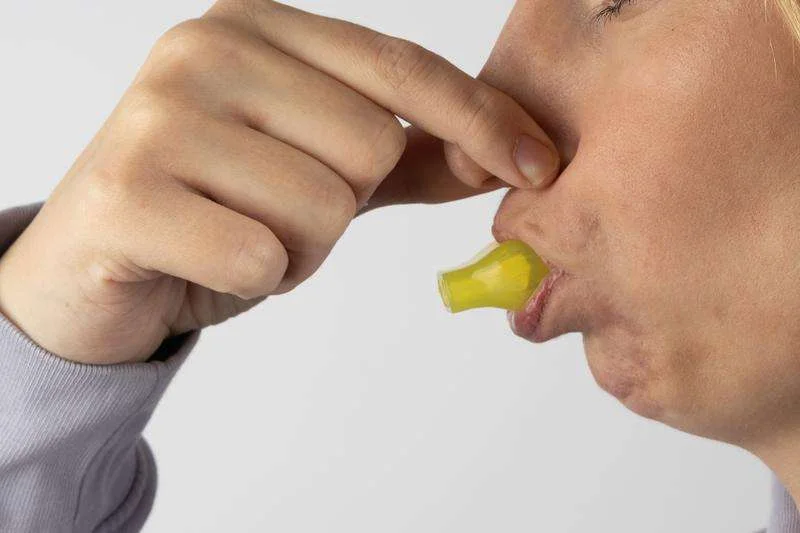
For ventilation of the middle ear there is the AirFlip, which uses brief pressure changes with the nose closed. Whether and when it is right for you is best discussed with a practice.
- From day 1
Basic exercise
A few minutes three times a day with the FaceFormer ZERO; you increase the repetitions week by week.
- From around week 3
Pull exercise and night
The pull exercise is added. At night you wear the FaceFormer ZERO as soon as you have mastered the basic exercise.
- After a few weeks
Switching to the ONE
During the day, you train with the FaceFormer ONE. It is the same size and shape as the ZERO, just made of firmer material.
- From around week 6
Head balance
The head balance rotation engages the muscles that hold the head.
- Over months
The pattern runs by itself
The exercise manual allows six to twelve months until the new sequences run without thinking.
Training is a learning process, not a switch. Even if your jaw, neck or middle ear ventilation are already changing, in our view the sound can remain perceptible for quite some time, because the auditory pathway holds on to a learned pattern. Whether and when the noise changes cannot be predicted. A sound that stays the same therefore says little on its own about how far along your training is.
Some users report that the tone became quieter or faded into the background after they had worked on breathing, swallowing and head balance for months. These are individual cases and not a promise. But they show that it can be worth keeping at it.
The free FaceFormer app guides you through the basic exercises, and you can find all modules on the exercise pages. Also pay attention to small changes, for example whether your jaw and neck feel looser.
Everyday life
Tinnitus in everyday life
Teeth apart
Apart from chewing and swallowing, your teeth do not touch. If you catch yourself clenching, release your teeth and place the tip of your tongue against your palate.
Lips closed, nose open
Your lips rest loosely together, and the air takes the route through your nose.
Head over the body
Adjust your screen and seat so that your head is balanced over your body.
Don’t force silence
In complete silence, the sound becomes more noticeable. A quiet background noise can provide relief in the evening.
Do not stop prescribed treatment on your own
Only change a hearing aid, splint or medication prescribed on medical advice in consultation with your practice. The training can be combined with them.
Questions
Frequently asked
What is tinnitus?
Tinnitus is a tone or noise without an external sound source, such as a whistling in the ear, rushing, humming or buzzing. As a rule, only the person affected can hear it. If it persists for longer than three months, it is referred to as chronic tinnitus. Worldwide, about one in seven adults has some form of it.
What causes tinnitus?
Common triggers are noise, hearing loss, inflammation or sudden hearing loss. The noise is maintained in the auditory pathway of the brain. Many people affected can change the tone via the jaw and neck. In our view, the starting point of long-standing tinnitus usually lies in a disturbed interplay of breathing, swallowing and head balance.
Can tinnitus come from the jaw?
The jaw joint sits directly in front of the ear canal, and the same nerve branch supplies the chewing muscles, the muscle that opens the Eustachian tube and a muscle in the middle ear. People with craniomandibular dysfunction (TMD) have tinnitus considerably more often. If the noise changes when you clench your teeth, this points to such a connection.
Can tinnitus come from the neck?
The nerves of the upper neck report to the same brainstem in which the auditory pathway is wired. People with tinnitus report neck complaints more often, and in studies, treatments of the neck were able to ease the ear noise. In our view, head balance plays a central role here.
When should I see a doctor about tinnitus?
Promptly if the noise appears suddenly and at the same time you hear less well, if it pulses in time with your heartbeat, if severe dizziness or neurological symptoms occur as well, or after a bang or an accident. With sudden hearing loss, the first two weeks count. Decisions about medication are made by your doctor.
Does tinnitus go away?
A newly occurring ear noise can become quieter or fade on its own, but no one can promise that. What can be influenced are the conditions under which the auditory pathway works. In our view, these include the signals from the jaw and neck and the ventilation of the middle ear, in other words breathing, swallowing and head balance.
What exercises are there for tinnitus?
In FaceFormer training you practise breathing, swallowing and head balance in one sequence, starting with the basic exercise. From around week 6, the head balance rotation for the throat and neck is added. For ventilating the middle ear there is the AirFlip, which is best discussed with a practice first.
Is stress the cause of tinnitus?
Stress can intensify tinnitus and explain why it gets louder during stressful phases. We do not see it as the sole cause, otherwise everyone under stress would have an ear noise. In our view, stress hits the spot that is already under strain.
Since I started training, my tinnitus has been louder. Should I carry on?
This can happen at the beginning and is usually not a bad sign. The training changes patterns that have often existed since childhood: head balance, jaw posture, muscle tension in the neck, pressure equalisation. In the first few weeks, the system reacts to this. Some people feel muscle soreness in the neck or the back of the head; others hear their ear noise more clearly for a while. In that case, reduce the load: only the basic exercise with 8 repetitions, adding one more each day up to 20, and only after that add the pull exercises and the night. Focus on clean execution rather than force. If the noise suddenly becomes much louder, or if hearing loss or dizziness occurs, have it checked by a doctor promptly.
More articles from the knowledge section
Experiences on this topic
Where to go next

Sources
- Jarach CM, Lugo A, Scala M et al. (2022). Global Prevalence and Incidence of Tinnitus: A Systematic Review and Meta-analysis. JAMA Neurology 79(9):888-900. PMID 35939312. Source
- Chandrasekhar SS, Tsai Do BS, Schwartz SR et al. (2019). Clinical Practice Guideline: Sudden Hearing Loss (Update). Otolaryngology Head and Neck Surgery 161(1 Suppl):S1-S45. PMID 31369359. Source
- Zenner HP (1998). Eine Systematik für Entstehungsmechanismen von Tinnitus. HNO 46(8):699-704. PMID 9773325. Source
- Wu C, Stefanescu RA, Martel DT, Shore SE (2016). Tinnitus: Maladaptive auditory-somatosensory plasticity. Hearing Research 334:20-29. PMID 26074307. Source
- Levine RA (1999). Somatic (craniocervical) tinnitus and the dorsal cochlear nucleus hypothesis. American Journal of Otolaryngology 20(6):351-362. PMID 10609479. Source
- Sanchez TG, Guerra GC, Lorenzi MC, Brandão AL, Bento RF (2002). The influence of voluntary muscle contractions upon the onset and modulation of tinnitus. Audiology and Neuro-Otology 7(6):370-375. PMID 12401968. Source
- Buergers R, Kleinjung T, Behr M, Vielsmeier V (2014). Is there a link between tinnitus and temporomandibular disorders? Journal of Prosthetic Dentistry 111(3):222-227. PMID 24286640. Source
- Skog C, Fjellner J, Ekberg E, Häggman-Henrikson B (2019). Tinnitus as a comorbidity to temporomandibular disorders: A systematic review. Journal of Oral Rehabilitation 46(1):87-99. PMID 30126027. Source
- van der Wal A, Michiels S, Van de Heyning P et al. (2022). Reduction of Somatic Tinnitus Severity is Mediated by Improvement of Temporomandibular Disorders. Otology and Neurotology 43(3):e309-e315. PMID 35020685. Source
- Bousema EJ, Koops EA, van Dijk P, Dijkstra PU (2018). Association Between Subjective Tinnitus and Cervical Spine or Temporomandibular Disorders: A Systematic Review. Trends in Hearing 22:2331216518800640. PMID 30269683. Source
- Michiels S, Van de Heyning P, Truijen S, Hallemans A, De Hertogh W (2016). Does multi-modal cervical physical therapy improve tinnitus in patients with cervicogenic somatic tinnitus? Manual Therapy 26:125-131. PMID 27592038. Source
- Ghadiali SN, Swarts JD, Doyle WJ (2003). Effect of tensor veli palatini muscle paralysis on eustachian tube mechanics. Annals of Otology, Rhinology and Laryngology 112(8):704-711. PMID 12940669. Source
- Fuller T, Cima R, Langguth B, Mazurek B, Vlaeyen JW, Hoare DJ (2020). Cognitive behavioural therapy for tinnitus. Cochrane Database of Systematic Reviews 1:CD012614. PMID 31912887. Source
Get started
Ready for the training?
The free FaceFormer app guides you through the basic exercises, counts along and reminds you of your sessions. If you wish, a practice from the practitioner directory can support you.

FaceFormer ZERO + ONE
Both material hardnesses for getting started, day and night. The set for adults.

FaceFormer ZERO
The softer FaceFormer for getting started, for children and for the night.

FaceFormer ZERO Children’s Set
ZERO with hygiene box, plush bag and success book with stamp.
FaceFormer training aims to restore the physiological setting of the basic functions of breathing, swallowing and head balance, with lip closure and the tongue reference position, thereby creating the conditions under which symptoms can improve. It does not replace a medical assessment. You can find practitioners near you in the practitioner directory.


