

Specialist article: tongue
Cutting a tongue tie?Frenotomy, function and training
A frenulum that is too short holds the tongue down on the floor of the mouth. When the cut is necessary, who assesses this and why the tongue then first has to learn what it could never do before: to rise to the palate and to take part in swallowing and nasal breathing, by day and at night.
Does this sound familiar?
Does your tongue really reach the palate?
What applies to you or your child?
Tap whatever applies to you.
If several points apply, it is worth taking a close look at how the tongue functions. Whether the frenulum is the reason is assessed by a specialist who examines the mouth and tongue in motion.
Self-test in front of the mirrorHow we support the therapyThe key points at a glance
- The lingual frenulum connects the underside of the tongue to the floor of the mouth. In our view, it is too short when it restricts function, not simply when it looks conspicuous. The simplest test: with the mouth open, does the tip of the tongue reach the palate behind the upper front teeth in a controlled way?
- If the frenulum really is too short, it has to be cut. This is decided by the medical or dental specialist, and for babies together with the midwife, breastfeeding counsellor and paediatric practice.
- Because the tongue has never learned the correct pattern, it has to learn it from scratch after the cut. In our opinion, this works best with triadic training of the basic functions that practises breathing, swallowing and head balance together, such as FaceFormer therapy.
Video
You have a tongue tie. Can it remain without consequences or not?
Das Video lädt erst nach dem Klick. Dann werden Daten an YouTube (Google) übertragen.
Anatomy
What the lingual frenulum is and what it is for
A small band under the tongue with a big effect on an entire functional space.
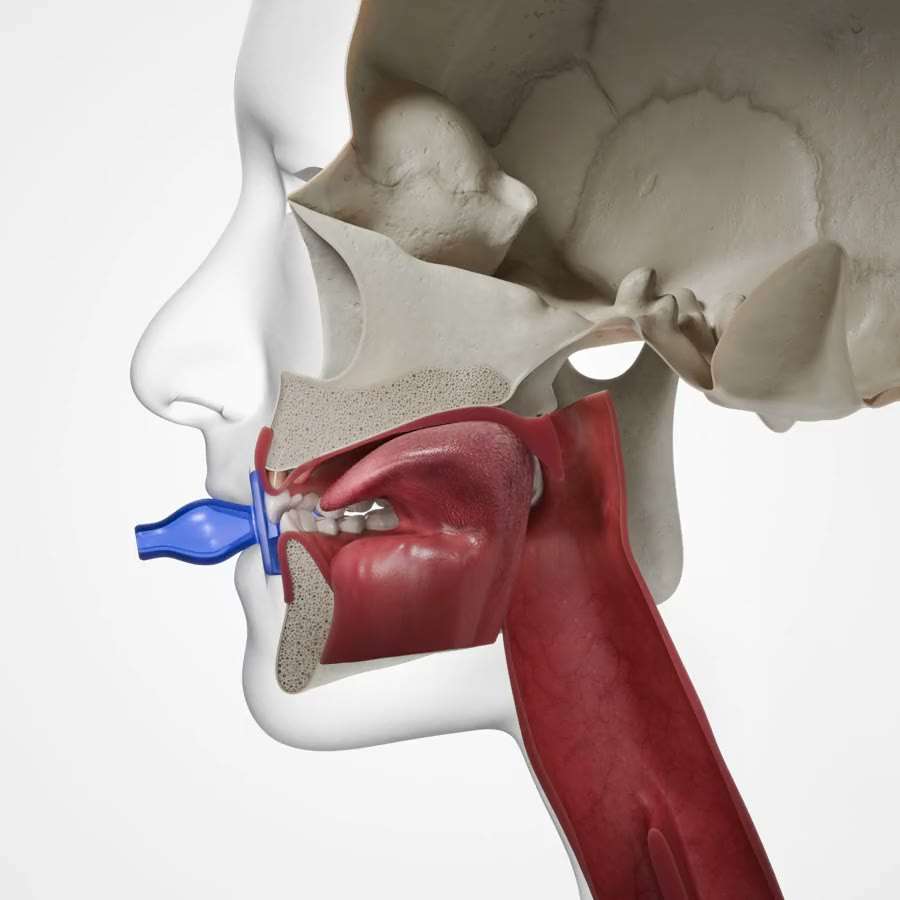
Lift your tongue and look in the mirror. The thin band of mucous membrane in the middle, between the underside of the tongue and the floor of the mouth, is the lingual frenulum, known medically as the frenulum linguae. It gives the tongue central guidance. If it is attached far back and is elastic enough, it does not interfere with any movement.
The tongue is not an appendage in the mouth. It works in a space in which the soft palate, larynx, lower jaw and hyoid bone are finely coordinated with every swallow. We speak of the triad of breathing, swallowing and head balance.
If the tip of the tongue is held down on the floor of the mouth, this system lacks a central building block. Vital functions such as swallowing and breathing still work, but only by way of detours. These very detours are the real subject of this article.
Assessment
When a frenulum is too short
What matters is what the tongue can do. What the frenulum looks like says little on its own.
in the first year of life have ankyloglossia according to an analysis of 15 studies with more than 24,000 children, boys more often than girls2
is the figure given by the Cochrane review, depending on how strict the definition is1
The figures vary because there is no uniform standard. The diagnostic tools have not been sufficiently tested, and diagnoses and procedures have increased sharply over the last 15 years2. The American Academy of Pediatrics therefore stresses the importance of carefully assessing feeding and milk transfer in infants. A conspicuous frenulum alone does not explain a breastfeeding problem3.
If, with the mouth open, the tip of the tongue reaches the small hump behind the incisors in a controlled way, that is enough.This is how Dr. Klaus Berndsen describes the test for adolescents and adults. In his view, releasing a frenulum when the tongue is sufficiently mobile brings no benefit.
Baby at the breast
Slips off, clicks, feeds for a very long time or is not properly satisfied. The mother has sore nipples.
Tip of the tongue
Notched or heart-shaped when the tongue is stuck out.
Contact with the palate
With the mouth open, the tip does not reach the palate.
Mouth and breathing
The mouth is often open, and breathing is through the mouth.
Speech
Sounds such as S, L or R can only be made with workarounds.
Night
Snoring, restless sleep, a dry mouth in the morning.
None of these signs proves that the frenulum is too short. Many have other causes, such as a tongue that has simply never learned to lie up against the palate. With lisping, for example, in our view tongue function is usually more important than the frenulum; more on this in the article Lisping and tongue function.
Self-test
Recognising a tongue tie: the mirror test
Five steps, two minutes, one mirror. The test shows you what your tongue can do. It is not a diagnosis.
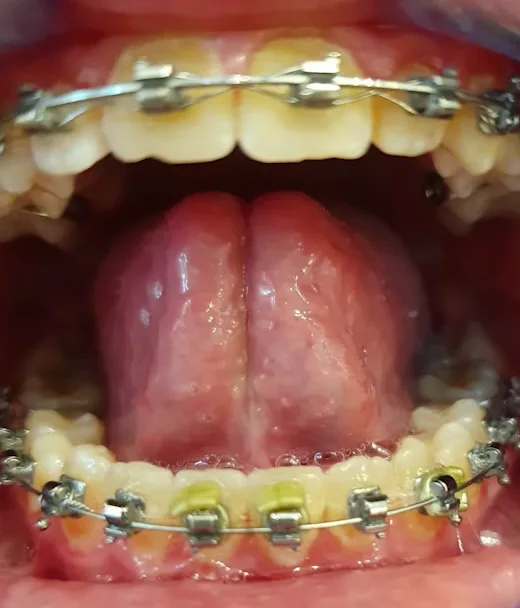
Typical signs of a frenulum that is too short are easy to see. When stuck out, the tip of the tongue looks notched or heart-shaped; Dr. Berndsen speaks of the heart tongue. Under the tongue, the frenulum reaches far forward, almost to the tip. And with the mouth wide open, the tongue does not lift off the floor of the mouth.
The tongue then cannot reach its tongue reference position at the front of the palate either. It often also shows tooth impressions along its edges, because it lies low and presses sideways against the teeth.
- Step 1
Tip of the tongue to the palate
Open your mouth wide and place the tip of your tongue on the small ridge behind the upper front teeth. Watch for: the tip only gets there with the mouth half closed, or not at all.
- Step 2
Stick out your tongue
Stick your tongue straight out as far as possible and look at the tip. Watch for: the tip becomes notched or heart-shaped, or is pulled downwards.
- Step 3
Look under your tongue
Lift your tongue and look at the frenulum. Watch for: it is short and tight, reaches almost to the tip of the tongue or turns white when stretched.
- Step 4
Suction and click
Suck your whole tongue flat against the palate and let it drop with a click. Watch for: the tongue does not suction broadly against the palate, and the click does not work, or only with the help of the lower jaw.
- Step 5
Lick your lips
Run the tip of your tongue once all the way around your upper and lower lips. Watch for: the upper lip cannot be reached, or the lower jaw has to move along.
In babies
The baby keeps slipping off the breast during feeding, clicks audibly, feeds for a very long time or is not properly satisfied. The nipples are sore. With a bottle, milk often runs out of the corner of the mouth.
In toddlers
The tip of the tongue looks heart-shaped when stuck out. Solid food is pushed back and forth in the mouth for a long time, and the mouth is often open.
In school-age children
Sounds such as S, L or R can only be made with workarounds. The tongue pushes forward when swallowing, and the child breathes through the mouth at night.
Many of these signs also have other causes, and a self-test does not replace an examination. Whether the frenulum is too short is determined by a specialist: the paediatric practice, the dental practice, the ENT practice or oral and maxillofacial surgery. For babies with feeding problems, midwives and breastfeeding counsellors are the first point of contact.
Chain of cause and effect
What a restricting frenulum changes in everyday life
The tongue still has to swallow, many hundreds to a thousand times a day. It finds a substitute route.
The tongue does not come up
The tip does not reach its reference point at the front of the palate. The body of the tongue stays low in the mouth.
Swallowing takes a detour
Instead of working upwards and backwards, the tongue presses forwards against the teeth. The lips and cheeks help out.
The mouth opens more often
Without the tongue as a support against the palate, keeping the mouth closed is harder. The air more often takes the route through the mouth.
The pattern becomes a habit
Because it is repeated so often, the brain stores the detour as the norm. Those affected often notice nothing, since it was never any different.
During growth, form follows function. Without the pressure of the tongue from inside, the upper jaw can develop more narrowly and the palate higher; more on this under high palate. In infants, breastfeeding is affected as well. At the breast, the tongue works in a wave from front to back, as the article Breastfeeding and oral motor skills shows. If the tongue is held down, this becomes difficult.
with suspected sleep-related breathing disorder had a short frenulum without enlarged tonsils in a retrospective clinical analysis. This group showed more abnormalities in the oral cavity5
for a questionnaire-based risk of sleep apnoea was found by a Polish cross-sectional study in children with a short lingual frenulum6
Both studies show associations, not a cause and not an effect of treatment. But they fit with what we see every day. A tongue that does not lie up against the palate leaves the mouth open more easily, and mouth breathing puts strain on the upper airways, especially when lying down.
The procedure
Frenotomy: when the cut is necessary
If the frenulum really is too short, it has to be cut. There is no way around this.
On TV: In “JENKE. Experiment. Schlaflos” (ProSieben, 8 October 2026), Jánik von Wilmsdorff has his lingual frenulum cut. The FaceFormer can also be seen in the programme, in connection with sleep and posture. Watch the programme free of charge on Joyn
Dr. Klaus Berndsen says this without reservation. In a borderline case, where it is unclear whether the frenulum really is too short, he observes that mobility can improve through training. This is for the specialist to assess. If the frenulum is too short or attached too far forward, no training replaces the procedure.
Whether and how surgery is performed is decided by the specialist who examines you or your child: paediatrics, oral and maxillofacial surgery, ear, nose and throat medicine or dentistry. For babies with breastfeeding problems, midwives and breastfeeding counsellors are the first point of contact, together with the paediatric practice.

In newborns
- Usually a short snip with scissors or by laser
- A short procedure, often without anaesthesia
- Put the baby back to the breast straight afterwards; breastfeeding is the best movement
- Support from a midwife and breastfeeding counsellor
In older children and adults
- Often a plastic surgical technique, for example Z-plasty or Y-plasty
- The aim is to prevent the band from growing back together
- The technique is chosen by the practice performing the procedure
- Afterwards, targeted training of tongue function
What research says about breastfeeding: in the Cochrane review of five randomised trials, frenotomy reduced the mother’s pain during breastfeeding in the short term. A consistent improvement in breastfeeding itself could not be shown. The studies were small, and many babies in the control groups were later operated on as well1. The US ENT specialist society also found no agreement on many questions in its expert consensus and cites a lack of evidence as the reason4.
According to the American Academy of Pediatrics, a preventive cut with the promise of preventing later jaw or airway problems is not supported by evidence3. That is why the question of function always comes first. If function is restricted and the frenulum is the reason, the cut is the right first step.
After the cut
After the cut: how we support the therapy
The cut gives the tongue freedom of movement. The pattern it never had does not come about by itself as a result.
For years, the tongue has swallowed and spoken using compensatory movements and kept the mouth open. These sequences are stored in the brain like any other habit. When the frenulum is released, the tongue is free, but the brain does not yet know the new route. That is why, in our view, the pattern has to be learned anew from scratch: tongue to the palate, swallowing against the palate, lips closed, breathing through the nose.
Like after a long time in a plaster cast
When the cast is removed, the leg is free again. Even so, you still limp for a while, because the body has become used to the protective posture. Only walking itself, repeated often and precisely, brings back the old gait. It is similar with the tongue, except that it has usually never known the correct gait.
- Before the procedure
Preparing the pattern
A few weeks beforehand: the basic exercise three times a day, with 8 repetitions in week 1, 14 in week 2 and 20 from week 3. In addition, lip closure and nasal breathing in everyday life. This way the tongue already gets to know the path it is meant to follow afterwards, and the tension in the oral cavity can settle into order.
- Procedure and healing
Pause and go-ahead
After the frenotomy, the wound heals first. If the practice that performed the procedure gives you its own movement exercises for the first few days, these take priority. Agree with the practice when you start using the FaceFormer again.
- Once you have the go-ahead
Building up from scratch
A fresh start with the basic exercise, three times a day, again beginning with a few repetitions. The goal is the tongue reference position: tip on the ridge behind the incisors, body of the tongue broad against the palate, swallowing with tooth contact.
- From around week 3
Pull exercise and night
The pull exercise is added, and the training extends into the night with the soft ZERO. This way the new pattern is also practised during sleep.
- From around week 6
Expanding
Advanced modules supplement the training; after a few weeks, daytime training can switch to the firmer ONE. For the night we recommend the ZERO, but the ONE can also be used at night.
- For children
The practice’s own plan
For children, the practice decides when and in what form training starts. A common guideline: days 1 to 14, 5 basic and 5 pull exercises each, three times a day; days 15 to 28, 10 of each; from week 5, 20 of each, playfully and with praise.
There are initial data on the combination of frenuloplasty and myofunctional therapy. In a questionnaire analysis of 348 treated patients, 91% reported satisfaction, and many also reported less mouth breathing and snoring. The study was retrospective, without a control group and without a sleep laboratory, and the authors themselves call for objective measurements7. It does show, however, that specialists think of the cut and the training together.
Sleep
Tongue tie and sleep: what matters at night
During sleep, nobody can consciously counteract. That is where it becomes clear which pattern the tongue has really stored.
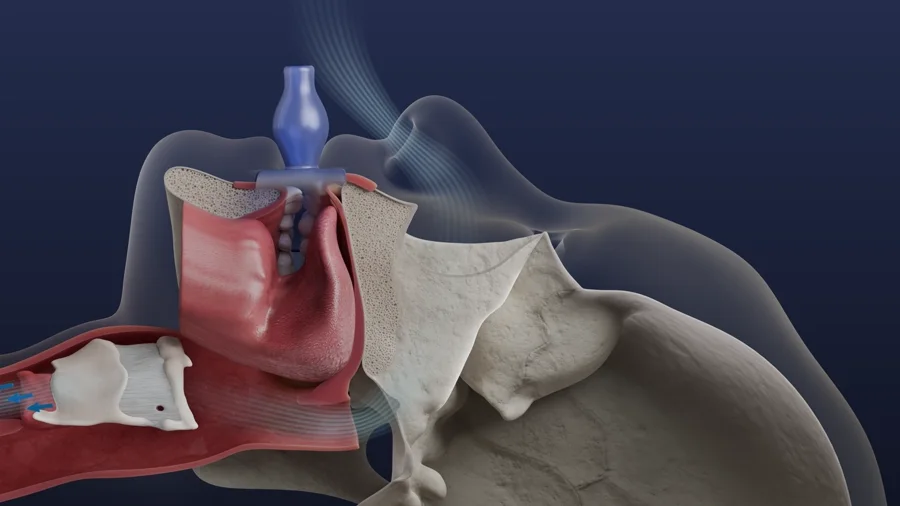
If the tongue rests against the palate, the mouth stays closed without effort and the air flows through the nose. At the same time, the tongue forms part of the wall of the upper airway. If it lies low and falls backwards when you lie down, the throat becomes narrower. This can promote snoring.
That is why the night is part of the training. During night-time training, the soft FaceFormer ZERO lies in front of the teeth and reminds the lips and tongue of their place. We advise against mouth tape; the reasons are in the article Mouth taping.
was the drop in the mean value in adults with sleep apnoea across nine studies on myofunctional therapy. The studies were small and mostly without a control group8
was the reduction in snoring in the same studies8
These data relate to training in general, not to people after a frenotomy. But they show that the muscles of the tongue and throat play a role during sleep and can be trained. In our view, training breathing, swallowing and head balance creates the conditions under which night-time patterns can change.
Sleep apnoea always belongs in a doctor’s hands. Do not stop prescribed CPAP therapy on your own initiative; training can run alongside it. More on this in the article Snoring and sleep apnoea.

Experiences
What we see in practice again and again
For us, tongue tie is not a marginal topic. We come across it all the time.
At the ISST in Unna, we often encounter tongue tie in treatment, especially in children.We see again and again that a frenulum that is too short remains undetected for a long time, because swallowing and speaking somehow work by way of detours. And we see that after the release, the old pattern persists as long as it is not retrained.
In two of his videos, Dr. Klaus Berndsen reports on a 60-year-old man with lifelong swallowing problems. His frenulum was attached far forward at the tip of the tongue. It was released, and afterwards he trained the new pattern. In this course, according to Dr. Berndsen’s report, he was clearly better after a few weeks. This is an individual case, not evidence of an effect, and it cannot be transferred to others.
Dr. Berndsen also observes that a frenulum can stick together again after the procedure, especially if the tongue is moved little afterwards. For babies, in his view, breastfeeding itself is the best tongue training. You can find further courses from FaceFormer therapy, each as an individual case, under FaceFormer before and after.
Adults
Tongue tie in adults: is it still worth it?
Tongue tie does not only occur in babies. Many adults only find out about it late.
If you grew up with a frenulum that is too short, you often notice nothing. It was never any different, and swallowing, speaking and breathing have settled into compensatory patterns. Adults are becoming increasingly aware of the topic, often in connection with snoring, jaw complaints or misaligned teeth that return after braces.
Have it assessed
With your mouth open, does the tip of your tongue reach the palate in a controlled way? A specialist checks whether the frenulum is the reason.
If it is too short, it is cut
In adults, usually with a plastic surgical technique so that the band does not stick together again.
Rebuilding the pattern
Compensatory patterns that are decades old do not change by themselves. In our view, targeted training of breathing, swallowing and head balance is needed afterwards.
Further information: Lena Koopmann, a holistic pain coach, posturologist and certified FaceFormer practitioner with whom we work, also deals with the topic of tongue tie in adults. With us, she also leads the group coaching for FaceFormer training, also available as group coaching for children. You can find out more about her work at Train & Pain.
Training
How the tongue practises with the FaceFormer
A pattern, not strength training. The FaceFormer gives the lips and tongue a fixed path.
In the basic exercise, the FaceFormer sits behind the lips and in front of the teeth. The lips close around it, the tip of the tongue seeks the reference point on the palate, the head balances upright, and breathing is through the nose. This is followed by a swallow with tooth contact. The negative pressure draws the tongue to the palate. We explain in detail exactly what the tongue reference position looks like in a separate article.
Start with ZERO
The soft yellow ZERO is the starting point for everyone and our recommendation for the night, but the ONE can also be used at night. For daytime training, the firmer ONE follows after a few weeks. Both are the same size and shape.
Children
For children up to 10 years, we recommend the ZERO. For small children, the practice decides when and in what form training starts. More under FaceFormer for children.
Go-ahead after the procedure
Agree with the practice that performed the procedure when you start training after a frenotomy.
Support
The free FaceFormer app guides you through the basic exercises. You can find a practice near you in the practitioner directory.
You cannot do without either the operation or the training afterwards.Dr. Klaus Berndsen in the video on tongue tie. You have to stick with it; it can be worth it.
Questions
Frequently asked
When does a tongue tie need to be cut?
When it restricts the function of the tongue, that is, drinking, swallowing, speaking or lifting the tongue to the palate, and a specialist sees the frenulum as the cause. A conspicuous appearance alone is not a reason. If it really is too short, in our view the cut is indispensable.
How do I recognise a tongue tie?
Typical signs are a heart-shaped notch in the tip of the tongue, a frenulum that reaches far forward, and a tongue that does not reach the palate when the mouth is wide open. The self-test in this article shows what you can look out for. The diagnosis is made by a specialist.
Who decides on a frenotomy?
The examining specialist from paediatrics, oral and maxillofacial surgery, ENT or dentistry. For babies with breastfeeding problems, involve your midwife and a breastfeeding counsellor as well.
Is a frenotomy painful for a baby?
In newborns it is usually a very short procedure, often without anaesthesia, and the baby is put back to the breast straight afterwards. The practice that carries it out will explain how it works and what you should look out for afterwards.
Can a tongue tie affect snoring?
Studies show an association between a short frenulum and sleep-related breathing disorders in children, but no proof of a cause. In our view, what counts is whether the tongue lies up against the palate, the mouth stays closed and breathing takes place through the nose. Snoring and breathing pauses should be checked by a doctor.
Tongue tie in adults: is it still worth it?
If the frenulum is too short, it is cut in adults too, usually with a plastic surgical technique. In our view, the pattern then has to be rebuilt, because compensatory movements have become ingrained over decades. You have to stick with it; it can be worth it.
Does the frenulum grow back together after it has been cut?
In newborns rarely, according to Dr. Berndsen’s observation. In older children and adults, a simple cut can stick together again, which is why a plastic surgical technique is often chosen there. In our view, targeted movement of the tongue afterwards is part of it.
When can you start training after a frenotomy?
As soon as the practice that performed the procedure gives the go-ahead. Adults and older children can already begin with lip closure, nasal breathing and the basic exercise beforehand; in our experience, this can make getting started afterwards easier.
Does training replace a frenotomy?
No. If the frenulum is too short, it needs to be cut. Training is the second, necessary step, because afterwards the tongue still has to learn the correct pattern.
More articles from the knowledge section
Where to go next

Sources
- O’Shea JE, Foster JP, O’Donnell CP, Breathnach D, Jacobs SE, Todd DA, Davis PG (2017). Frenotomy for tongue-tie in newborn infants. Cochrane Database of Systematic Reviews 3:CD011065. PMID 28284020. Source
- Hill RR, Lee CS, Pados BF (2021). The prevalence of ankyloglossia in children aged <1 year: a systematic review and meta-analysis. Pediatric Research 90(2):259-266. PMID 33188284. Source
- Thomas J et al., American Academy of Pediatrics (2024). Identification and Management of Ankyloglossia and Its Effect on Breastfeeding in Infants: Clinical Report. Pediatrics 154(2):e2024067605. Source
- Messner AH, Walsh J, Rosenfeld RM et al. (2020). Clinical Consensus Statement: Ankyloglossia in Children. Otolaryngology Head and Neck Surgery 162(5):597-611. PMID 32283998. Source
- Guilleminault C, Huseni S, Lo L (2016). A frequent phenotype for paediatric sleep apnoea: short lingual frenulum. ERJ Open Research 2(3):00043-2016. PMID 27730205. Source
- Brożek-Mądry E et al. (2021). Short lingual frenulum and head-forward posture in children with the risk of obstructive sleep apnea. International Journal of Pediatric Otorhinolaryngology 144:110699. PMID 33823467. Source
- Zaghi S, Valcu-Pinkerton S, Jabara M et al. (2019). Lingual frenuloplasty with myofunctional therapy: Exploring safety and efficacy in 348 cases. Laryngoscope Investigative Otolaryngology 4(5):489-496. PMID 31637291. Source
- Camacho M, Certal V, Abdullatif J, Zaghi S, Ruoff CM, Capasso R, Kushida CA (2015). Myofunctional Therapy to Treat Obstructive Sleep Apnea: A Systematic Review and Meta-analysis. Sleep 38(5):669-675. PMID 25348130. Source
Get started
Ready for the training?
The free FaceFormer app guides you through the basic exercises, counts along and reminds you of your sessions. If you wish, a practice from the practitioner directory can support you.

FaceFormer ZERO + ONE
Both material hardnesses for getting started, day and night. The set for adults.

FaceFormer ZERO
The softer FaceFormer for getting started, for children and for the night.

FaceFormer ZERO Children’s Set
ZERO with hygiene box, plush bag and success book with stamp.
FaceFormer training aims to restore the physiological setting of the basic functions of breathing, swallowing and head balance, with lip closure and the tongue reference position, thereby creating the conditions under which symptoms can improve. It does not replace a medical assessment. You can find practitioners near you in the practitioner directory.


