

Specialist article: children
Weaning off the dummyWhy it is about the tongue
Dummy, thumb, lower lip: what soothes lies exactly where the tongue is supposed to learn its place. Here you will find out what sucking habits change in the mouth, why there is no good dummy and how your child learns the right function instead of the habit.
Does this sound familiar?
How much time does the dummy spend in your child’s mouth?
What applies to your child?
Tap whatever applies to you.
If two or more points apply, it is worth taking a closer look. Not because something bad has happened, but because a pattern is just becoming established. And what has been learned can also be relearned.
What a dummy changes in the mouthHow weaning succeedsThe key points at a glance
- A dummy lies exactly in the space in which the tongue orients itself upwards towards the palate. In our view, it keeps the tongue down, opens the mouth and lets swallowing take place underneath it. In our view, there is therefore no physiological dummy, regardless of how it is shaped or labelled.
- For the teeth and jaw, what matters most is the duration in hours per day and in months. We see thumb sucking and lip biting as oral habits, in our view usually as the consequence of a function that is missing.
- Weaning therefore means more than taking away. In our view, the conditions are best if your child learns the right function, embedded in breathing, swallowing and head balance: closed lips, tongue reference position, nasal breathing and a swallow that begins up at the palate.
Video
Dummy or not? Breastfeeding, dummies and sudden infant death
Das Video lädt erst nach dem Klick. Dann werden Daten an YouTube (Google) übertragen.
Sucking
Why babies suck and what the dummy was invented for
Sucking is the first major training in life. It organises breathing, swallowing and head balance, the three basic functions on which much in the body is built.
Already in the womb, from around the 10th to 14th week of pregnancy, your child swallows amniotic fluid. This lays down the swallowing pathway in the brainstem long before it is needed. At the breast, this programme is then really challenged: the lips seal, the tongue works in a wave from front to back, and breathing runs through the nose. How much is trained in the process is described in the article on breastfeeding.
The dummy has a different history. It was never invented to shape a jaw, but to soothe children. In the past, it was crumpled scraps of cloth soaked in honey and sometimes even in alcohol or opium. Today it is silicone; the intention is the same.
This is not a reproach to parents. Anyone who gives their child a dummy wants to do something good for them. But sucking on a dummy does not replace sucking at the breast. It is a different movement, and that is exactly the point.
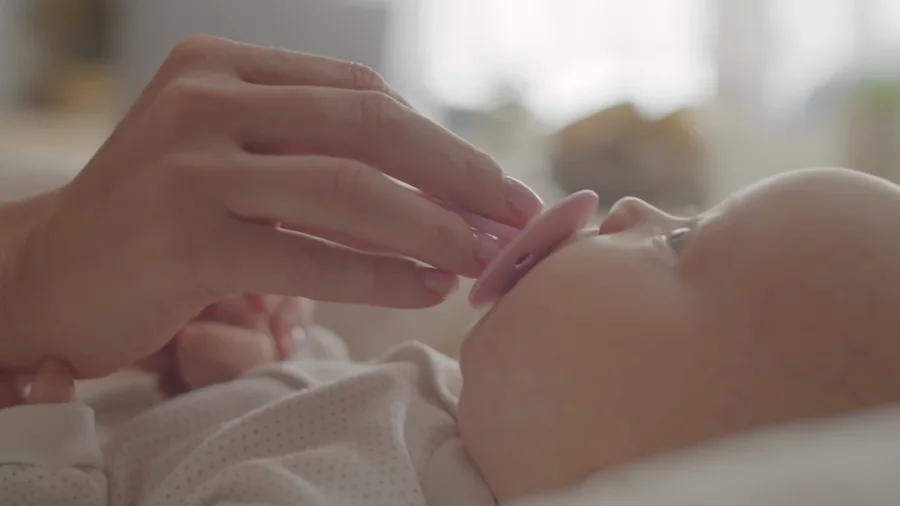
A dummy does not need a replacement. Simply none.This is how Dr. Klaus Berndsen answers parents who ask what should take the dummy’s place. A child manages well without it if the habit has not already formed.
In the mouth
What a dummy changes in the mouth
Whether dummy, thumb, finger, bottle teat or drinking straw used for constant sucking: what matters is the effect, not the name. An object lies in the mouth for a long time.
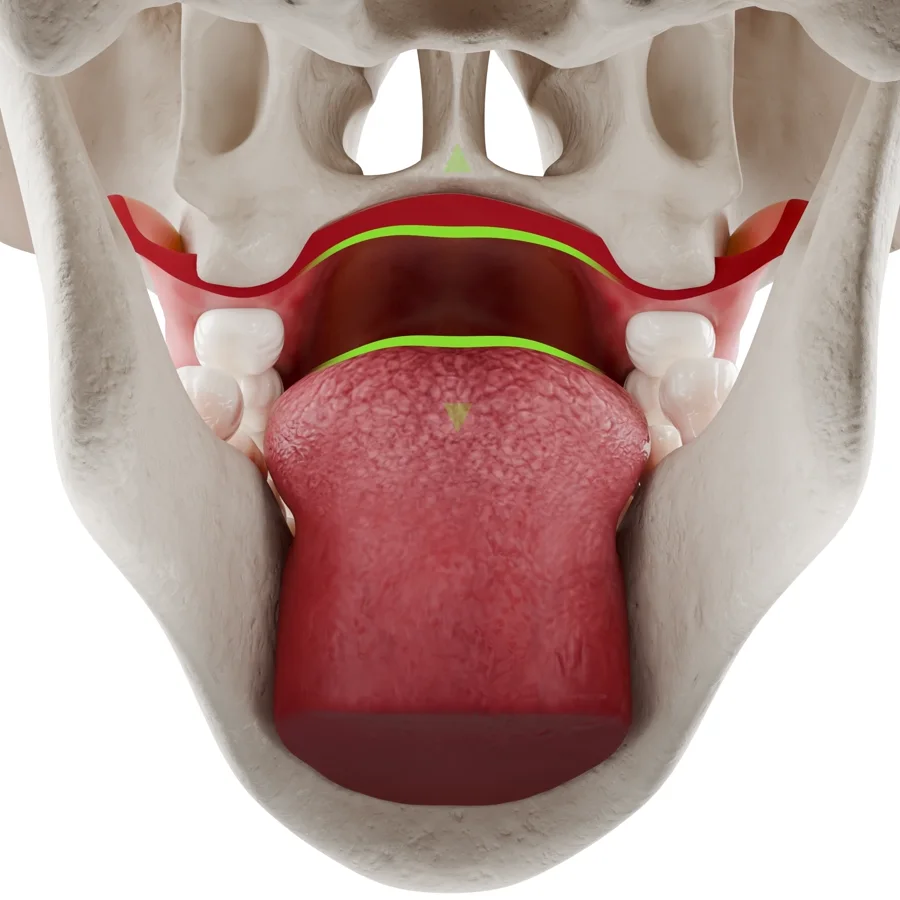
The teat lies exactly where the tongue is supposed to orient itself upwards. In the tongue reference position, the tip of the tongue lies at the small ridge behind the upper incisors, and the body of the tongue lies broadly against the palate. With the dummy, the tongue cannot take up this anchor point, and it may never get to know it as its place at all.
The mouth is open
With the teat between the lips, the lower jaw remains lowered. The muscles that close the mouth lose their balance of tension.
The tongue works low down
Many swallows then begin underneath the foreign object. The tongue presses forwards against the teeth and jaw instead of upwards against the palate.
The brain stores the detour
Because this is repeated many hundreds to a thousand times a day, the detour becomes a standard pattern, especially during sleep.
Form follows
During growth, the bone responds to the forces that act on it over long periods. The palate and dental arches can develop according to the pattern they experience.
An open mouth is often associated with mouth breathing, because the route through the mouth seems shorter. In this way, a habit becomes a second pattern that stabilises itself. Why this matters for the airways is explained in the article Mouth breathing and nasal breathing.
Orthodontic?
Is there a good dummy? In our view, no
“Jaw-friendly”, “orthodontic”, “physiological”, “tooth-friendly”: the labels promise a lot. They do not change anything about the position in the mouth.
Try it yourself: place a pencil crosswise between your incisors, close your lips around it and swallow. What happens?
Manufacturers therefore make the neck of the teat particularly thin. In our view, this changes little, because any object between the jaws lowers the lower jaw and keeps the tongue away from the palate. Dr. Berndsen puts it pointedly: such dummies are not jaw-shaping but rather jaw-deforming.
met the inclusion criteria of a systematic review on orthodontic dummies. One found open bite more often with conventional dummies, two found no difference, and for lateral crossbite, not a single one did5
were analysed by a review from Basel, twelve of them with a high risk of bias. Dummies were associated with open bite and lateral crossbite; so-called functional dummies showed open bite less often4
Less open bite does not mean that the tongue learns its place. The studies measure tooth positions, not function. None of these studies has shown that a dummy changes anything for the better in the position of the tongue or the swallowing pathway. We therefore say clearly: there is no physiological dummy, even if manufacturers claim otherwise.
The duration
Not the force, the hours decide
A short suck while falling asleep has a different effect from a dummy that is in the mouth for half the day. There is a simple reason for this.
The orthodontist William Proffit described that the position of the teeth depends above all on the forces that are applied for a long time, i.e. the pressure of the tongue, lips and cheeks at rest. Short, strong forces such as those during chewing hardly move teeth1. A dummy acts over hours. That is exactly what makes it significant for the growing jaw.
If the tongue lies broadly against the palate, it gives the upper jaw support and direction from the inside. When swallowing, it presses upwards many hundreds to a thousand times a day. If this stimulus is missing because a teat keeps the tongue down, in our view the palate lacks an important shaping force.
More on this connection can be found in the article High palate.
were followed from birth in Iowa. Long dummy habits changed the dental arches, and some changes persisted long after weaning2
were summarised by a review on non-nutritive sucking. The longer the habit lasted, the higher the risk of tooth and jaw misalignments3
The message for parents is both reassuring and clear. The shorter the daily sucking time and the earlier the habit ends, the less opportunity a pattern has to become ingrained. From a speech and language therapy perspective, the rule is to treat the dummy like a medicine, with a clear reason, a limited duration and a fixed end11.
More than teeth
Breathing and ears: what is connected with the open mouth
The position of the teeth is only the visible part. The mouth, nose, throat and ears depend on the same muscles and the same sequences.
Without mouth closure, the slight negative pressure in the mouth that arises during swallowing is missing. During swallowing, the muscles of the soft palate also open the Eustachian tube and thus ventilate the middle ear. If swallowing happens differently, in our view the ear is also ventilated differently. In our view, small children with recurring middle ear infections are therefore a reason to look at dummies and mouth breathing.
acute middle ear infections occurred in a Finnish study among children from well-baby clinics whose parents were advised to limit the dummy, compared with clinics without this advice. Even restricting it to falling asleep had an effect6
Open mouth
While playing, watching TV or sleeping, the mouth is open.
Snoring
Your child snores or sleeps restlessly with an open mouth.
Ears
Middle ear infections keep coming back, or the ear feels blocked for a long time.
Infections
Colds drag on, and the nose is often blocked.
Snoring and recurring ear infections are first a matter for the paediatric practice, which checks adenoids and hearing, for example. More on this in the articles on middle ear infections in children and on adenoids and mouth breathing.
Sleep
And sudden infant death? A thin body of evidence
Many parents hear that a dummy during sleep protects their baby. If you look at the studies, little of this remains, and on the other side there are harms that hardly anyone weighs against it.
In its recommendations for safe infant sleep, the American Academy of Pediatrics lists, alongside the back sleeping position, a firm surface, breast milk and a smoke-free environment, also the dummy during sleep, for breastfed babies only once breastfeeding is well established7. This is based on observational studies in which babies with a dummy were affected less often. Such studies show a correlation, not a cause. Sleeping position, smoking, breastfeeding and sleep environment can hardly be separated cleanly in them, and to this day there is no recognised mechanism of action. A Cochrane review searched for randomised studies on this question and found not a single one8.
Well-founded protective factors
- Sleeping on the back
- Firm, flat surface, sleeping bag instead of duvet and pillow
- Separate cot in the parents’ room
- Smoke-free environment, no overheating
- Breast milk
Dummy during sleep
- Correlation from observational studies, no cause proven
- No randomised study available
- How it is supposed to work is unclear
- It usually falls out shortly after falling asleep; according to the recommendation, it does not have to be put back in
The big declines came when parents stopped letting their babies sleep on their stomachs.
That alone does not fit together well: the dummy usually falls out of the mouth shortly after the baby falls asleep. So for most of the night for which protection is claimed, it is not there at all. A common argument is that it keeps the airways open. In our view, it opens the airway through the mouth, and that is exactly the one a baby should not learn as a habit. The nose is the airway the body is built for.
What is hardly weighed up in the recommendation are the costs: the dummy keeps the tongue low and forward, it interferes with breastfeeding, in studies it is associated with more frequent middle ear infections, and it can deform the bite and jaw. We therefore do not consider the dummy a protective factor. In our view, it does more harm than it can prevent according to this evidence. The other points are well documented: back sleeping position, a firm surface, a sleeping bag, a separate cot in the parents’ bedroom, a smoke-free environment and breast milk. Discuss with your paediatric practice how to make your baby’s sleep safe.
Thumb and lip
Thumb sucking and lip biting: habit as a consequence
Many parents forbid it, apply plasters or paint on bitter nail varnish. This starts at the end of the chain.
The thumb, fingers and lower lip have a similar effect in the mouth to the dummy. The thumb has one advantage: anyone who plays with their hands has to take it out. Dr. Berndsen observes that children who suck for a long time beyond the first year of life were often used to a dummy beforehand. It is a trained sucking behaviour.
In lip biting, your child pulls the lower lip behind the upper incisors. It pushes the teeth forwards, and the mouth closes not via the lips but via the teeth.
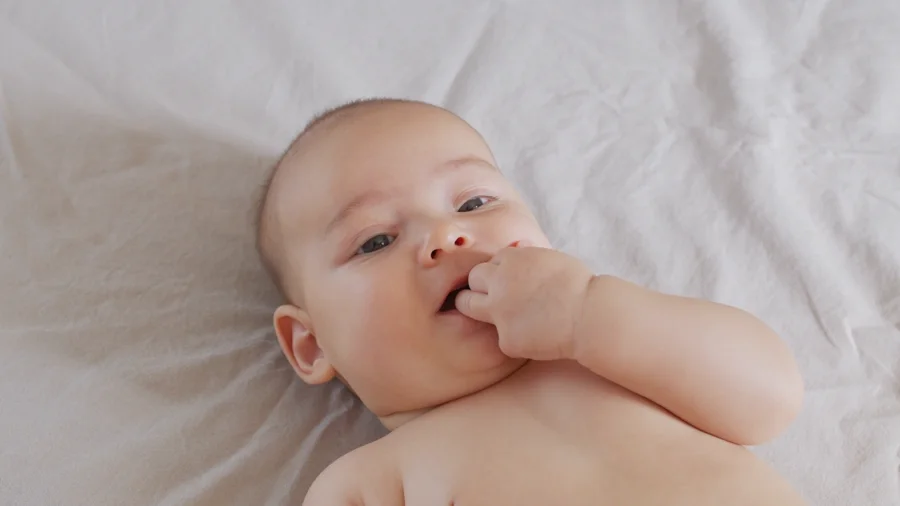
The habit is a consequence
We see thumb sucking and lip biting as oral habits, in our view usually a substitute solution for a function that is missing. Where the tongue does not lie against the palate and the lips do not close by themselves, the mouth looks for another hold.
Bans fall short
Plasters and bitter nail varnishes block the thumb, but the tongue does not learn its place as a result. A palatal crib is even a second foreign object, exactly where the tongue is supposed to go. Dr. Berndsen often observes that the habit then moves on, to the lip, to the nails, to the tongue between the teeth.
What the studies say
A Cochrane review found an effect on thumb sucking for palatal cribs and reward programmes, in studies of low quality with few children9. Whether the function behind it was put right was not investigated.
A habit cannot be taken away. It is replaced by a better one.A pattern does not change through insight, but through many precise repetitions. The training is based on this.
In practice
Weaning off the dummy: how to go about it
The easiest dummy to give up is the one that never becomes a habit. If it is there, in our experience a calm, always identical routine helps more than strictness.
- Week 1
Gone during the day
The dummy stays away during play, in the pram and when out and about. Do not leave it lying in sight and do not hang it on a chain. What cannot be seen is asked for less often.
- Week 2
Only for falling asleep
It only comes out for a few minutes when falling asleep. Once your child is asleep, carefully take it out.
- After
Gone completely
Some children need a few days for this, others a few weeks. Give it away, swap it or say a ceremonial goodbye: this is where your imagination comes in.
Redirecting the thumb
If the thumb wanders into the mouth, calmly take the hand away and give your child something to hold, a cloth or a favourite toy. Always say the same short sentence.
Evening ritual
The need is greatest when falling asleep. Give your child something in both hands, sing softly or tell a story, the same every evening.
Reminding without embarrassing
For lip biting, agree on an affectionate signal, such as tapping your own lips.
Making progress visible
A star chart in which you mark every day achieved, and a small reward for a full week.
Drinking without a teat
When drinking from an open cup, your child has the lips on the rim and the tongue stays in the mouth. A spout or drinking straw, on the other hand, lies in the mouth again.
Taking setbacks calmly
On days when your child is ill or tired, the old habit often comes back. The next day, simply carry on.
At the latest when the first words come, the mouth needs its space for speaking. That is a good time to say goodbye to the dummy. If the habit persists for months despite calm, consistent attempts, this is a sign that the function behind it needs support.
Relearning
Learning the right function: training instead of a replacement
Weaning takes a habit away. Relearning gives the mouth a new task. This is where FaceFormer training comes in.
Thumb sucking and dummy habits are among the areas of application named in the FaceFormer’s exercise instructions. In the basic exercise, the lips close around the lip wedge, the tip of the tongue lies at its reference point, breathing runs through the nose, and then comes a swallow that begins up at the palate. This is the order that sucking at the breast laid down.
 Drag to rotate
Between the lips The lip wedge lies between the lips and points forwards. The exercise trains lip closure.
In front of the teeth The membrane lies in the oral vestibule in front of the teeth. Inside the mouth itself, the space remains free for the tongue.
Soft silicone The yellow ZERO is made of softer material. It is recommended for children up to ten years.
The FaceFormer is therefore not a dummy substitute. It is not given for soothing but for practising, in short sessions. ZERO and ONE are the same size and shape; they differ only in the hardness of the material. Older children practise according to a plan that starts with a few repetitions. The free FaceFormer app guides you through the basic exercises.
There is a parent survey on the programme by the University of Jena: after six weeks of the exercise programme, 19 out of 24 parents of children aged between 9 and 11 reported that habits such as thumb sucking, lip biting or nail biting had become less frequent10. This is an observation without a comparison group, not proof of efficacy. But it fits what we see in practice.
With small children, the practice determines from when and in what form training takes place. Children under four years train only with expert supervision. Exercise plans, motivation and procedure are described on the page FaceFormer for children. Ongoing speech and language therapy or orthodontic treatment can be combined with the training and is not to be ended on your own initiative.
Taking a closer look
When you should take a closer look
Some signs show that a compensatory pattern has already become established, even if the dummy or thumb has long gone.
Tongue between the teeth
The tongue becomes visible when speaking or swallowing, or your child lisps.
Teeth do not meet
The incisors do not meet when biting, or the upper ones protrude far forward.
One-sided bite
On one side, the lower molars bite outside over the upper ones.
Mouth and saliva
The mouth is open at rest, the lips look moist and shiny, saliva runs.
The habit remains
Sucking or lip biting persist for months despite all attempts.
Restless sleep
Your child snores, sleeps restlessly or wakes up in the morning with a dry mouth.
Then it is worth looking not only at the teeth but at the function. The connections are explored in more depth in the articles on open bite, on edge-to-edge bite and crossbite and on lisping. Practices that work with FaceFormer therapy can be found in the practitioner directory.
Questions
Frequently asked
When should you wean your child off the dummy?
As early as possible; ideally, do not start the habit at all. At the latest when the first words come, the mouth needs its space for speaking. For the teeth and jaw, what matters most is how many hours a day and how many months the dummy is in the mouth.
Is there an orthodontic dummy?
In our view, there is no physiological dummy. Every dummy lies between the jaws and, in our view, keeps the tongue down and the mouth open. A systematic review found only three usable comparisons among 607 studies, and none showed an advantage of the orthodontic dummy for lateral crossbite.
How do I wean my child off the dummy?
Step by step: first leave it out during the day, then only briefly for falling asleep, and take it out as soon as your child is asleep. Some children need a few days, others a few weeks. A fixed ritual, a swap or a star chart help. The dummy does not need a replacement.
Is thumb sucking better than a dummy?
Both have a similar effect in the mouth, because an object lies where the tongue belongs. The thumb has to come out during play, but it is always available and harder to give up. We see thumb sucking as a habit behind which there is a missing function.
How can I help my child stop thumb sucking?
Bans and bitter nail varnishes start at the end of the chain. Redirecting during the day, a consistent evening ritual and praise for every bit of progress work better. In our view, the conditions are best if your child practises lip closure, tongue reference position and nasal breathing in the basic exercise, so that the mouth no longer needs the thumb for support.
Do tooth misalignments correct themselves after weaning?
Some do, some do not. In a long-term observation, individual changes such as a lateral crossbite persisted long after weaning. If the tongue stays low or your child continues to swallow forwards, the cause continues to have an effect. That is why it is worth looking at function.
Does a dummy protect against sudden infant death?
This has not been proven. The link comes from observational studies, a Cochrane review found not a single randomised study on it, and the dummy usually falls out shortly after falling asleep. In our view, its disadvantages for the tongue, breastfeeding and jaw outweigh this. Well-founded measures are the back sleeping position, a firm surface, a sleeping bag, a separate cot in the parents’ bedroom, a smoke-free environment and breast milk. Discuss with your paediatric practice how to make your baby’s sleep safe.
Can the FaceFormer replace the dummy?
No, and it is not meant to. The lip wedge lies between the lips, the membrane in front of the teeth, and the mouth remains free for the tongue. The FaceFormer is used for practising in short sessions, not for soothing. For children up to ten years, the ZERO is recommended.
More articles from the knowledge section
Where to go next

Sources
- Proffit WR (1978). Equilibrium theory revisited: factors influencing position of the teeth. The Angle Orthodontist 48(3):175-186. PMID 280125. Source
- Warren JJ, Bishara SE (2002). Duration of nutritive and nonnutritive sucking behaviors and their effects on the dental arches in the primary dentition. American Journal of Orthodontics and Dentofacial Orthopedics 121(4):347-356. PMID 11997758. Source
- Doğramacı EJ, Rossi-Fedele G (2016). Establishing the association between nonnutritive sucking behavior and malocclusions: A systematic review and meta-analysis. Journal of the American Dental Association 147(12):926-934. PMID 27692622. Source
- Schmid KM, Kugler R, Nalabothu P, Bosch C, Verna C (2018). The effect of pacifier sucking on orofacial structures: a systematic literature review. Progress in Orthodontics 19(1):8. PMID 29532184. Source
- Medeiros R, Ximenes M, Massignan C, Flores-Mir C, Vieira R, Porporatti AL, De Luca Canto G (2018). Malocclusion prevention through the usage of an orthodontic pacifier compared to a conventional pacifier: a systematic review. European Archives of Paediatric Dentistry 19(5):287-295. PMID 30054865. Source
- Niemelä M, Pihakari O, Pokka T, Uhari M (2000). Pacifier as a risk factor for acute otitis media: a randomized, controlled trial of parental counseling. Pediatrics 106(3):483-488. PMID 10969091. Source
- Moon RY, Carlin RF, Hand I, Task Force on Sudden Infant Death Syndrome (2022). Sleep-Related Infant Deaths: Updated 2022 Recommendations for Reducing Infant Deaths in the Sleep Environment. Pediatrics 150(1):e2022057990. PMID 35726558. Source
- Psaila K, Foster JP, Pulbrook N, Jeffery HE (2017). Infant pacifiers for reduction in risk of sudden infant death syndrome. Cochrane Database of Systematic Reviews 4:CD011147. PMID 28378502. Source
- Borrie FR, Bearn DR, Innes NP, Iheozor-Ejiofor Z (2015). Interventions for the cessation of non-nutritive sucking habits in children. Cochrane Database of Systematic Reviews 3:CD008694. PMID 25825863. Source
- Kopp S, Berndsen K, Berndsen S, Ifert F, Langbein U (2004). Strategien myofunktioneller Therapie mit dem FaceFormer. Quintessenz 55(1):45-52. University of Jena, 24 children, without a comparison group. Source
- Furtenbach M, Wallner B (2009). Myofunktionelle Therapie (MFT) im orofazialen Bereich: praktische und kritische Aspekte aus logopädischer Sicht. Kieferorthopädie 41(4):259-264. Source
Get started
Ready for the training?
The free FaceFormer app guides you through the basic exercises, counts along and reminds you of your sessions. If you wish, a practice from the practitioner directory can support you.

FaceFormer ZERO + ONE
Both material hardnesses for getting started, day and night. The set for adults.

FaceFormer ZERO
The softer FaceFormer for getting started, for children and for the night.

FaceFormer ZERO Children’s Set
ZERO with hygiene box, plush bag and success book with stamp.
FaceFormer training aims to restore the physiological setting of the basic functions of breathing, swallowing and head balance, with lip closure and the tongue reference position, thereby creating the conditions under which symptoms can improve. It does not replace a medical assessment. You can find practitioners near you in the practitioner directory.


